Old Bruton Church, Williamsburg, Virginia, in the Time of Lord Dunmore by Alfred Wordsworth Thompson
View the artwork: Old Bruton Church, Williamsburg, Virginia, in the Time of Lord Dunmore →
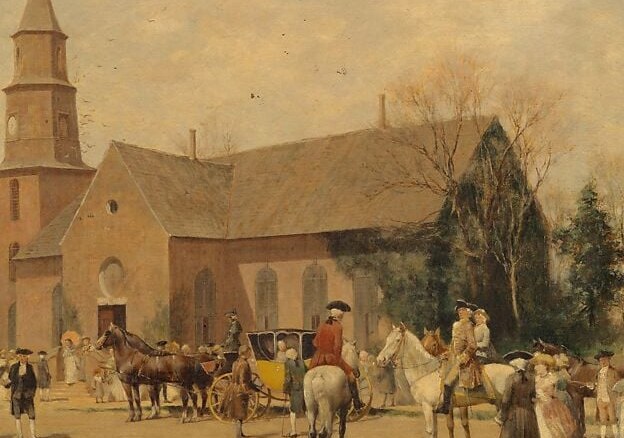
Old Bruton Church, Williamsburg, Virginia, in the Time of Lord Dunmore, painted by Alfred Wordsworth Thompson in 1893, lives in that strange gap between history and memory. Thompson painted it sixty years after the American Revolution, looking back at a world that no longer existed outside of a few standing walls and passed-down stories.
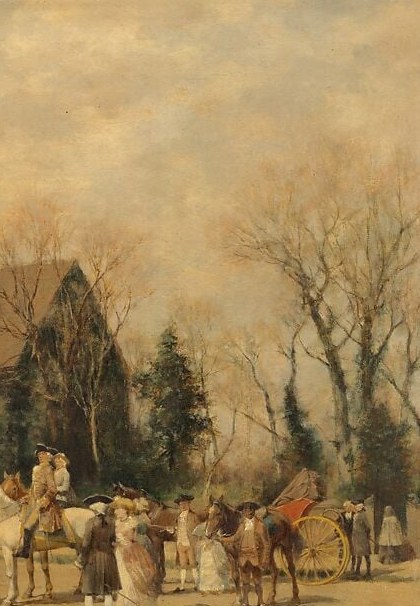
The scene centers on Bruton Parish Church, still standing and active in Williamsburg today. The black carriage in the left foreground belonged to Lord Dunmore, Virginia's last royal governor. The crowd in frock coats, long skirts, and tricorn hats is walking on an unpaved dirt road, exactly as Williamsburg's streets would have been. Every detail reinforces that this is a specific place and a specific moment, carefully reconstructed.
Thompson was born in Baltimore in 1840 and died just three years after completing this painting. He worked at a time when colonial Williamsburg had already receded into the past, before the full-scale restoration of the 20th century. This painting is one of the visual records that kept the old capital alive in the American imagination.
Look at the lone figure standing near the far right of the churchyard, apart from the gathered crowd. He almost escapes notice, but once you see him, the painting becomes two stories: the social world gathering on the left, and one person standing apart from it. The steeple overhead was already old by the time Thompson painted it, and it is still watching.
#arthistory #americanart #williamsburgva
Details


Transcript
Virginia, 1893. The Revolution has been over for more than a century. But this painter is looking further back. The carriage belongs to Lord Dunmore, Virginia's last royal governor. The church is Bruton Parish, where the colony's leaders prayed. These people in tricorn hats and long skirts have no idea what is coming. That steeple is still standing in Williamsburg today. One artist, born in Baltimore, reconstructed a Sunday morning he never saw.