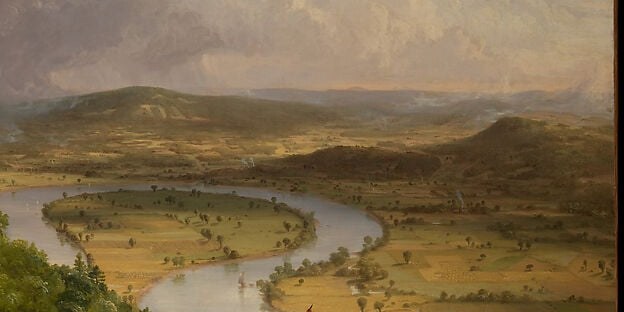
View from Mount Holyoke, Northampton, Massachusetts, after a Thunderstorm—The Oxbow by Thomas Cole
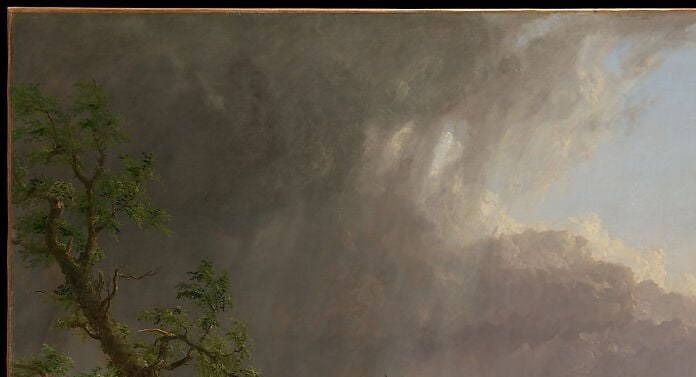
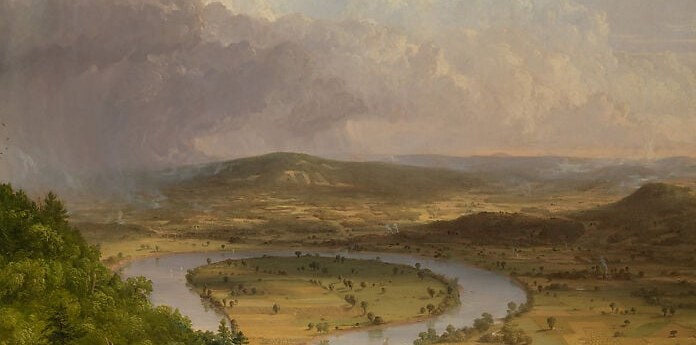
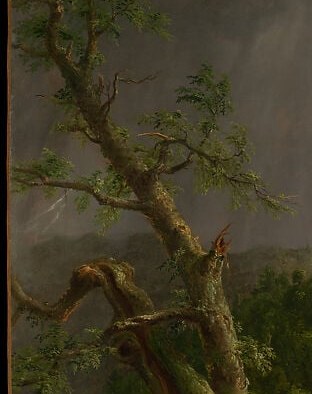
Thomas Cole’s “View from Mount Holyoke, Northampton, Massachusetts, after a Thunderstorm, The Oxbow” (1836) is a landscape split in two. On the left, a broken tree and a violent storm. On the right, sunlit fields and a neat, cultivated valley. It is not a neutral view. It is an argument made in paint, and it hangs today at The Metropolitan Museum of Art.
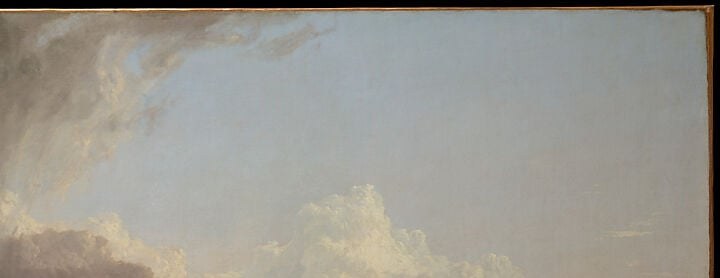
Look first at the blasted tree on the left, then let your eye follow the river’s oxbow curve as it separates wild highland from tidy farmland. The storm’s edge, directly above the bend, is the painting’s most virtuoso passage: roiling grey dissolving into warm gold. Scholars have also found Hebrew letters spelling “Shaddai” (Almighty) embedded in the pattern of cleared trees on the hillside, a theological signature hidden in the foliage.
Cole was the founder of the Hudson River School, and in 1836 he was wrestling with his own purpose. His patron Luman Reed had urged him back to pure landscape after an exhausting allegorical series. Cole hiked up Mount Holyoke, sketched the valley after a real thunderstorm, and then did something quietly radical: he painted himself into the scene. A tiny figure with an umbrella and an easel, standing on a rocky ledge, looking out.
You will find him if you slow down. He is the only human in the frame, and he is not in the sunlit valley. He is still on the wilderness side, painting both Americas at once.
#arthistory #hudsonriverschool #thomascole
Details
Transcript
One side is a world ending. The other, a world being born. Thomas Cole painted this argument in 1836. The oxbow river itself draws the line between chaos and order. But look closely at the wilderness side. Hidden on the ledge: the artist himself. He placed his easel exactly between the storm and the sun. A witness to what America was losing, and what it was racing to become.