Still Life with Flowers on a Marble Slab by Rachel Ruysch
View the artwork: Still Life with Flowers on a Marble Slab →
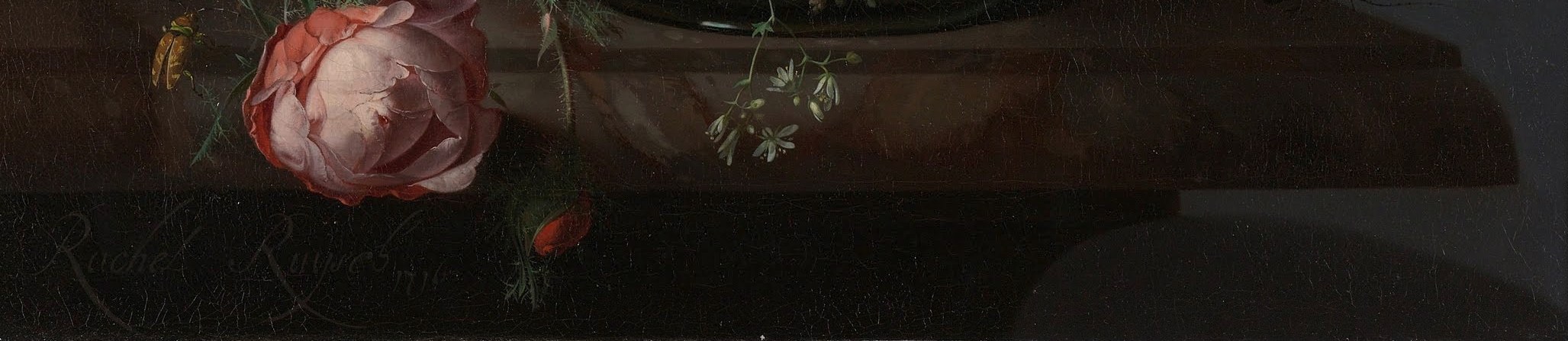
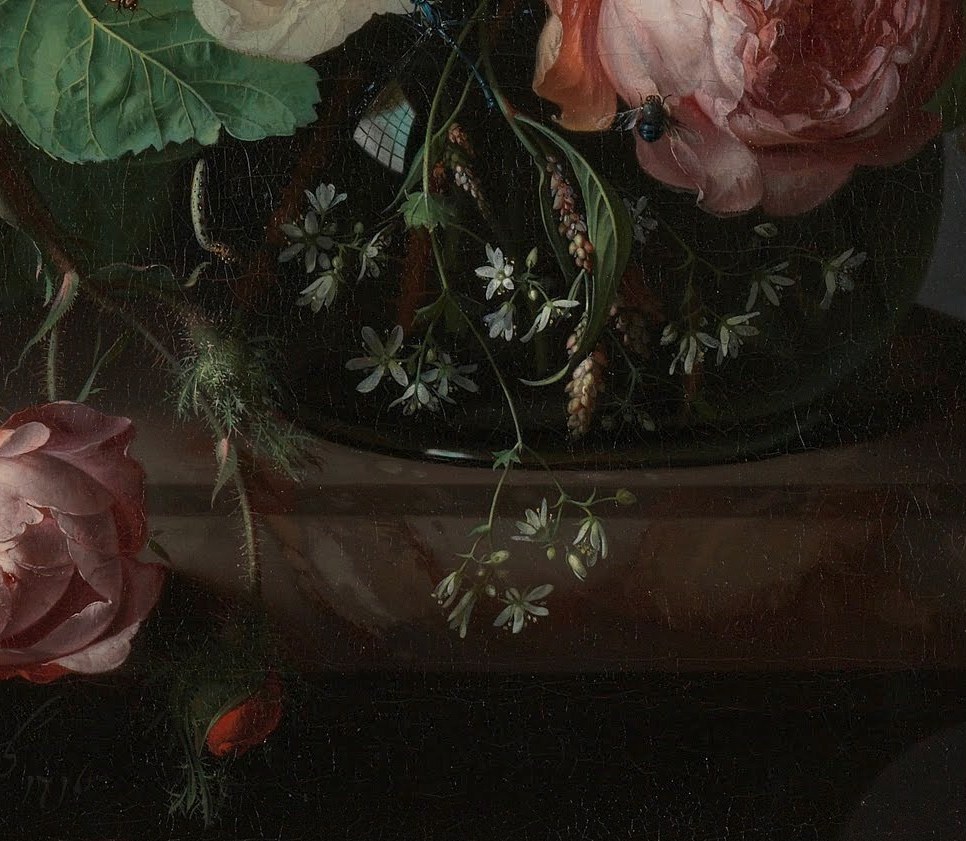
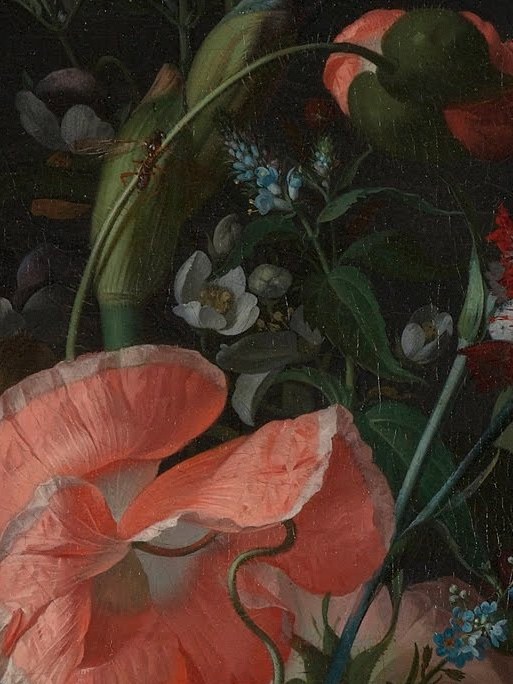
Still Life with Flowers on a Marble Slab, painted by Rachel Ruysch in 1716, is a masterclass in illusion hiding in plain sight at the Rijksmuseum. The painting's real subject is not the flowers themselves but what sits on top of them: a scatter of painted dewdrops so precise they appear to bend light.
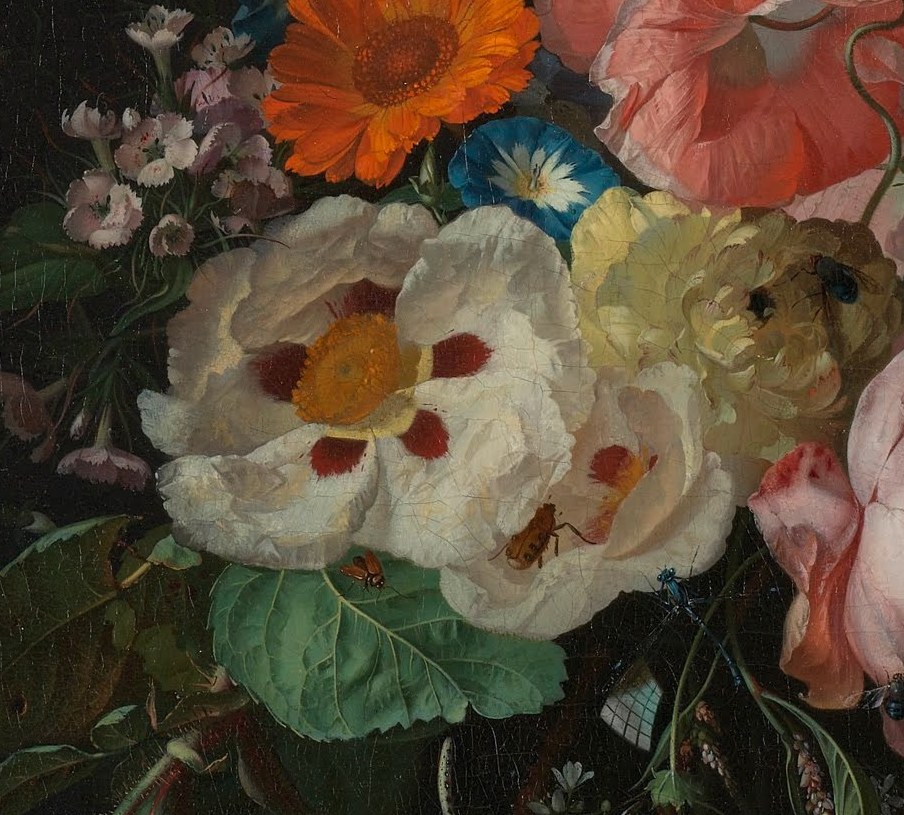
Look first at the large white rose at the bouquet's center. Every petal is modeled individually, shifting from warm cream to cool blue-gray shadow. Once your eye settles there, move to the tiny transparent spheres resting on the white petals. Each drop contains its own microscopic world: a bright point of reflected light, a dark underside, and a faint cast shadow that anchors it to the petal's surface.
How did she do this? Ruysch sharpened her brush tips over a candle flame or hot needle to create a point fine enough for this level of detail. Her technique was so prized that her paintings sold for as much as 750 guilders, while Rembrandt's works at the time often fetched half that. Museums acquired her paintings while she was still alive and working; she supported her family entirely through her art.
Rachel Ruysch painted professionally for over six decades and became the best-documented female painter of the Dutch Golden Age. A single dewdrop on a petal, studied up close, still holds its illusion after three centuries.
#arthistory #dutchgoldenage #rachelruysch
Details
Transcript
She painted this in 1716. Her price was already a rumor across Europe. Start at the center. One white rose, fully opened. To paint this, she hardened her brush on a hot needle. Now look closer. Water drops, sitting on the petals. Each drop is a lens: highlight, shadow, and a tiny reflection of the room. Collectors paid extra for these. Ruysch could charge double what Rembrandt did.