Madonna and Child with Saints by Ludovico Carracci
View the artwork: Madonna and Child with Saints →
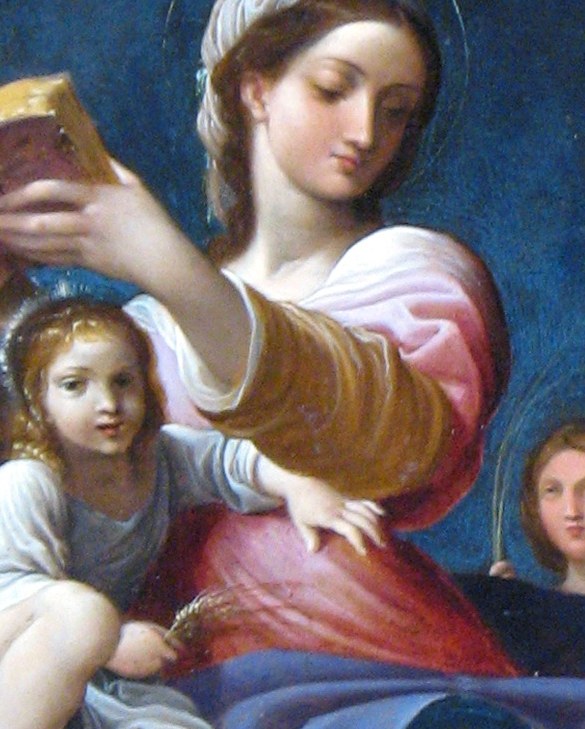
Ludovico Carracci painted this altarpiece, Madonna and Child with Saints, in Bologna around 1607, not on wood or canvas, but on a sheet of copper.
Copper gives the paint an unusual depth. The dark background isn't merely black; the metal beneath warms the shadow, while the ultramarine blue of Mary's mantle, real ground lapis lazuli, sinks into the smooth surface with a richness canvas cannot match. Carracci's chiaroscuro here is theatrical, the figures lit from an unseen source, pulled forward out of near-total darkness.
The painting survived a quiet danger. Copper altarpieces were mounted inside protective wooden frames. When this one's frame was lost, the exposed metal was left vulnerable to dents, corrosion, and the wrong cleaning solvent. It survived anyway, held together by the care of whoever understood what they were looking at.
Look at the bearded saint kneeling at lower right. The clasped hands and the light picked out on his forehead are a reminder that this is an oil painting on metal, a surface smoother than a mirror back, and far more fragile. What else might be hiding on copper in a museum storeroom, mistaken for an ordinary panel?
#arthistory #italianbaroque #ludovicocarracci
Details




Transcript
They look like a holy family, painted for a church. It was. Bologna, 1607. A new altarpiece for a chapel. But Ludovico Carracci painted it on something no one expected. Not canvas, not wood. A sheet of copper. The smooth metal lets the shadows breathe. And the ultramarine blue, ground lapis lazuli, sinks deeper. For centuries it was safe inside its frame. Then the frame was lost. A copper painting, unprotected, survives by care alone.