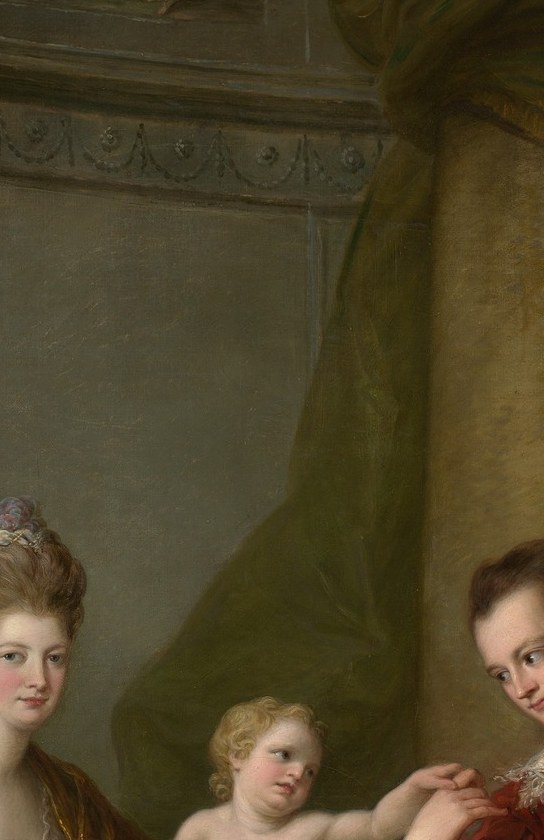
Edward Smith Stanley (1752–1834), Twelfth Earl of Derby, with His First Wife (Lady Elizabeth Hamilton, 1753–1797) and Their Son (Edward Smith Stanley, 1775–1851) by Angelica Kauffmann
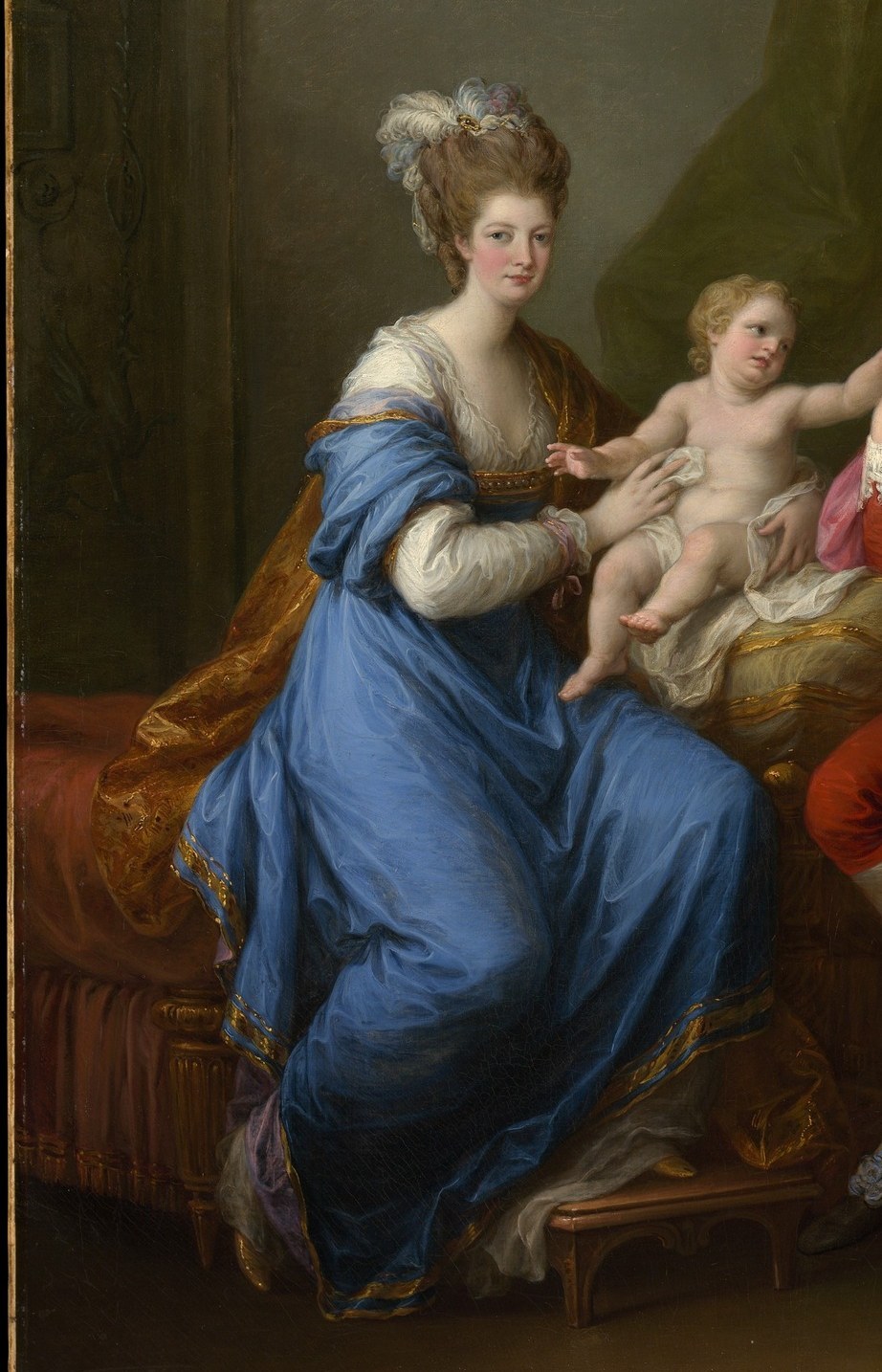
Angelica Kauffmann painted this portrait of Edward Smith Stanley, the Twelfth Earl of Derby, his wife Lady Elizabeth Hamilton, and their young son around 1776. It marks the year Stanley inherited his title, a moment of total dynastic confidence, long before the marriage famously collapsed.
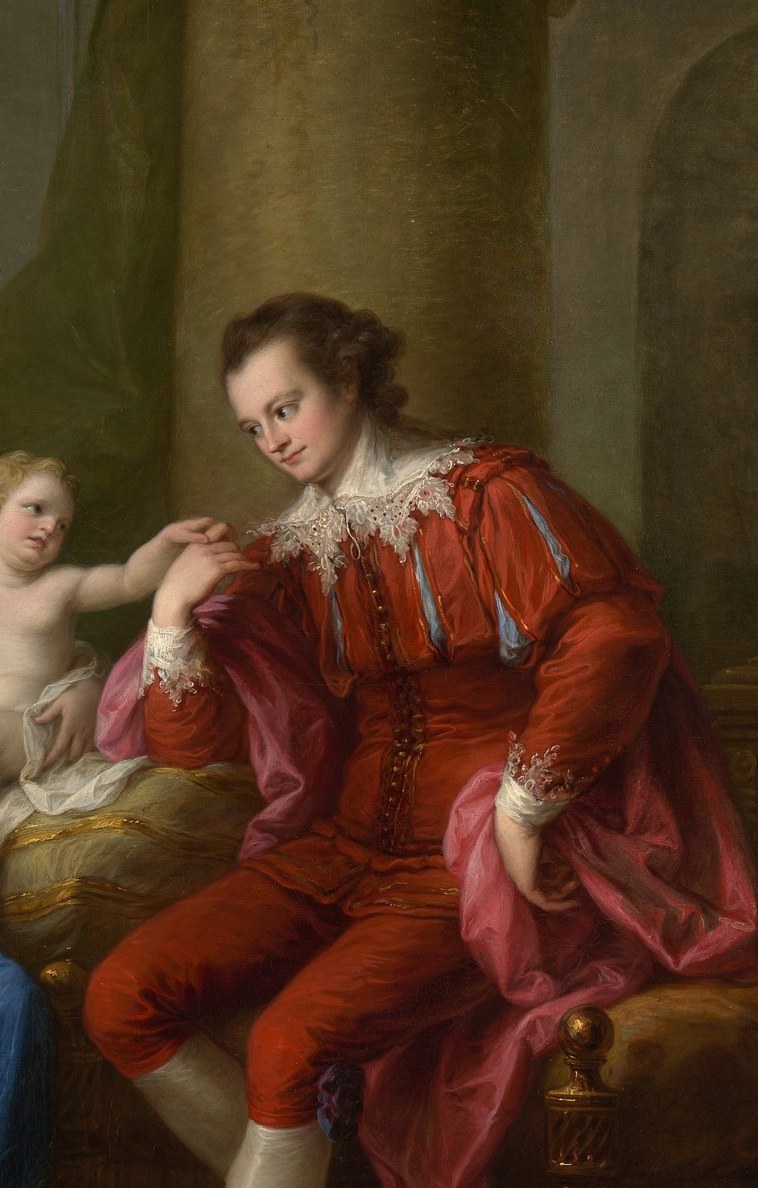
Look at the structure. The infant is the visual pivot; both parents orient toward him. The Earl wears a slashed red velvet doublet and a wide Van Dyck lace collar, a deliberately old-fashioned costume that signals inherited aristocratic glory rather than new money. Below them, two spaniels rest, the traditional symbol of marital fidelity in portraiture.
Within two years, Lady Elizabeth left her husband for another duke. She died ostracized in 1797. The painting descended through her mother’s family and eventually appeared at Christie’s in London on March 17, 1855, sold by the Dukes of Argyll. New York financier Bernard M. Baruch later bought it and gave it to The Metropolitan Museum of Art in 1959 in memory of his wife.
A portrait of three people whose lives took very different paths, now very still and very public. What do you notice first, the tenderness, or the gold frame it’s been sold in?
#arthistory #angelicakauffmann #metmuseum
Details
Transcript
This is a picture of a happy family. The artist’s fee is lost to time. But this canvas has a paper trail. It hit the block at Christie’s in London. Date: 17th March, 1855. The man in the portrait holds the gavel. Edward Smith Stanley, Twelfth Earl of Derby. She is Lady Elizabeth. He is the infant 13th Earl. An American financier eventually paid to make it a Met museum piece.