Surf on Rocks by William Trost Richards
View the artwork: Surf on Rocks →
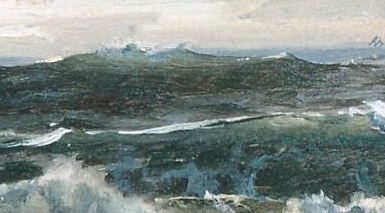
William Trost Richards painted "Surf on Rocks" in the 1890s, on a small board he could fit into his portable easel. It now lives at the Metropolitan Museum of Art. He had largely given up landscape by then, spending his late career on the New England coast, studying the exact moment sea breaks against stone.
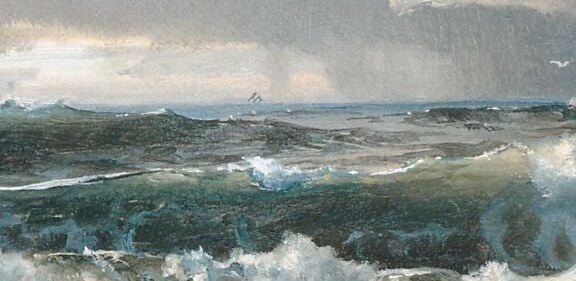
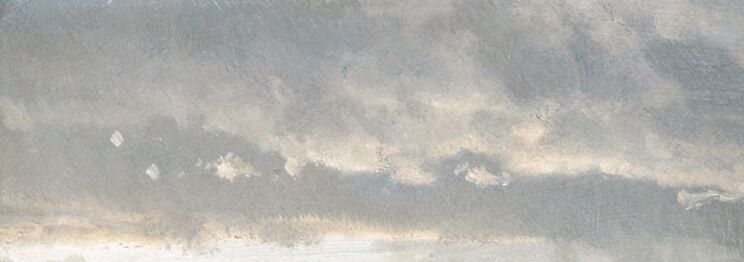
Look for the gulls. They drift high in the grey sky, two or three tiny white specks above the spray. Without them, the wave flattens into wallpaper. With them, the scale snaps into place: this water is enormous, and you are very small.
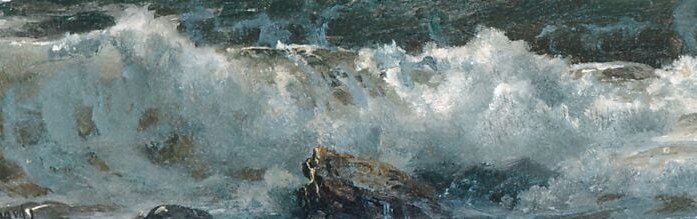
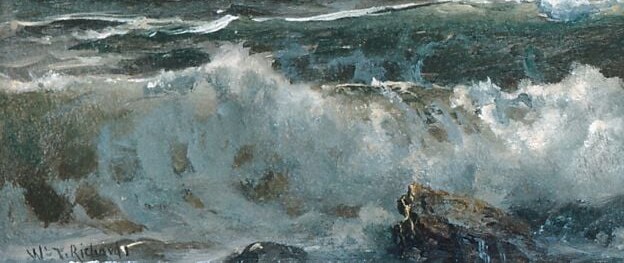
Richards trained as a designer of gas fixtures before studying painting in Philadelphia and Europe. He became associated with the Hudson River School, but he broke from its romantic haze. He insisted on near-photographic precision: the wet gleam on rock, the lace-like edge of dissipating foam, the near-black trough that makes the white spray jump. The Met notes he rendered geological texture with a geologist's care and understood tidal motion like a mariner.
In 1881 he built a summer house on Conanicut Island, Rhode Island, and never really left. This painting stayed in his family until his daughter Anna, an accomplished painter herself, gave it to the Met in 1932. Next time you see a seascape, find the birds. The painter put them there to tell you the truth.
#arthistory #williamtrostrichards #americanart
Details
Transcript
The wave hits you first. Thick white paint, carved into spray. Richards painted this on a board small enough to carry into the surf. He wanted the cold Atlantic exactly as it was. Now look above the spray. Two or three white gulls, tiny against the grey. Without them, the wave has no scale. You'd scroll past the immensity.