The Valley of Wyoming by Jasper Francis Cropsey
View the artwork: The Valley of Wyoming →
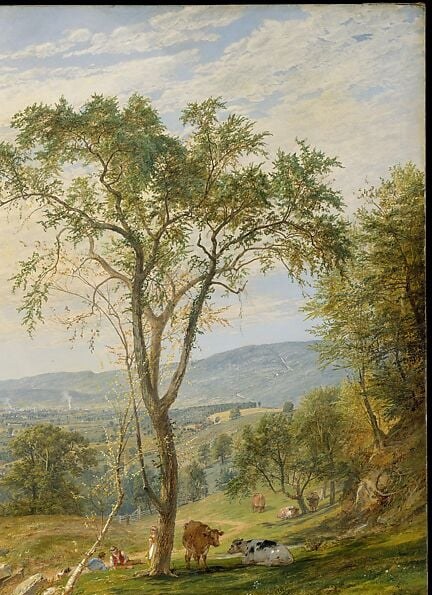
The Valley of Wyoming is Jasper Francis Cropsey's monumental 1865 landscape, painted just as the American Civil War came to a close. The seven-foot-wide canvas is a crowning achievement of American Luminism and hangs today in the Metropolitan Museum of Art's American Wing.
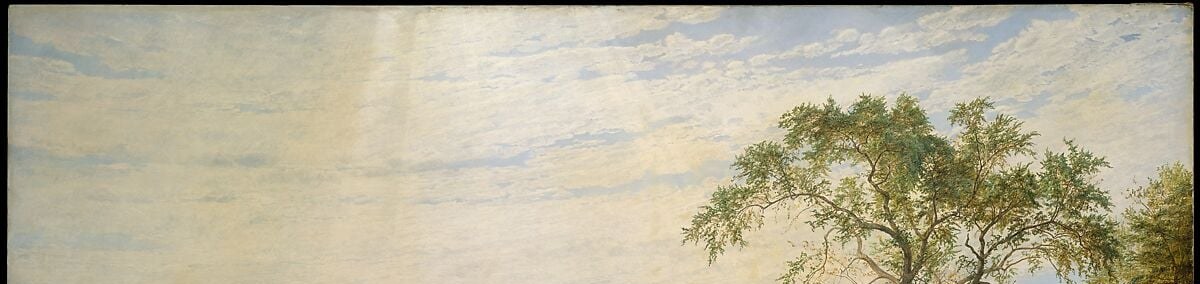
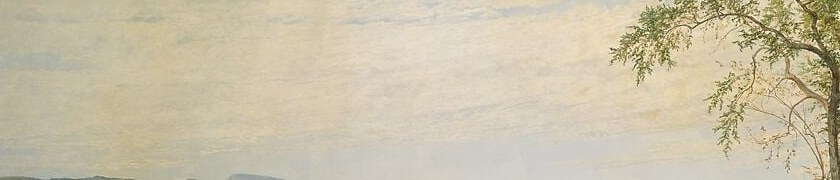
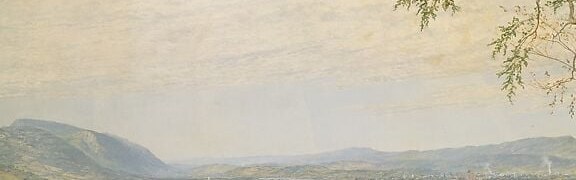
The real feat is the sky itself, occupying more than a third of the picture. Cropsey built the light with dozens of translucent oil glazes instead of opaque paint. The result is a luminosity that seems to emanate from within the canvas, not merely fall upon it. Watch the distant hills as they meet the horizon. The precise tonal transition, where blue mountains become indistinguishable from the pale blue sky, is what Luminist painters called "aerial perspective." It makes the valley feel boundless by simply erasing the boundary.
Milton Courtright, a native of the valley who became president of the New York Elevated Railroad Company, paid the artist $3,500 for this commission. The painting's original frame carried verses from a poem commemorating the 1778 massacre of settlers in the Wyoming Valley. So a picture of perfect pastoral peace is overlaid with a memory of violence, reframed as a vision of national healing at the war's end.
The entire valley is a sanctuary. The Pocono ridges enclose it like walls; the cattle and sunlit fields suggest a civilization thriving rather than ravaged. Cropsey built it all from thin air and linseed oil.
#arthistory #hudsonriverschool #americanart
Details

Transcript
Look at the far edge of the valley. The blue hills vanish into the blue sky. This is not a fog. It is a precise optical effect. Cropsey finished this in 1865, the year the Civil War ended. He built the light from the canvas up. Thin, transparent glazes turn the paint into pure atmosphere. The sky does not fall on the land. It seems to rise out of it.