Santa Maria della Salute, Sunset by William Stanley Haseltine
View the artwork: Santa Maria della Salute, Sunset →
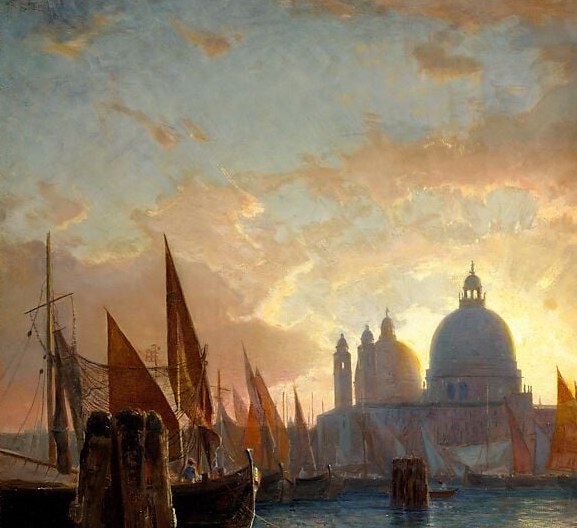
William Stanley Haseltine's "Santa Maria della Salute, Sunset" was painted in his Roman studio between 1870 and 1885, based on a watercolor sketch he made on Venice's Grand Canal in the 1870s. The Met received it as a gift from his daughter Helen in 1954, and today it is one of the museum's definitive views of Venice.
What you are seeing is a deliberate act of omission. Haseltine knew this Baroque church intimately, having sketched it many times, but in the final canvas he chose to dissolve its ornate marble surface into silhouette. The sun crowns the dome like a secular halo, making the building sacred through atmosphere rather than architectural detail.
The story of this painting is the shift it represents. Haseltine trained with the meticulous Hudson River School in New York and the Düsseldorf Academy in Germany, both known for sharp, linear precision. But after settling permanently in Rome in 1869, his handling loosened. He began treating his on-site watercolors not as rigid documents to copy, but as flexible elements to recompose in the studio. The sky here graduates from cool cerulean overhead to vivid salmon at the horizon, and the broken reflections on the lagoon anticipate Impressionist water technique.
The small work boat on the right, a batela a coa di gambero, appears in Haseltine's original watercolor nearly unchanged. That standing boatman is not a studio invention. He is a document of the working lagoon vessels most tourists ignored, carried across years and hundreds of miles from a sketchbook to this canvas.
#arthistory #williamstanleyhaseltine #hudsonriverschool
Details


Transcript
They look like a building dissolving into light. William Stanley Haseltine sketched this church many times. He knew every stone. But in the final painting he blurred them all. Look at the sun. It sits directly behind the dome. This is the real altar. Light, not marble. He painted this from a watercolor made years earlier in Venice. That boatman was there in the 1870s. Haseltine carried him home. The painting belonged to his daughter. She gave it to the Met in 1954.