The Artist Sketching at Mount Desert, Maine by Gifford, Sanford Robinson
View the artwork: The Artist Sketching at Mount Desert, Maine →
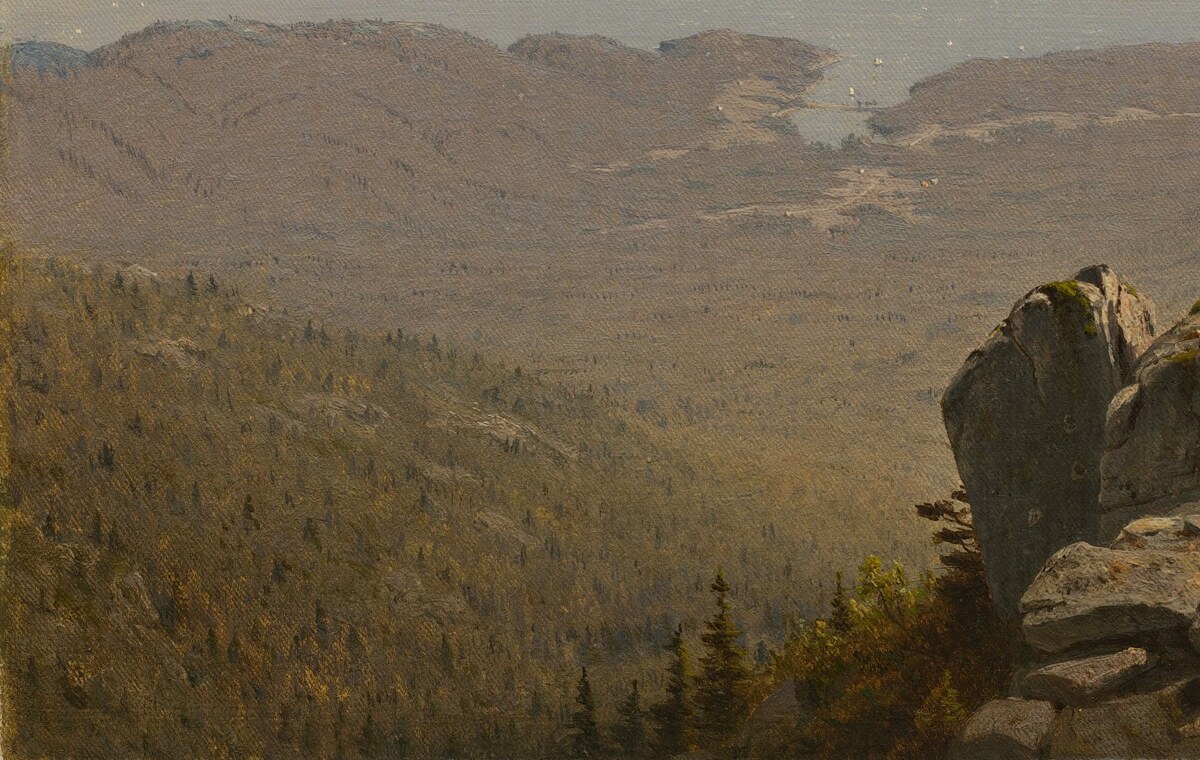
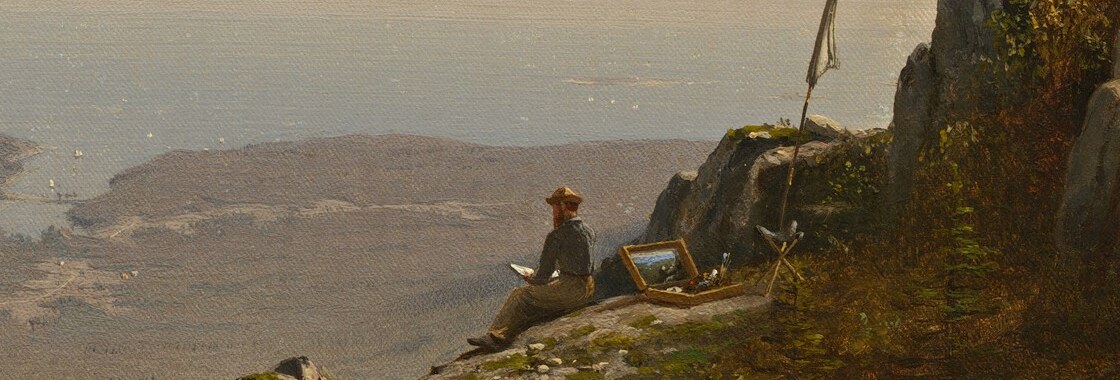
This is Sanford Robinson Gifford's The Artist Sketching at Mount Desert, Maine, an oil on canvas completed between 1864 and 1865. Only 11 inches wide, it is a modestly scaled yet powerful visual argument for a radical idea among nineteenth-century American landscape painters: that a true picture of wilderness requires the artist's body to have been in it.
Gifford places himself on the dark granite ledge in the foreground, his half-finished sketch and drawing tools visible in sharp detail beside him. His figure is tiny against the vast recession of valley, forest, and distant bay. The composition makes a claim of authenticity, you are seeing a scene documented on-site, not invented in a New York studio.
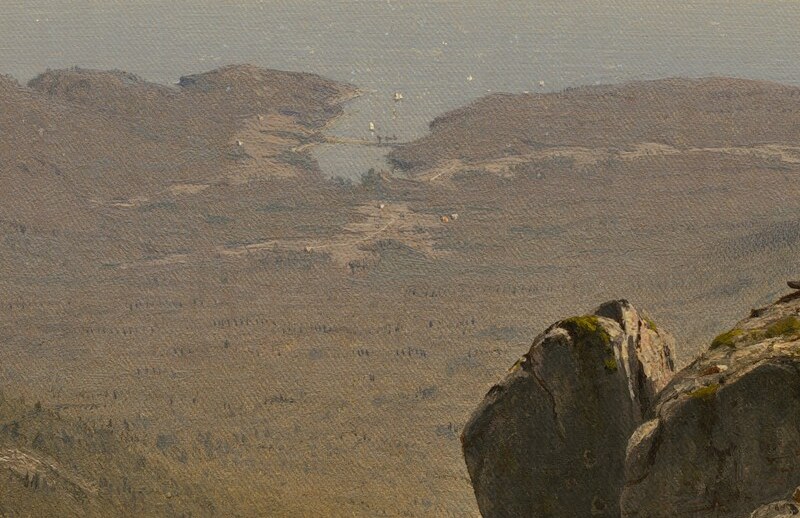
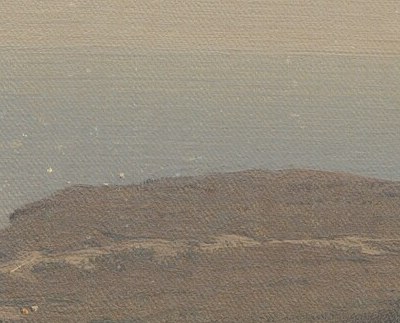
Beyond the ledge, Gifford operates in a Luminist register. The middle ground dissolves into a hazy, almost abstract field of light, and the distant islands and water are barely legible on the horizon. The painting contrasts the tactile, textured rock passage in the foreground with the silken dissolution of the sea and sky, showing Gifford's full technical range in one small frame.
The work's provenance includes fellow Hudson River School painter John Frederick Kensett and later the collection of Jo Ann and Julian Ganz, Jr., who acquired it in 1979. They gifted it to the National Gallery of Art in 2004, a donation completed in 2008, where it holds accession number 2004.99.1.
What an artist will do to prove they were really there.
#arthistory #americanart #hudsonriverschool
Details

Transcript
He painted himself into the picture. The sketchbook and tools sit right beside him. This was an advertisement for plein-air painting. Proof he truly stood on this rock, in 1864, and saw this coast. Then he dissolves the whole island into light. Gifford gave this tiny 11-inch painting to the nation in 2004.