Untitled by Mahavihara Master
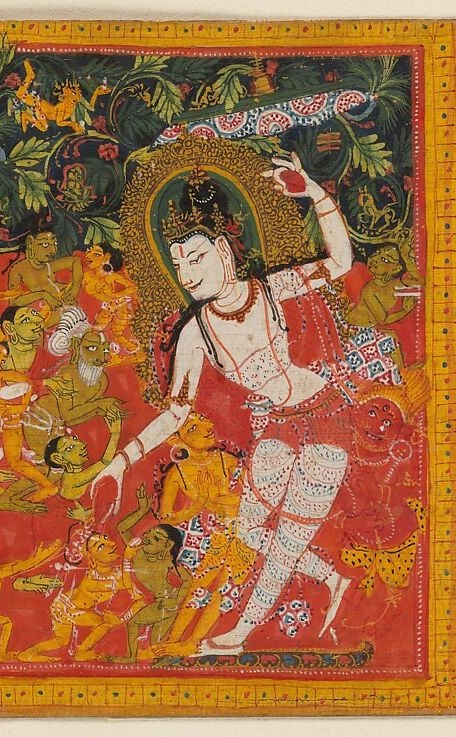
This is an untitled painting of the Bodhisattva Avalokiteshvara, made in the early 12th century by an artist now called the Mahavihara Master. It lives at the Metropolitan Museum of Art. The astonishing thing is the surface: a dried palm leaf no larger than a hand, ridged and brittle, yet carrying a fully realized sacred world in opaque watercolor.
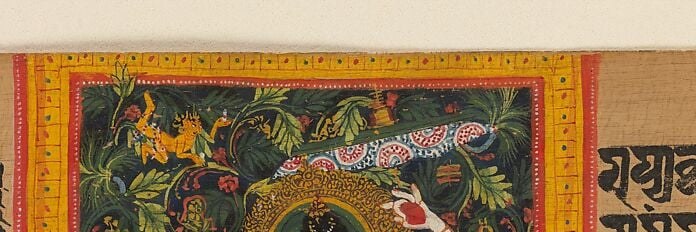
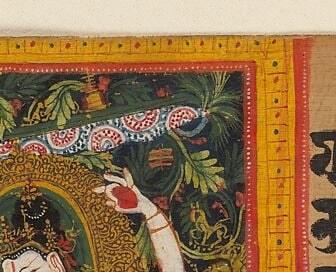
Look first at the ground behind the deity. That burnished gold-orange wash has no gilding in it; the painter built the glow from pigment alone, substituting paint for precious metal to signal that this space is not earthly. Then let your eye fall to the lower garment. The white dhoti is modelled with parallel stroke after parallel stroke, so fine and confident that the line itself becomes invisible and only the volume remains. Each leaf in the green canopy above is one gesture, no reworking, because opaque watercolor on palm leaf permits no scraping back.
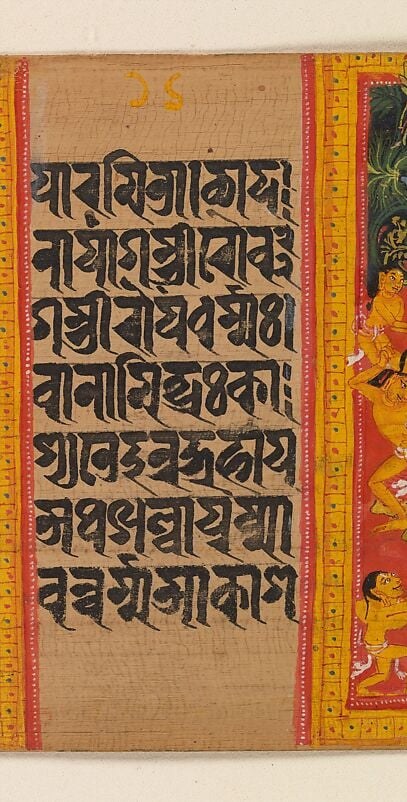
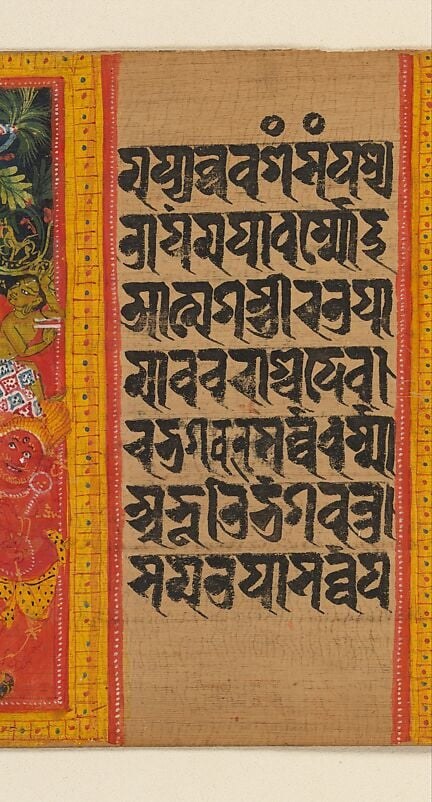
The Mahavihara Master was almost certainly a Buddhist monk working in the scriptorium of one of the great monasteries of eastern India under the Pala dynasty. His name is attached to a single deluxe manuscript of the Ashtasahasrika Prajnaparamita, the Perfection of Wisdom in 8,000 Verses, commissioned by a queen whose name is otherwise lost to history. The folios are now split between New York and Lhasa. The large-scale murals that once covered the monastery walls he lived among are entirely gone.
This tiny leaf is what survives: a portable monastery wall, painted by someone who knew the text, the iconography, and the sheer nerve required to put a brush down on a surface that offers no second chances.
#arthistory #palaart #mahaviharamaster
Details
Transcript
The canvas is a dried palm leaf. Just larger than your hand. Fragile, ridged, alive with veins. The painter was almost certainly a Buddhist monk. He laid down a burnished gold-orange ground that makes the deity seem lit from within. Then he drew the white dhoti with parallel strokes so fine the brush almost disappears. Every leaf in the canopy above is a single, controlled gesture. No room to correct. The great monastery murals that inspired him are all lost. Only this leaf remains.