Bull's Head Tavern by William P. Chappel
View the artwork: Bull's Head Tavern →
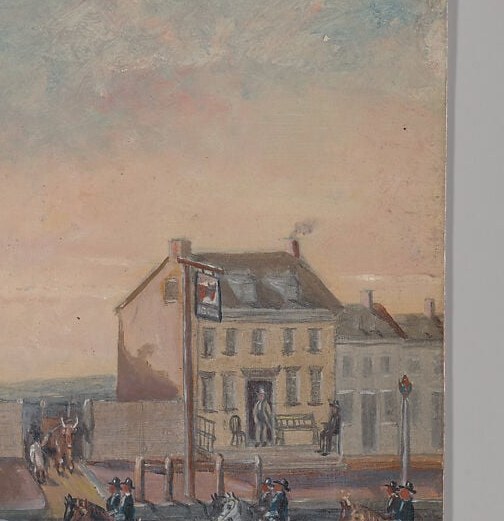
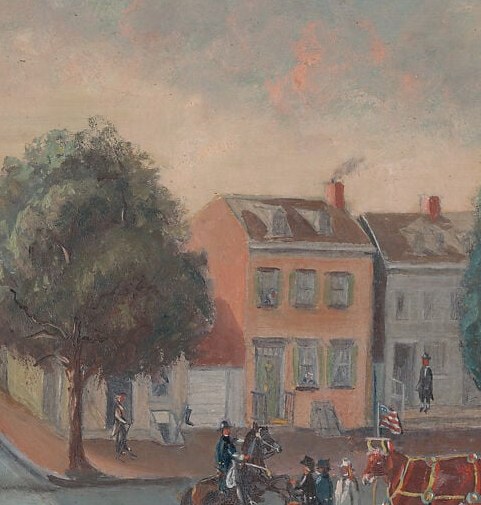
This is New York City in the 1870s, and it's an eyewitness account of a specific block that no longer exists. William P. Chappel's "Bull's Head Tavern" captures a Federal-style commercial building on an unpaved Bowery street, anchored by its enormous pictorial trade sign. The painting lives at the New-York Historical Society.
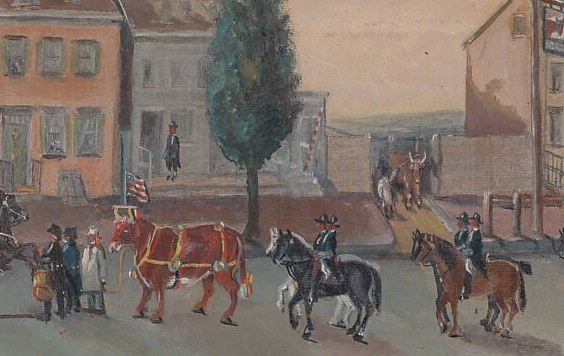
Look first at the cluster of horses in the street and the top-hatted gentleman by the tavern door. This was not merely a saloon; the Bull's Head was Manhattan's central horse market, a place where wealthy merchants traded livestock as routinely as stock certificates. The rider in the center of the street keeps the whole static scene moving, while small pedestrian figures in the mid-ground reveal a thoroughfare far busier than a first glance suggests.
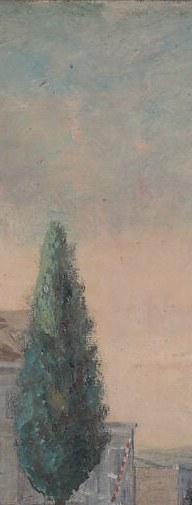
Chappel painted this on slate paper, a dark, smooth ground. The technique is clearest in the pale sky: he let the stone's own darkness stand in for the shadows of the unpaved road, while painting the luminous gaslit sky thinly across the top. The bull's head sign, glowing bright white, becomes the most intensely illuminated object in the whole composition, a beacon for the commerce happening below it.
The block is gone. The tavern itself was demolished in the late 19th century as the city pushed its grid northward. What Chappel left behind is a piece of topographic evidence, a street corner caught between rural past and metropolitan future.
#arthistory #nyc #19thcentury
Details
Transcript
This is a New York City street, around 1875. The unpaved ground tells you how far downtown this was. These weren't just drinking. They were trading horses. A business deal happening right on the open street. His silk top hat marks him as a man of means. The whole operation is advertised by this painted board. Chappel painted this on slate paper. The dark stone does the shadow work.