Canadian Rockies (Lake Louise) by Albert Bierstadt
View the artwork: Canadian Rockies (Lake Louise) →
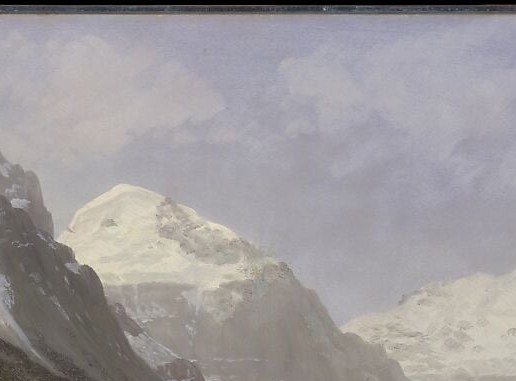
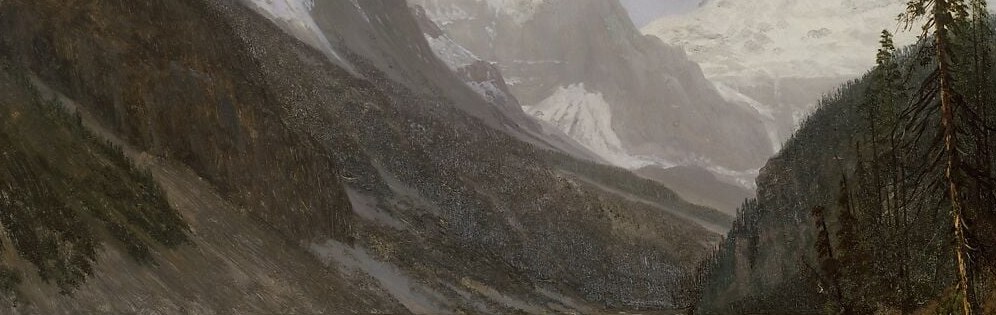
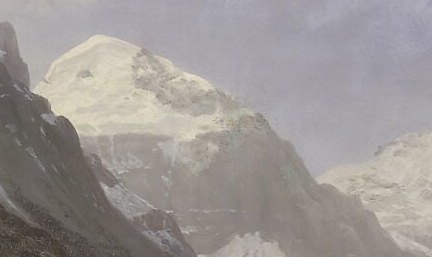
Albert Bierstadt's 'Canadian Rockies (Lake Louise),' painted around 1889, is a portable oil sketch that reveals how a master of the monumental compressed a vast landscape into a few confident strokes. At just under 15 by 21 inches, this small piece on paper captures the glacial lake in Alberta's Banff National Park with a speed and directness that his enormous studio canvases deliberately concealed.
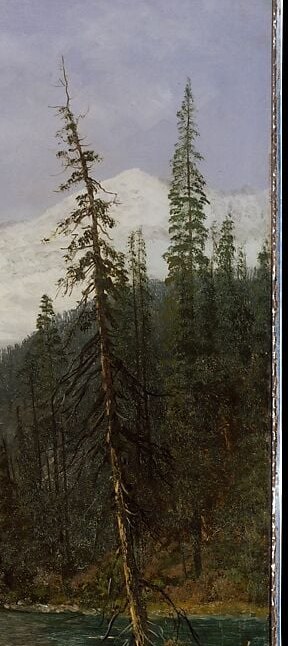
Look at the rocky foreground at the lower left. Those white scratches are not added detail, they are the paper ground itself showing through thin washes of paint, a record of rapid field observation. Higher up, a single dark spruce on the right margin operates as a repoussoir, a compositional device that frames the valley and makes the distant snow peak feel colossal by contrast. The cold blue-grey of the water is barely a single gesture, yet it physically communicates the temperature of a glacial lake.
Bierstadt, who trained in Düsseldorf and became the foremost painter of the western landscape, used sketches like this as raw visual data. He would return to his New York studio and expand these shorthand notes into the luminous, ten-foot panoramas that defined his fame. By the late 19th century, however, taste had shifted toward the modest observational approach of the Barbizon school, and these once-private sketches came to be valued as art in their own right.
The painting entered the Metropolitan Museum of Art in 1982 as a bequest from Ruth Alms Barnard, where it now hangs in the American Wing. What other secrets do you think a confident painter can hide in a stroke that looks casual?
#arthistory #AlbertBierstadt #HudsonRiverSchool
Details

Transcript
This is not a finished panorama. It is oil paint on paper, made outdoors in minutes. Those white scratches are bare paper breathing through. One dark tree against the sky gives the mountain its size. A single brushstroke holds the glacial cold of Lake Louise. Bierstadt would scale this sketch into ten-foot epics back in New York.