View on the Catskill—Early Autumn by Thomas Cole

Thomas Cole's 'View on the Catskill, Early Autumn' (1836-37) is one of the most beautiful lies in American painting. It now hangs in the Metropolitan Museum of Art.

The valley glows with perfect autumn light. A mother picks flowers by the creek while her infant sits beside her. A farmer herds horses. A man rows quietly on the water. It is a vision of human life in complete harmony with nature.

None of it was true. In 1837, Cole wrote a furious letter to his patron Jonathan Sturges, lamenting that the Canajoharie and Catskill Railroad was tearing through this exact landscape. He called the destruction 'dreadful.' Then he sat down and painted the railroad out of existence, constructing an America that was already gone.

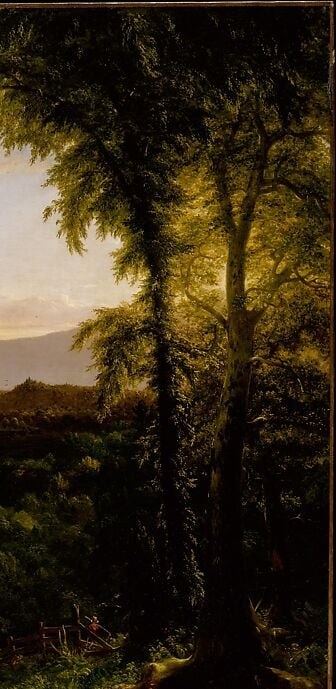
He did leave clues. Look in the left foreground shadows: axe-cut tree stumps. A split-rail fence marks property boundaries. These are the only honest marks on the canvas, and Cole knew exactly what he was doing when he painted them.

#arthistory #hudsonriverschool #thomascale

Details
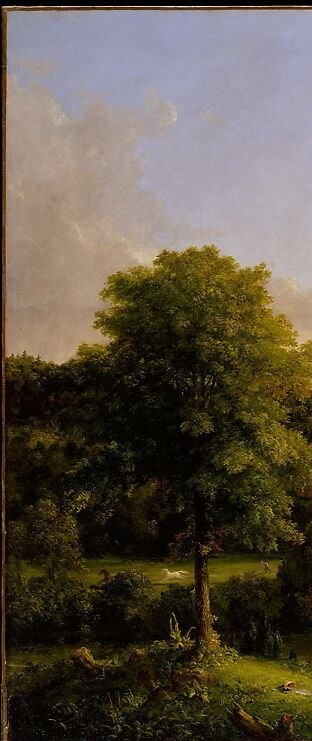
Cole's compositional anchor , their near-black silhouette against the luminous valley creates the dramatic push-pull central to Hudson River School framing, acting as a natural proscenium wing
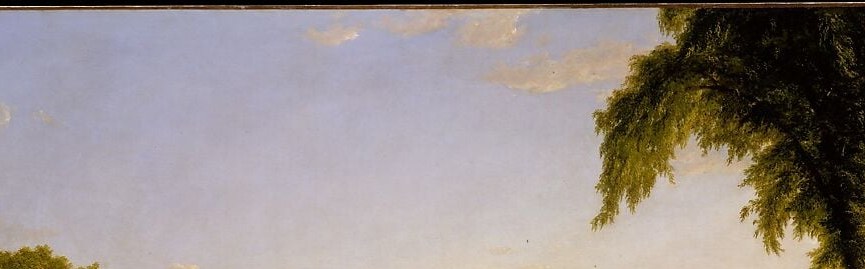
Symmetrical partner to the left tree mass; together they form the natural arch that stages the valley as theatre , Cole's compositional signature imported from Claude Lorrain via Turner
Cole's atmospheric centerpiece , diffused autumn light across the full width of the canvas suggests divine benediction over the pastoral scene, the painting's theological argument made visible
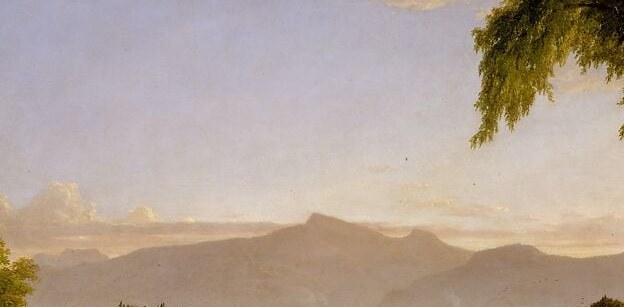
Cool recession blues anchor the painting geographically while dramatizing American wilderness scale; Cole painted these from imagination and 1831 sketches, not present observation
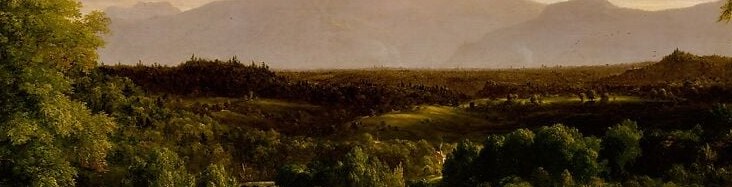
The real subject of Cole's argument , this expanse of sunlit productive land is what the railroad threatened and what he idealized; its brightness is deliberate propaganda for an Edenic America
Transcript

This looks like untouched American wilderness. But the painter lied to his own patron. Those stumps are the only truth Cole allowed in. In 1837, he raged against the railroad destroying this valley. Then he painted it out completely. No tracks. No smoke. Just a farmer, a rower, a mother. A fence draws a property line through paradise. Cole knew Eden was already for sale.