Menna and Family Hunting in the Marshes, Tomb of Menna by Nina M. Davies
View the artwork: Menna and Family Hunting in the Marshes, Tomb of Menna →
Menna and Family Hunting in the Marshes is the most complete surviving record of New Kingdom Egyptian marsh hunting, every species, every tool, every social relationship preserved in a single painted scene. The original was painted around 1400 BC on the wall of the Tomb of Menna, a scribe and agricultural overseer, on the West Bank of Thebes. What you see here was recorded by Nina M. Davies, the early 20th-century Egyptologist who spent her career copying tomb paintings before time could take them.
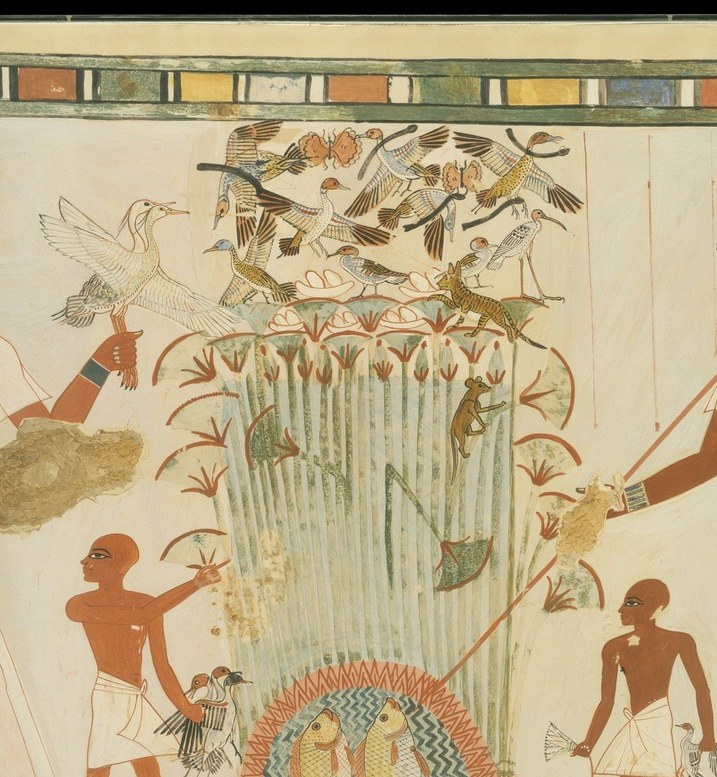
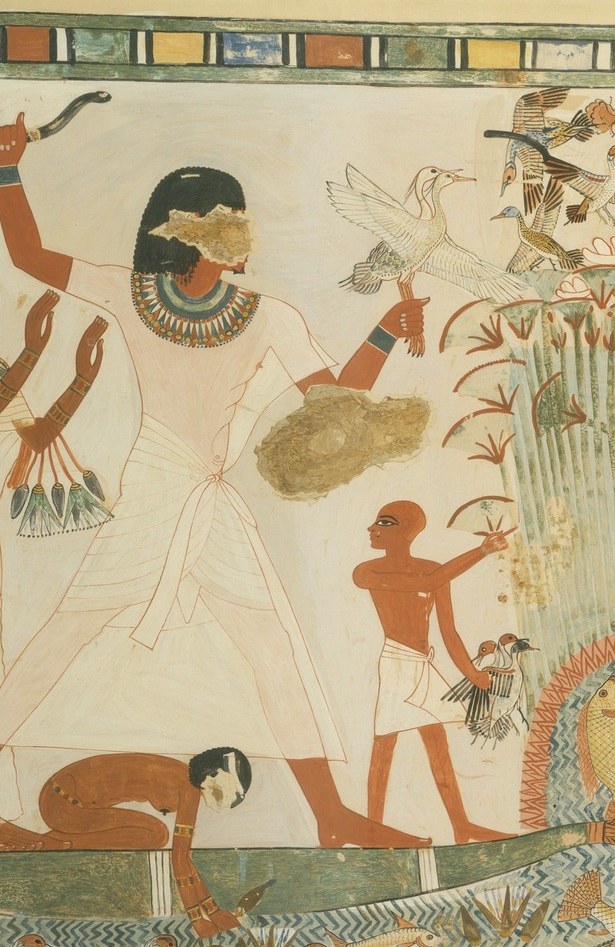
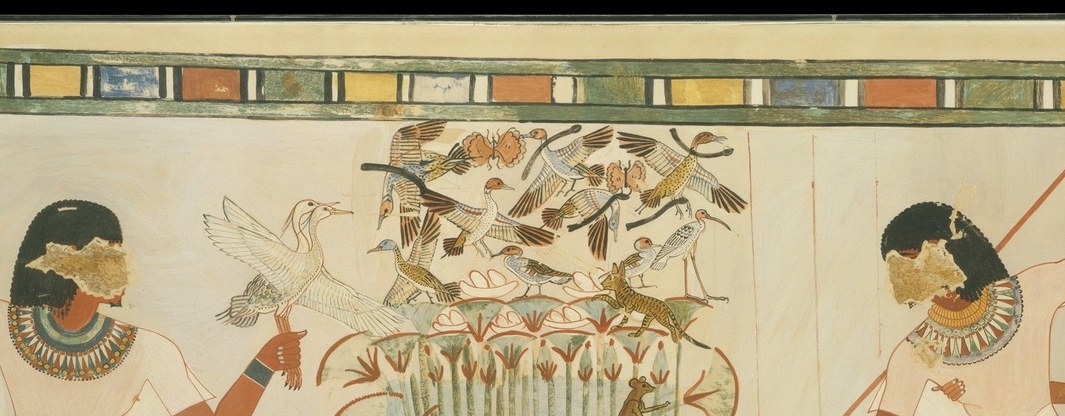
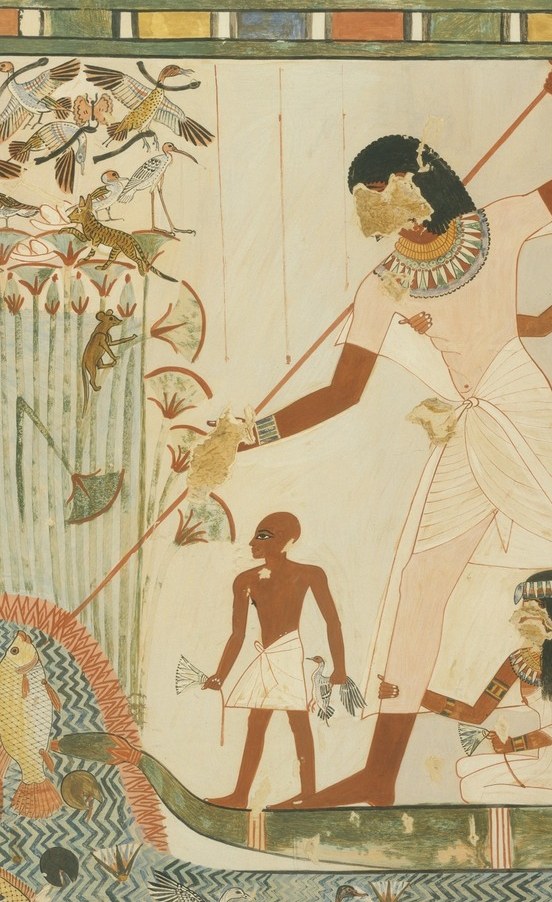
The image works like a contract. Menna stands at the center, hieratically oversized, gripping a throw-stick and three dead birds in one raised fist. That throw-stick is not just a hunting tool, it is a symbol of solar rebirth, and by holding it, Menna asserts mastery over chaos and death. Around him, the marsh explodes with precision: papyrus thickets, individually drawn waterfowl startled into flight, fish carved into the water below, and lotus blossoms whose daily closing and opening pattern made them the Egyptian symbol of resurrection.
No detail is casual. His wife wears a white linen gown and a perfume cone, ritual markers of celebration and purity, and she holds a sistrum rattle used in temple worship. A daughter flanks them at one side, an attendant at the other, and if you look carefully into the reeds, the family cat is hunting too. These figures are not decoration. Egyptian tomb art functioned as a legal assertion: the relationships, servants, and abundances depicted here would persist into the afterlife, held in force by the image itself.
We are looking at someone's deeply practical hope, painted in the belief that seeing it was enough to make it real. Which detail in this marsh would you have wanted to carry into eternity?
#arthistory #ancientegypt #egyptiantomb
Details

Transcript
Menna, a scribe and overseer, wanted his afterlife perfectly provisioned. So he commissioned his tomb around 1400 BC, on the West Bank of Thebes. Look at what he holds: a throw-stick and three birds in one fist. The throw-stick was a weapon, but also a symbol of solar rebirth. The marsh erupts around him, papyrus, lotus, water teeming with fish. His wife stands beside him, holding a lotus and a sistrum rattle. A tiny cat hunts inside the reeds. Family life follows him into eternity. This was not an artist's fantasy. It was a legal document for the next world.