Scenes from the Life of the Virgin by http://www.wikidata.org/.well-known/genid/5e0246832e895d8fe6824595db947505

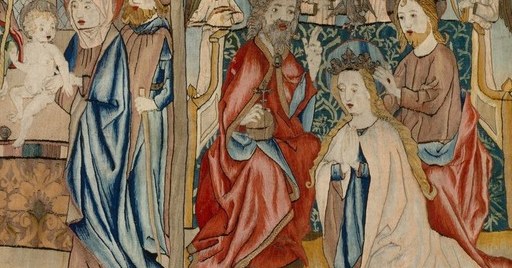
This is 'Scenes from the Life of the Virgin,' a wool and silk tapestry woven around 1500 by an unidentified workshop, now in The Met Cloisters. It tells the Virgin Mary's story across five framed panels, from her birth to her passing.

Look up. The top decorative border, which appears to be only floral scrollwork, is actually populated with small human faces peering out from the foliage. They are easy to miss at a distance, but up close they become a quiet, permanent audience witnessing every event below.

Tapestries like this one were luxury objects in late-medieval Europe, hung in churches or wealthy households. The inclusion of portrait medallions in borders was a known convention, but the subtlety here, faces woven with the same thread as the surrounding leaves, rewards only the most patient viewer.

It is a lovely thought: the weavers gave the Virgin's story a built-in congregation, hidden in plain sight, outliving everyone who first hung this cloth.

#arthistory #medievaltapestry #hiddenfaces

Details
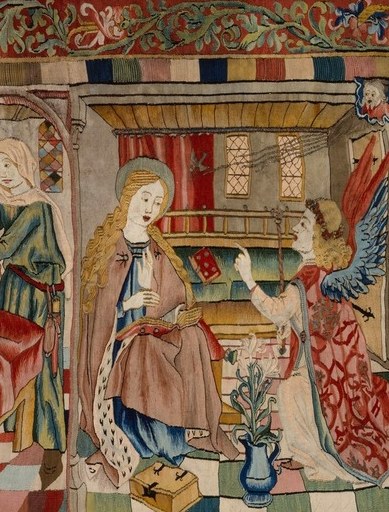
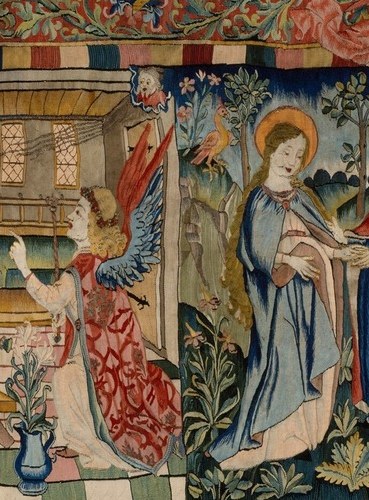
Large spread wings rendered in contrasting thread colors; the posture of address , body angled toward Mary , conveys the moment of divine interruption before Mary has responded.
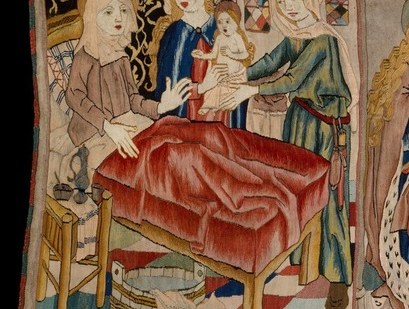
Likely St. Anne after giving birth to the Virgin; the bed scene anchors the opening of the life-cycle narrative and shows intimate domestic tenderness rare in monumental tapestry.
Her tilted head and gathered robe signal surprise or reverence; her blue mantle is the dominant chromatic anchor of the composition.
Mary laid out horizontally mirrors the birth-bed of the leftmost scene, creating a visual and theological rhyme: the cycle that opens with a birth closes with a death-sleep.
Human portrait medallions hidden inside acanthus or floral borders are a signature detail of late-medieval tapestry , viewers rarely look up to find them; a genuine hidden-detail candidate.
Transcript

At first glance, a life of the Virgin in five chapters. Woven around 1500, this tapestry told a story most churchgoers already knew. An angel arrives. A scroll is presented. A life ends surrounded by mourners. But the weavers added an audience no one notices. Human faces are concealed inside the floral border overhead. They have watched this sacred story, silently, for five centuries.