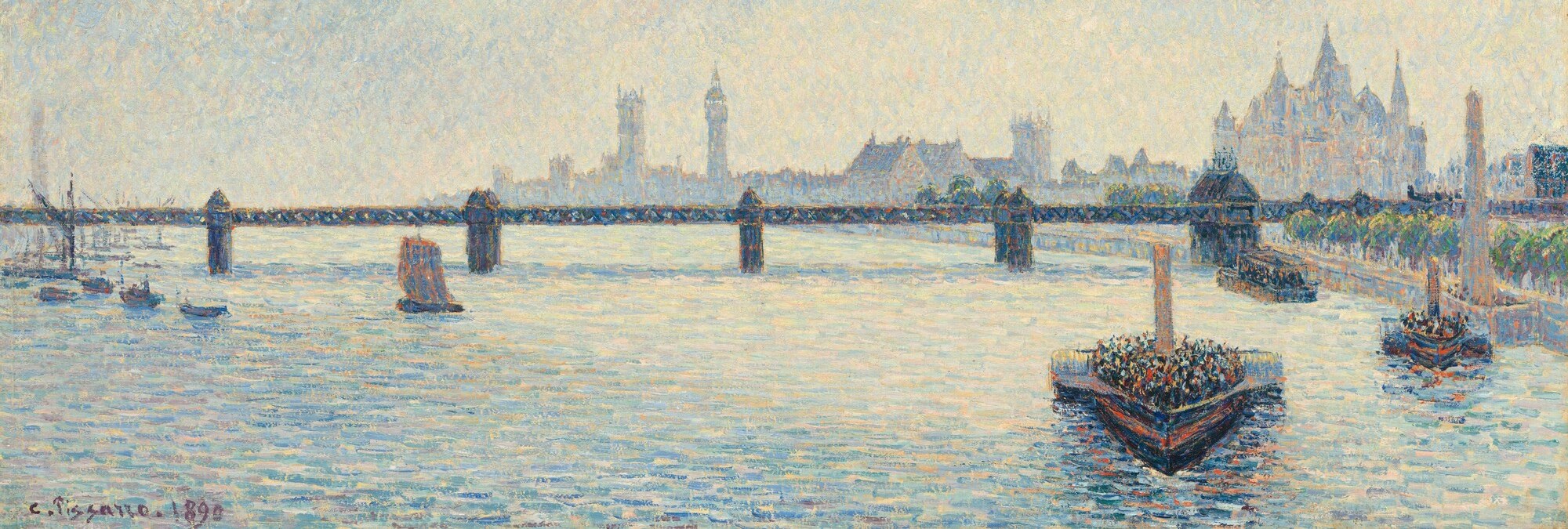
Charing Cross Bridge, London by Pissarro, Camille
View the artwork: Charing Cross Bridge, London →
Camille Pissarro painted this view of the Thames during a six-week stay in London in the late spring of 1890. He set up his easel on Waterloo Bridge and painted what he actually saw: a working river crowded with paddle steamers and cargo barges, the iron span of Charing Cross Bridge cutting across the middle distance, and Big Ben rising through the city's soft yellow-grey haze. The finished canvas is now in the National Gallery of Art in Washington.
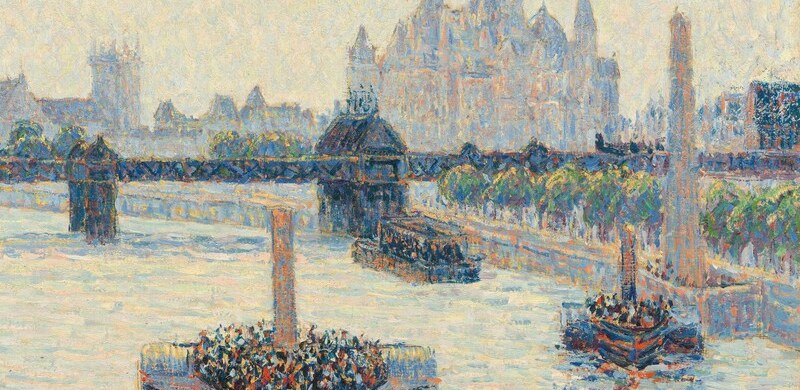
Look at how the bridge's iron lattice is the one hard edge in the picture. Everything else, Parliament's Gothic towers, the north-bank chimneys, the steam from the paddle vessel, dissolves into atmosphere. Pissarro was painting light and air as much as architecture. And in the foreground right, the dark, heavy cargo barge anchors the scene: this is not a pretty river view but a documentary of the working Thames.
Pissarro had recently been experimenting with Seurat's pointillism, and you can see the dotted touch in the steamer's deck and in patches of the water. But he never fully committed to the system, the sky and river still breathe with the looser hand of Impressionism. When he returned to France, the canvas was not done. He wrote to his niece Esther Isaacson, who had stayed in London, asking her to supply additional sketches from the bridge. He completed the painting in his Éragny studio, working what he called 'day and night' on the London series.
The dealer Boussod, Valadon et Cie bought it from the artist that October. It passed through several collections before Paul Mellon acquired it in 1963 and later gave it to the nation. A painting begun on an English bridge, finished in a French village, now hanging in America, and still carrying the feel of a grey London morning on the river.
#arthistory #camillepissarro #impressionism
Details



Transcript
London, 1890. A 59-year-old painter sets up his easel on Waterloo Bridge. The iron truss of Charing Cross Bridge anchors the whole scene. Beyond it: Big Ben and Parliament, dissolving into the city's famous haze. A paddle steamer passes beneath the bridge, funnel smoking. And in the foreground, a heavy cargo barge, the working Thames, not the postcard one. He left London after six weeks, the canvas unfinished. His niece Esther stayed behind and sent more sketches so he could complete it. He finished the series working day and night in his French studio, 200 miles away.