Firemen's Washing Day by William P. Chappel
View the artwork: Firemen's Washing Day →
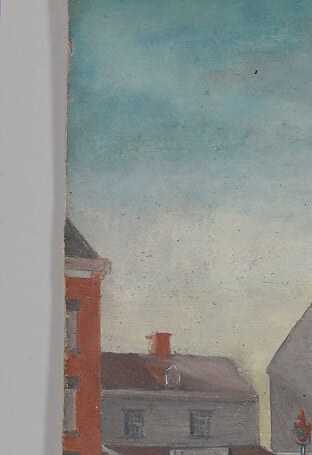
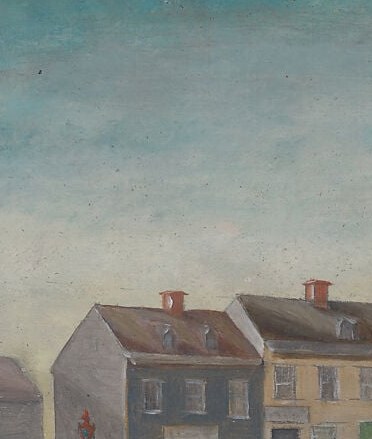
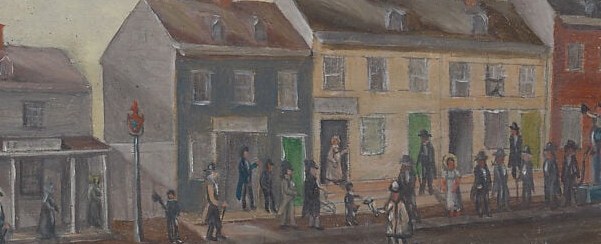
This is "Firemen's Washing Day," a small oil painting on slate paper by William P. Chappel, made in the 1870s. It hangs today at the Metropolitan Museum of Art. The single most surprising thing about it is the surface itself: Chappel painted on a thin slab of slate, and you can still feel how the oil sat on top of the stone instead of soaking in, giving every brushstroke a crisp, almost ink-like clarity.
Look at the group of men scrubbing their shirts on the sidewalk. These are firemen, still in their suspenders, bent over a task that has nothing to do with heroism. Follow the pale diagonal hose stream cutting across the pavement. It turns their own fire equipment into a washing-day tool. Then drop your eye to the lower foreground: the dark, matte wet street is the slate itself, showing through the paint.
William P. Chappel lived in this neighborhood. He walked these blocks daily, and the scene is genuinely unposed, a candid moment of working-class routine rather than a formal composition. Firehouses like the red brick one on the left had heavy boilers, hence the multiple chimney stacks. The summer wash was done on the sidewalk because the station was sweltering. Chappel captured a world he knew from inside, and he captured it on one of the oddest painting surfaces in American art.
The painting was largely unknown for decades. It resurfaced quietly and now sits in the Met as a small but precise document of 19th-century New York street life. Next time you walk past a firehouse, look down at the sidewalk.
#arthistory #americanart #nychistory
Details

Transcript
New York City, the 1870s. A working street. The red brick firehouse anchors the block. Its firemen are out here, on the sidewalk. Shirts off, suspenders up, working the wash. A hose sprays across the pavement. Their own equipment, turned laundry aid. The painter lived on this very street. This is what he saw. He painted it on a thin slab of slate. The stone surface lets the wet pavement breathe.