View on the Seine: Harp of the Winds by Homer Dodge Martin

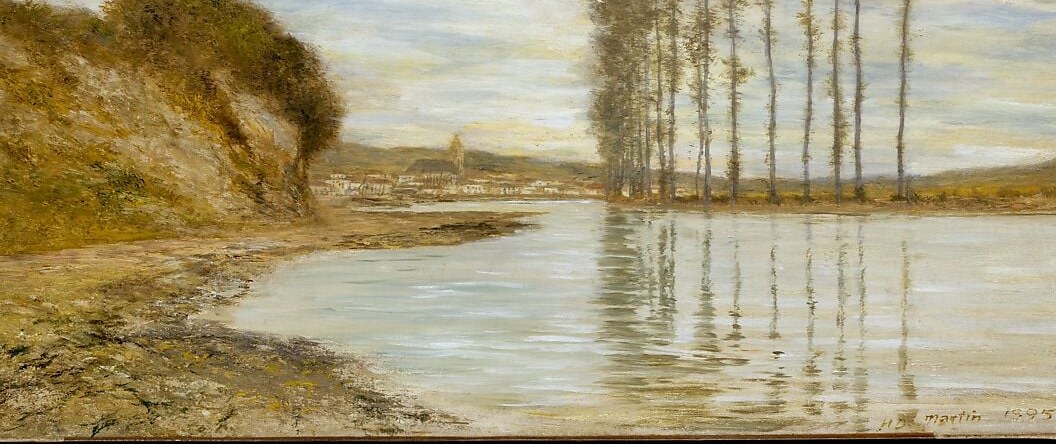
Homer Dodge Martin painted "View on the Seine: Harp of the Winds" between 1893 and 1895 while living in France. He was going blind. A tumor was pressing on his optic nerve, gradually erasing his sight. In the last years of his life, he painted light itself.

Look at how the horizon line nearly vanishes into the water. Martin achieved this dissolution by using glazes, dozens of translucent layers of thin oil paint, building up a depth that feels airborne and luminous. The poplars on the right bank give the painting its subtitle, standing like a harp that trembles with the wind.

Martin was an American painter from the Hudson River School tradition, but this late French period transformed his work. He shifted from detailed precision to an almost abstract rendering of atmosphere, driven partly by the necessity of his failing vision.

The painting now hangs in the Metropolitan Museum of Art. It was his final masterpiece: a vast, quiet river seen by a man who was, hour by hour, losing the light.

#arthistory #americanart #homerodgemartin

Details
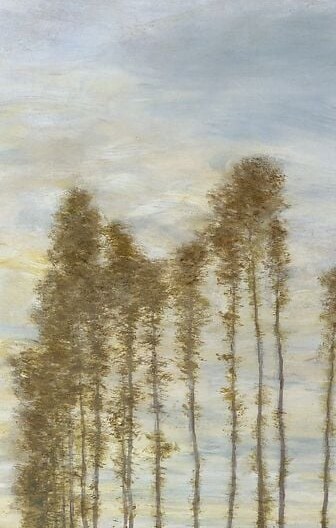
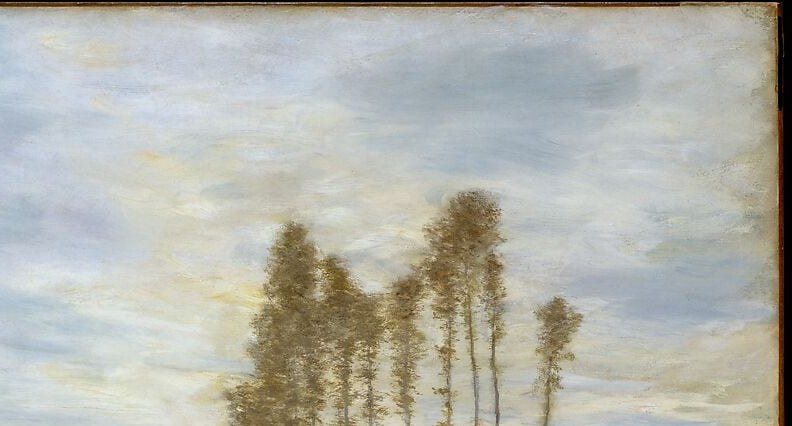
The painting's namesake , these wind-responsive trees are the 'Harp of the Winds'; their verticality dominates the composition and gives the scene its eerie stillness punctuated by implied movement.
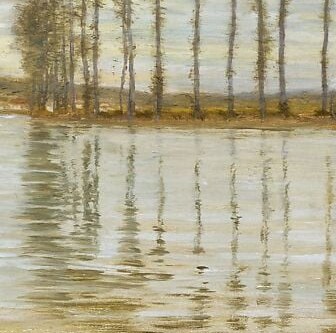
The river functions as a second sky , pale, luminous, reflective , giving Martin twice the light-catching canvas; its glassiness is what makes the poplar reflections possible.
A near-perfect inversion of the trees in the glassy water signals absolute calm; the doubling creates an hourglass of sky-and-depth that is the painting's visual anchor.
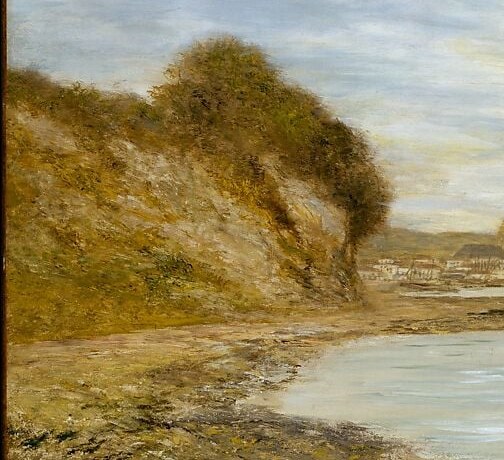
The one solid, tactile mass in an otherwise airy composition; its warm earth tones anchor the palette and confirm the season as late autumn or early winter.
Loose, atmospheric cloud-painting that shifts from warm ochre toward cooler grey-blue on the right; the graduated handling shows Martin's tonal control over a wide sky passage.
Transcript

Homer Dodge Martin painted this in France, nearly blind. A tumor was pressing on his optic nerve. He taught himself to see through fog. Look how the light dissolves the horizon. He built this glow with transparent layers of paint, one over another, for years. He called it the Harp of the Winds. The trees catch the breeze you cannot see. He finished it months before he died. His last great work.