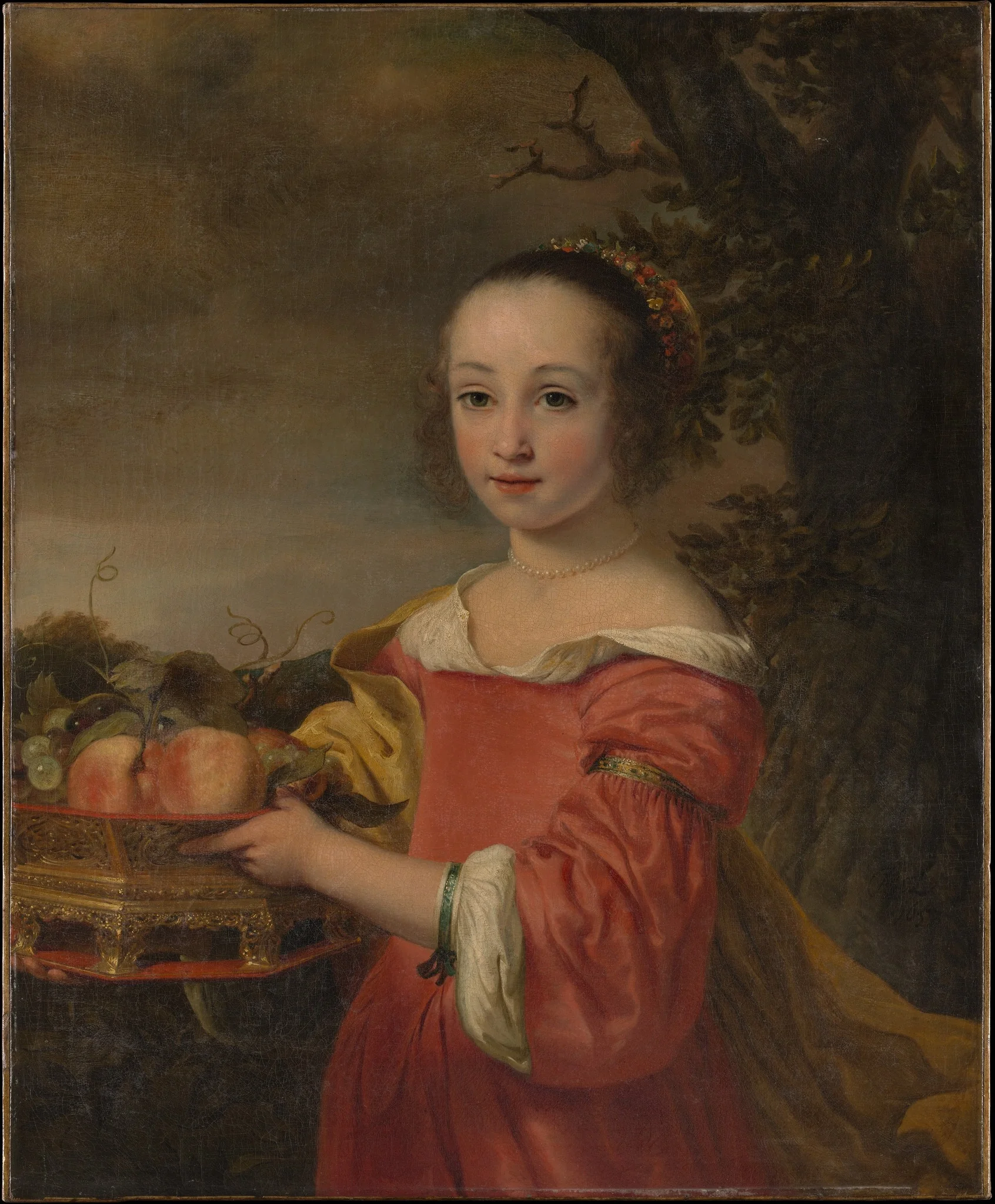
The painter Ferdinand Bol arrives in most histories wearing someone else's coat. He is the loyal pupil, the apprentice who absorbed his master so completely that for two centuries his canvases were bought, hung, and admired as works by Rembrandt. That account is accurate, and it is also a trap. It compresses a long, deliberate career into a single act of imitation and quietly drops the more interesting question: what did Bol want that his teacher would not give him? Stand in front of one picture for a while and the answer comes up to meet you. It is not a question of talent versus mediocrity. It is a question of appetite, of what kind of art a man decides is worth spending his life making.
This essay makes one argument. Bol's defining achievement was not fidelity to Rembrandt but a slow, profitable defection from him. Where Rembrandt pushed paint toward roughness, weighted shadow, and inward drama, Bol pulled the opposite way, toward smooth surfaces, even daylight, and the flattering composure that Amsterdam's merchant families wanted on their walls. His portrait of the child Petronella Elias with a Basket of Fruit holds a basket of fruit and, in the same gesture, holds the whole turn of his career. Read that single canvas closely and Bol stops being a shadow. He becomes the maker of a distinct, sociable, prosperous way of seeing, and the maker of a market for it.
A surgeon's son in Rembrandt's shop
Bol was born in Dordrecht on 24 June 1616, the son of a surgeon named Balthasar Bol, and he died in Amsterdam in 1680 (biographical record). The provincial, professional background matters. He came from a household that understood instruments, precision, and the steady earning of a fee, and he carried that temperament into the studio. A surgeon's son knows that a clean result is worth more than a dramatic one. By the late 1630s he was working in Rembrandt's Amsterdam workshop, then the most ambitious training ground in the northern Netherlands, learning to build a head out of shadow and to let a single warm light do the work of a whole composition. The lessons stuck. The instinct behind them did not.
The decisive date is 1641, when Bol left to open his own independent studio (per his biography). From that moment the imitation thesis starts to leak. A man who simply wanted to paint like Rembrandt would have stayed close to the recipe. Bol did the reverse. Across the 1640s and 1650s he sanded the grain off his teacher's manner. The early history pieces still carry the Rembrandt charge, the Getty's Messenger of God Appearing to Joshua of about 1640 among them, with its dramatic shaft of supernatural light breaking over a startled commander. But the portraits, where the rent money actually came from, drift steadily toward a cooler, glossier, more legible surface. He was building a product, and the product was flattery rendered with conviction.
It helps to picture the economics. An independent master in Amsterdam lived or died by repeat custom from the regent families and the great trading houses. Those clients did not want to be unsettled by their own portraits. They wanted a likeness that confirmed their standing, looked expensive, and would hang well beside the next one. Bol grasped this faster than most of his peers, and he organized his whole manner around it. The smoothness was a business decision before it was a style, and the two became the same thing.
Looking hard at Petronella Elias
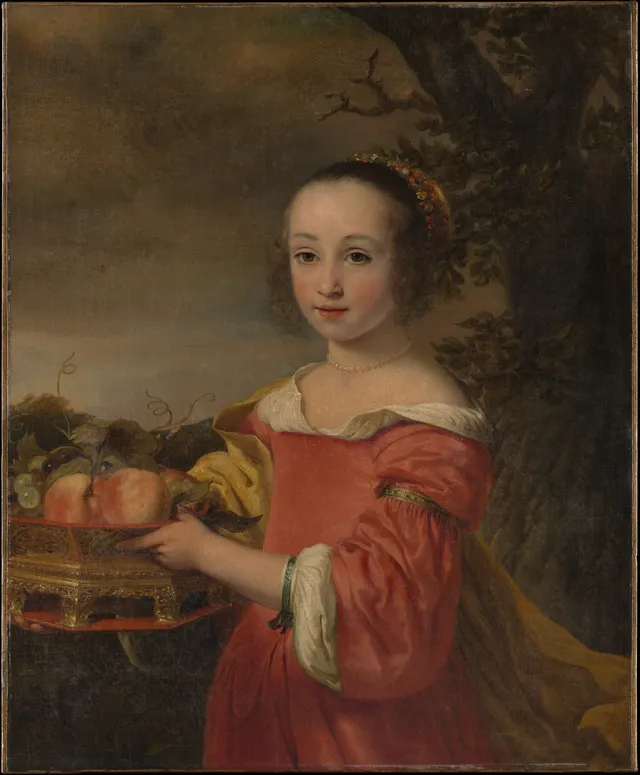
Go to the picture itself. Petronella Elias died at nineteen, and the dates folded into her title tell you she is shown here as a child, caught long before that early end. Bol sets her against a dark, unspecified ground, the standard portrait void of the period, and then refuses to let the void win. Light arrives from the upper left and lands first on her forehead and the bridge of her nose, then slides down across the round cheek and the small, deliberate hand. The face is built without the broken, gritty paint Rembrandt loved. The transitions are blended almost to invisibility, the skin reading as one continuous porcelain plane. Look closely at the edge where the lit cheek turns into shadow: there is no ridge of impasto, no visible drag of the brush, only a gradient so controlled it seems to have no hand behind it at all. You can see the choice he is making. He wants the child to look untroubled, polished, valuable.
Then there is the basket. She carries fruit, and the fruit is not a casual prop. In Dutch portraiture a child with heaped grapes, apples, and peaches is being aligned with Pomona and with the idea of abundance, fertility, and a household that wants for nothing. Bol paints the fruit with more textural appetite than he gives the dress, the grapes catching small wet highlights, the skins of the peaches slightly furred. The basket does the family's boasting so the girl's face does not have to. Look at how the composition tips the basket up toward the viewer, presenting its contents the way a merchant presents stock, while the child's gaze stays mild and frontal. The painting is performing two registers at once, innocence above and inventory below, and Bol keeps them from colliding by holding the whole surface at the same calm finish. The result is a small machine for reassurance.
This is the close-looking that earns the thesis. Rembrandt would have dimmed the room, dirtied the highlights, and made you feel the time of day. Bol clears the weather out. He gives a steady, almost timeless light because a portrait like this was meant to outlast the sitter and reassure her descendants. The handling is smoother, the palette warmer and more even, the mood unworried. None of that is a failure to be Rembrandt. It is a working painter deciding what his clients were actually paying for, and then delivering it without a wasted stroke. Notice too what he leaves out. There is no clutter, no symbolic memento, no second figure to complicate the reading. The child, the light, the fruit. That economy is its own kind of confidence.
The regents, the widow, the gods
Set Petronella beside three other works and the pattern stops looking like an accident. The first is The Regents of the Leper's house in Amsterdam in 1649, a group portrait of the kind that defined civic reputation in the Dutch Republic. The regent piece was the hardest commission a portraitist could take, because it had to make several men of equal standing look both individually present and collectively dignified, with no one slighted. Get the balance wrong and one sitter dominates, the others sulk, the painting fails as a record of shared authority. Bol solves it the way he solves the child: even light, clear faces, a controlled distribution of attention around the table. Where a group portrait could curdle into a row of stiff heads, his stays legible and decorous. He understood that these sitters were buying a record of their authority, and he gave them authority without theatrics.
The second is Caritas: Joanna de Geer with her Children, and here the social machinery is fully exposed. De Geer belonged to one of the wealthiest dynasties of the era, and Bol paints her in the guise of Caritas, the personification of charitable love, surrounded by her children Cecilia and Laurens Trip. The portrait historié, dressing real people in allegory, let a sitter claim a virtue while keeping her own face. Bol is comfortable in exactly this register. The mythological costume gives him an excuse for richer fabric and warmer skin, and the allegory flatters without strain. The same instinct that tipped a basket of fruit toward the viewer now drapes a banker's wife in personified generosity. The woman gets to be both herself and a moral idea, and Bol charges for both.
The third is Bacchus and Ariadne, proof that Bol kept one hand in pure mythology even as the portrait commissions paid the bills. The classicizing subject, the abandoned Ariadne met by the wine god, pulls him toward the smoother, more idealized European manner that painters like Sébastien Bourdon and the older Utrecht master Abraham Bloemaert were also working in. This is the current Bol was swimming toward all along. The Rembrandt of the 1640s was becoming unfashionable in elegant Amsterdam, and a polished, light-filled, lightly classical manner was rising to meet a richer clientele. Bol read that tide early, and he set his sail before most of his contemporaries had even felt the wind change.
Works discussed in this article
What the archive shows
The collected record bears the turn out at scale. Artifact World Gallery holds 74 works under Bol's name, spread across 21 separate venues and clustering between roughly 1630 and 1670. Two facts in those numbers are worth sitting with. The spread across twenty-one institutions tells you how thoroughly his portraits seeded the great museum collections, which is partly a function of how long they passed as Rembrandts and partly a measure of how many prosperous families once wanted one. A painter does not end up in twenty-one collections by accident. He ends up there because, for thirty years, the right people kept commissioning him.
The date band is the second fact, and it is the quieter of the two. The cluster ends around 1670, and that boundary lines up with something documented in his own life. Bol effectively stopped painting in his last decade, so the corpus does not just describe his style. It traces the exact shape of a career that ended by choice rather than exhaustion. The works thin out at the same moment the man steps back from the easel, and the data and the biography close on the same year.
Why he stopped is the most telling chapter, and it confirms the argument rather than complicating it. The biographical record describes a late self-portrait in which Bol presents himself as a man of the world, dressed in the embroidered finery of someone who no longer needs to sell the work of his hands (biographical record). It coincided roughly with his marriage to the wealthy widow Anna van Erckel, and after that marriage he largely put down the brush. The smooth, flattering, sociable painter had painted his way into the class he had spent thirty years portraying, and once inside it he no longer needed the trade. A Rembrandt would have kept gouging at the canvas until he died insolvent. Bol cashed out. The biography and the brushwork tell the same story.
The everyday face of the merchant city
Return to the single-sitter portraits and the case closes. The Portrait of a Woman and the companion Portrait of a man are the bread and butter of his practice, the kind of unnamed but unmistakably comfortable Amsterdammers who kept his studio busy. The Metropolitan Museum of Art catalogues one such Portrait of a Woman among its Dutch holdings. In these unidentified sitters the formula is at its purest. Quiet pose, restrained costume rendered with real attention to lace and dark silk, an even light, a face that meets you without anxiety. There is no narrative, no allegory, nothing to decode. The achievement is the surface itself and the social confidence it transmits.
It would be easy to read that restraint as a limit, and some critics have. The judgment I would defend is the opposite. The smoothness was the point, and it took discipline to sustain at this level. A flattering portrait that still looks like a specific human being, that records the lace truthfully while keeping the face serene, is a harder balance than it appears. Push it too far and you get a doll. Pull back too much and you lose the flattery the client paid for. Bol held the line between them for three decades and made a fortune doing so. The blandness some readers see is the sound of a difficult job done so cleanly that the effort vanished.
After Rembrandt, before the courtiers
Place Bol on the longer timeline and his significance sharpens. His life and work were already being set down by the early eighteenth century in Arnold Houbraken's biographies of the Netherlandish painters, De groote schouburgh der Nederlantsche konstschilders en schilderessen, the period source through which much of the Dutch Golden Age reached posterity. Houbraken's generation could still see what later admirers of Rembrandt would lose, that the smooth, elegant manner was not a dilution of art but a direction art was deliberately taking. To them, Bol was not a lesser Rembrandt. He was a successful modern.
That direction outran Bol entirely. The polished, light-filled portrait of consequence, the sitter shown at ease in fine cloth against a neutral ground, became the European standard for the next century. By the time Godfrey Kneller was running a portrait factory in London, the grammar Bol helped settle in Amsterdam had hardened into an international business with studios, assistants, and a price list. Bol is a hinge between Rembrandt's interior storms and that cooler, more sociable century that followed. To file him only as a faithful pupil is to miss the very thing that made him historically useful, which was his nose for where the demand was going.
So the defining work is not defining because it is his most famous. It is defining because Petronella Elias with a Basket of Fruit shows every decision Bol made over against Rembrandt, compressed into one small body. The blended skin instead of broken paint. The steady daylight instead of weather. The basket doing the family's boasting while the child stays calm. A picture meant to reassure rather than to disturb. Watch the fruit catch its highlights and the child hold her composure, and you are watching a working painter choose the future over his teacher, and getting rich on the choice.
Sources & further reading
- Ferdinand Bol — Wikipedia
- The Messenger of God Appearing to Joshua (about 1640) — The J. Paul Getty Museum
- Ferdinand Bol, artist record (Dutch, 1616-1680) — National Gallery of Art
- De groote schouburgh der Nederlantsche konstschilders en schilderessen — Internet Archive (Arnold Houbraken)
- Portrait of a Woman, object 435689 — The Metropolitan Museum of Art