Samuel F. B. Morse spent the better part of three decades losing an argument he could not bring himself to drop. He believed American painting owed a debt to the European grand manner, and that the debt was not money but ambition: a picture should carry an idea the way a sentence carries a thought, and a portrait that delivered only a good likeness had settled for too little. The young republic disagreed. It wanted its merchants, its statesmen, and its daughters set down with dignity and dispatch, and it paid for faces, not for allegories. Morse gave it faces. He gave it some of the most intelligent faces painted in America before the Civil War, and he resented nearly every one of them.
Here is the thesis this essay defends: the quarrel between a movement and the predecessor it grows out of is never settled, only inherited and restaged on new ground, and Morse's portraits are where we can still watch one painter fight it. The dispute he carried was old before he was born. It asked whether a picture should think or merely report, whether the highest work was the history painting heavy with moral argument or the likeness that kept a sitter breathing on a wall. The London academies had ranked the two with great confidence. Morse brought that ranking home, discovered his countrymen would not honor it, and lost the case commercially for the rest of his painting life. Before he abandoned the brush for a coil of wire and a tapping key, he did something stranger than concede. He painted the argument itself, whole, onto one enormous canvas inside the Louvre. The work he was paid to do, and despised, is the record of the case he never stopped making.
The fight he inherited
To see what Morse was fighting for, start with the ladder he kept in his head. The academies he studied under in London taught a strict order of worth. At the top sat history painting, the picture that stages a scene from scripture, myth, or the public life of nations and asks the viewer to read it. Portraiture ranked well below, useful and lucrative and, to an ambitious young man, faintly shameful. Morse came home around 1815 carrying that ladder and expecting his countrymen to climb it with him. They would not. There was almost no market for moral drama on a Boston wall, and a great deal of money in a flattering likeness. The conflict was not between him and a rival school. It was between an imported hierarchy and a society that had no use for it.
He kept climbing anyway. In 1822 he finished a vast interior of Congress at work, The House of Representatives, an evening session staged inside the chamber the architect Benjamin Henry Latrobe had built, lit by a single great central lamp, every legislator a tiny exact portrait set inside a machine of civic meaning. It was the kind of picture the academy would have praised, and it failed to draw the paying crowds he needed to recover its cost. Three years later the City of New York handed him a commission equal to the ambition: a full-length of the aging Marquis de Lafayette, the Revolution's living relic, ordered in 1825 and still hanging in the city's portrait collection. Notice the shape of even his successes. The republic would let him paint great men. It would not let him paint great ideas, and a portrait of a hero is still a portrait.
Hold that distinction in mind, because it governs everything that follows. A history painting asks for time and instruction. It wants a viewer who will stand and decode a chamber full of legislators, or a gallery wall thick with quotation, and come away changed. A portrait asks for recognition, and recognition is instant. The customer who paid Morse wanted to walk into a room, see a husband or a mother on the wall, and feel the small jolt of resemblance. The two demands pull a painter in opposite directions. Morse, by temperament and training, kept trying to smuggle the first into the second. The astonishing thing is how often the smuggling worked, and how little the country noticed or cared.
The portraits he resented
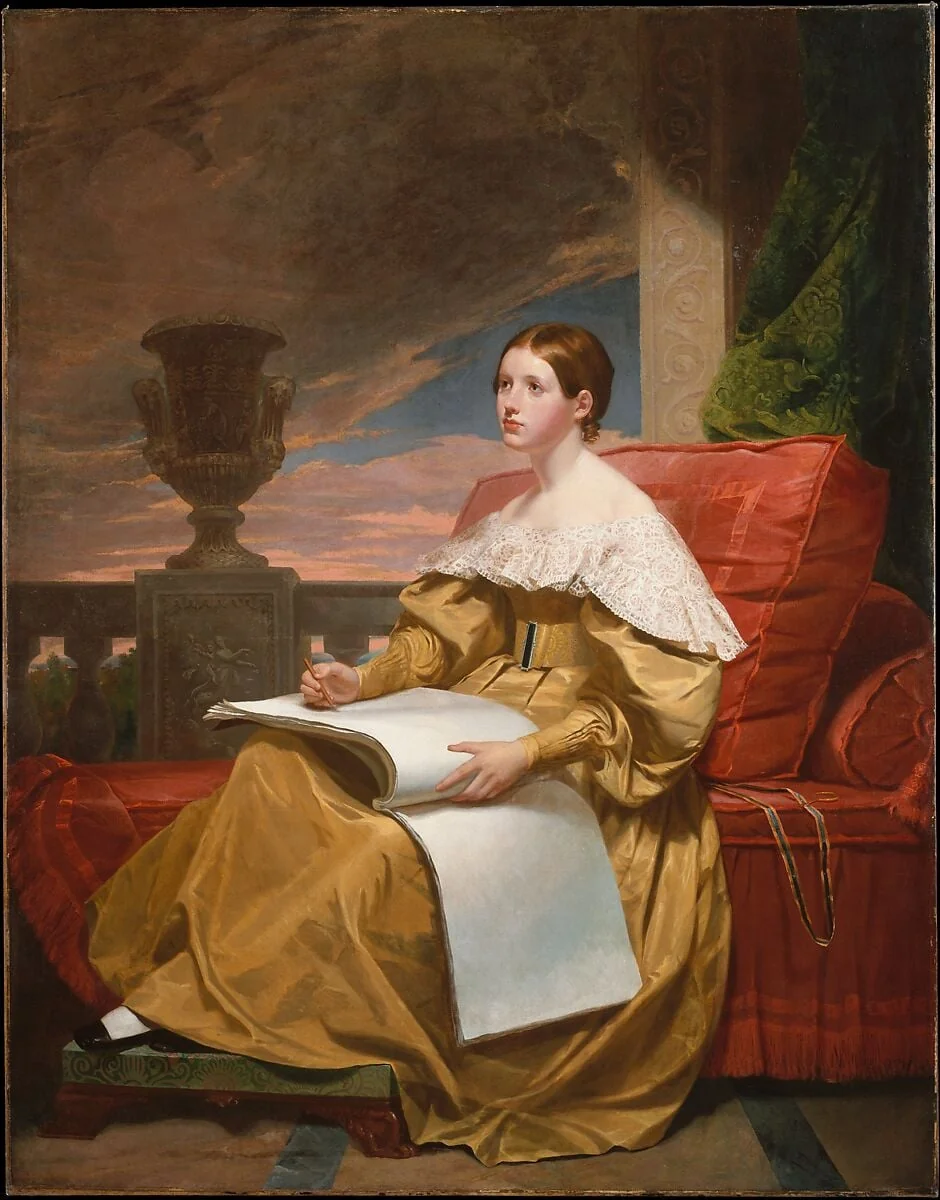
Look hard at Susan Walker Morse (The Muse) and you can watch the argument leak into a picture that did not ask for it. Around 1836 and 1837, in the years he was already bent over the first working models of the electric telegraph, Morse painted his own daughter Susan at full length and could not leave her a daughter (per the Metropolitan Museum of Art). She sits leaning against a large drawing board tilted across her lap, a pencil loose in one hand, her head turned up and slightly aside as though she has just caught a sound coming from outside the frame. The board tips toward us and flattens the space, so the sheet she works on reads almost as the picture plane itself. Warm light gathers on the cheek, the throat, the near hand, and lets the rest of the figure sink into a deep brown ground. He titled it The Muse. The likeness of a specific girl turns, under his hand, into the personification of inspiration. Even working for no fee, painting his own child, he reached past the face for an idea.
That upward, listening tilt of the head is the tell. A jobbing portraitist sets the eyes on the buyer and the buyer's eyes back on the sitter, a closed circuit of flattery. Morse breaks the circuit. Susan attends to something we cannot see, and her inattention to us is the whole point, because a muse is by definition turned toward a source the rest of us are denied. He has taken the most domestic subject available, a girl with a sketchbook, and bent it back toward myth. The picture cost him nothing in fees and everything in the larger account, since it proves he could not stop doing the one thing the market would not buy.
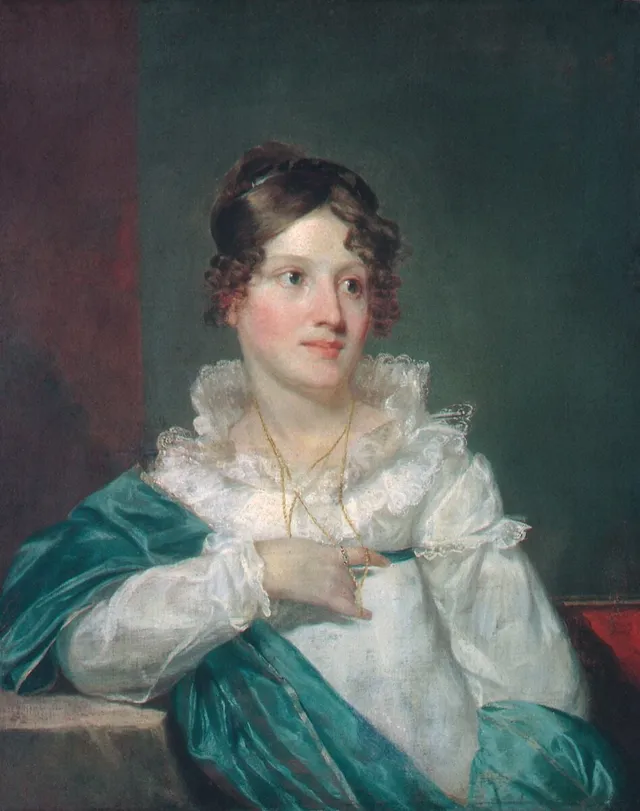
The commissioned work shows the same restless mind held on a short leash. Morse worked the southern portrait trade out of Charleston for several seasons, taking sitters at speed because the fees were the point. The result is a body of likenesses that are far better than they had to be. Mrs. Daniel DeSaussure Bacot meets the viewer with a level, unsentimental steadiness, the planes of the face built with an economy that betrays a man who had to finish before the light moved. There is no softening at the jaw, no borrowed glamour in the eye. He gives her the structural seriousness a lesser hand would have spent on a senator, and he gives it under deadline. The older Portrait of Mrs. John Earnest Poyas carries the same refusal to flatter past what the bones allow. The sitter is held in a plain frontal calm, the modeling firm, the mouth set without performance.
Set those women beside the public men and the children and the pattern resolves. The statesman De Witt Clinton gets the gravity of office, a heavy assured head built to hang in a civic room. The plain New England likeness of Cyrus Mansfield gets the same honest carpentry of the face, no rank to lean on, only the man. And the small, watchful sitter of Little Miss Hone gets a child's seriousness taken seriously, the gaze older than the dress. Read across them and you get the inventory of a career bent by demand rather than chosen. These are the works the country wanted. They are also, quietly, evidence of the case he lost, because every one of them does more than the commission required and none of it was enough to change what the country would pay for.
Gallery of the Louvre: the argument made literal
Between 1831 and 1833, working in Paris, Morse stopped implying the argument and painted it outright. Gallery of the Louvre is a fiction dressed as a record. He took the Salon Carré and rehung it in his imagination, crowding its walls with thirty-eight old-master pictures he chose, shrank, and arranged into a single composition, Leonardo's Mona Lisa and Raphael's La Belle Jardinière among them. The canvas is large enough to read as a room rather than a picture, roughly 187 by 274 centimeters, near six feet by nine. Copying the masters in the public galleries was the standard schooling of the age, and Morse turned that ordinary classroom exercise into a manifesto. He is telling an American audience, in paint, what their painters had been refused: here is the inheritance, look at it whole, learn it, do not settle for the quick likeness that pays the rent.
Stand close to the conceit and it grows odder. No visitor ever saw the Salon Carré hung the way Morse hangs it. He has edited the museum into a thesis, demoting whole schools and promoting the painters he wanted his countrymen to revere, so the wall becomes an argument about value rather than a transcription of a room. The light is his too, a warm theatrical glow that picks out the canvases he most wants you to study and lets the rest recede. This is not a souvenir of Paris. It is a syllabus, painted by a man who had given up expecting his country to assign one.
In the foreground he places small figures bent over their copies, himself among the instructors, so the picture stages its own argument about how an artist is made. It is, in effect, a defense brief for the hierarchy the republic had thrown out. The canvas now belongs to the Terra Foundation for American Art, and the National Gallery of Art showed it newly conserved in 2011 and 2012 as a focused exhibition built entirely around this one work. When it was fresh, Morse toured the painting through American cities and charged admission, hoping the spectacle of European greatness would finally pay. It did not. The plainest statement he ever made of his case found almost no buyers, which is the whole story of his painting life compressed into a single failed receipt.
What the archive holds
Artifact World Gallery's own holdings trace the shape of the working life behind the argument. We hold fourteen Morse paintings across five institutions, all of them roughly between 1808 and 1836, an arc that runs from a teenager's earliest efforts to the eve of the year he effectively set the brush down. Read the spread and the verdict is already there in the numbers. The count is dominated by portraits and near-portraits, the work the market demanded, while the grand public machines and the imagined gallery survive elsewhere as a handful of outliers. The corpus that bears his name is mostly the record of a concession. A man who wanted to be remembered for ideas is preserved, painting by painting, as the finest face-maker who could not get his country to want anything more.
That spread is itself an argument, made not by a critic but by a market. Fourteen surviving works, weighted heavily toward the sitter trade, is what a demand curve looks like when you turn it back into paint. The history pictures are rare because they were rarely commissioned and almost never recouped. The portraits are many because portraits are what changed hands. If you wanted a single object that proves Morse lost the case, you would not reach for a manifesto. You would point at the proportions of his own surviving output and let the count do the talking, De Witt Clinton and the Charleston women standing in for the dozens the country actually paid him to make.
Works discussed in this article
The argument, revisited
The lens of this essay is that every movement re-fights the quarrel it inherits, and Morse's case is the clearest proof in American art that the loser of such a fight does not always stay defeated. He had wanted a way to send meaning that did not depend on a likeness. By the later 1830s he had built one. The telegraph carried pure content along a wire with no face attached, no flattery to negotiate, no patron to please. The man who could not sell an idea in oil sold the very principle of transmitting ideas to the world, and the alphabet of dots and gaps that took his name is, in a real sense, the picture he had always been trying to paint. He simply painted it in current instead of pigment.
There is a photograph of him from the late 1850s, taken by a British firm, that captions the sitter not as an artist but as a professor. By then the public had agreed to forget what he was first, and he had largely agreed to let them. After his death his son gathered the correspondence and journals into a volume where the painter's old disappointment is still legible under the inventor's fame. Read those pages against the portraits and the case clarifies. Morse did not lose the argument with his predecessors because his side was weak. He lost it because the audience changed, and a young commercial republic wanted to recognize its own faces before it wanted to be taught how to read a picture.
It is worth resisting the tidy moral that the inventor redeemed the painter. He did not. The portraits do not need the telegraph to justify them, and The Muse would still be one of the best American pictures of its decade if Morse had never touched a wire. The continuity is in the man's hunger, not in some balance sheet that finally came out even. He wanted to carry meaning past the limits of resemblance, failed to do it in oil, and then did it in copper. Both halves of the life answer the same question. Only one of them paid.
So the quarrel between idea and likeness did not end when Morse gave up oils, any more than it had ended when the academies first ranked the genres, or when the next generation took up landscape and started the fight over again. It is the recurring dispute of the century, and Morse stands at the hinge of it in America. He carried the old case as far as paint would take him, set down the brush in something close to defeat, and then sent the argument out over a wire as a string of taps, each one an idea with no face attached, which is the picture he had wanted all along.
Sources & further reading
- Samuel F. B. Morse, Susan Walker Morse (The Muse) — The Metropolitan Museum of Art
- Gallery of the Louvre — Wikipedia
- The House of Representatives — Wikipedia
- A New Look: Samuel F.B. Morse's Gallery of the Louvre — National Gallery of Art
- Marquis de Lafayette (Morse) — Wikipedia
- Artists in and against the Museum — Smarthistory
- Professor Samuel Morse (albumen silver print, Maull & Polyblank) — The J. Paul Getty Museum
- Samuel F. B. Morse: His Letters and Journals (ed. Edward Lind Morse, 1914) — Internet Archive