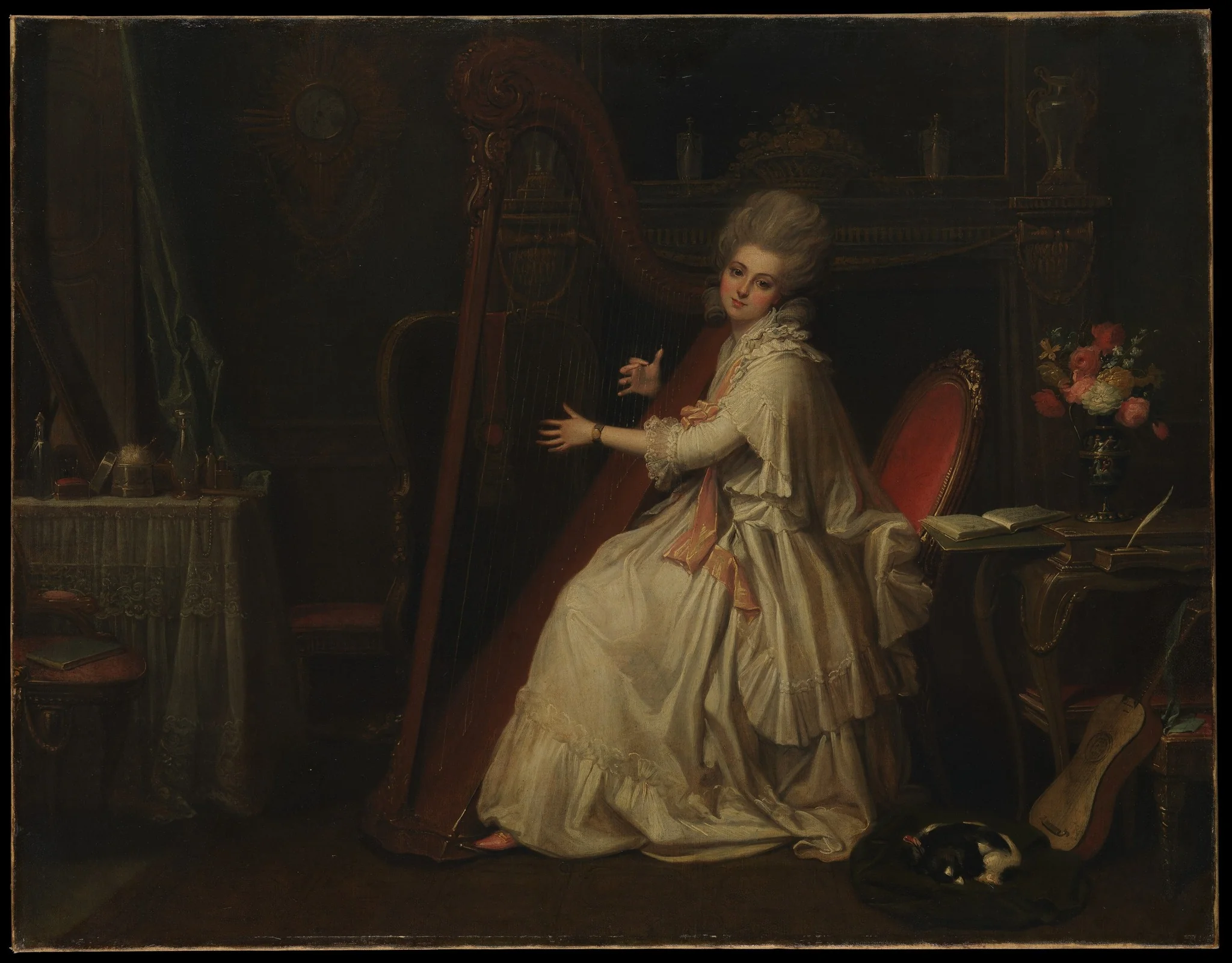
The fastest way to misjudge Richard Cosway, the Georgian portrait miniaturist, is to file him under flattery. He dressed his sitters in silver light, thinned his shadows almost to nothing, and gave half the fashionable women of Regency London the same large, wet, slightly startled eyes. Read quickly, that looks like a formula for vanity at scale. Read slowly, in front of the actual objects, and a different argument forces itself on you. Cosway's true subject was presence: the bodily conviction that a particular person is in the room with you, breathing, about to speak. His defining achievement was to make that conviction survive at any size, from a two-inch oval of ivory to a full canvas, without ever raising his voice.
This essay tests that claim against a single work and keeps returning to it: his Portrait of Marianne Dorothy Harland, the young woman later known as Mrs. William Dalrymple. I want to argue that everything Cosway is praised and blamed for is legible in that one picture, and that the picture is better, and stranger, than its reputation as a piece of charm. He is usually sorted into the company of grand-manner men like Reynolds and Gainsborough, the painters who built reputations on life-size oils. Cosway belongs there only on a technicality. His instincts were those of a miniaturist who happened, now and then, to work large, and the Harland portrait is where those two scales collide and hold.
A Devon boy who learned to be indispensable
Cosway was born on 5 November 1742 in Tiverton, Devon, and died in London on 4 July 1821, which sets his working life neatly inside the Georgian and Regency decades, the period when British portraiture turned professional and ruthless about reputation. (biographical record.) He came up through the drawing schools, won early premiums, and made himself useful to the right people with a speed that his rivals found distasteful. The decisive appointment came in 1785, when he was named Painter to the Prince of Wales, the only time that particular title was ever conferred on anyone.
That last fact is more than trivia. A court that wanted Reynolds for its state portraits wanted Cosway for something else: the small, private, wearable image of a face, the kind of object a prince could carry, gift, or hide. The future George IV trafficked in exactly such tokens, and Cosway became the supplier of choice. The position fixed his clientele for the rest of his career. He painted the people who orbited the prince, their wives, their mistresses, their children, and he painted them in a way that was meant to be looked at closely, held, and kept. His art was built around intimacy as a commercial proposition long before intimacy became a sentimental one.
Two early-twentieth and late-nineteenth-century catalogues let us see the shape of that output. G. C. Williamson's 1905 monograph reconstructs the long list of pictures Richard and his wife Maria exhibited at the Royal Academy and elsewhere between 1760 and 1806, which is as good a measure as we have of when his public career began and tapered off (Williamson, 1905). F. B. Daniell's 1890 catalogue of the engraved works records how widely his designs were copied into print, the secondary economy that carried a Cosway face far beyond the people who could afford the original. Together they describe a man whose images circulated at two speeds: the slow, costly, single object, and the fast, cheap, reproductive one.
The single work, revisited: Marianne Dorothy Harland
Stand in front of the Harland portrait and the first thing you register is how little is happening, and how completely it works. A young woman occupies the canvas almost entirely. She is turned a few degrees off the frontal, her shoulders soft, her head tipped just enough to suggest she has heard something off to the side. The gown is the pale, unstructured muslin of the 1770s and 1780s, painted not as cloth so much as as light passing through cloth. Behind her the landscape dissolves into a feathered, low-contrast haze, sky and foliage worked at the same value so that nothing back there competes with her face. There is no architecture, no attribute, no dog, no book. Cosway has stripped the grand-manner portrait of its props and left you alone with a person.
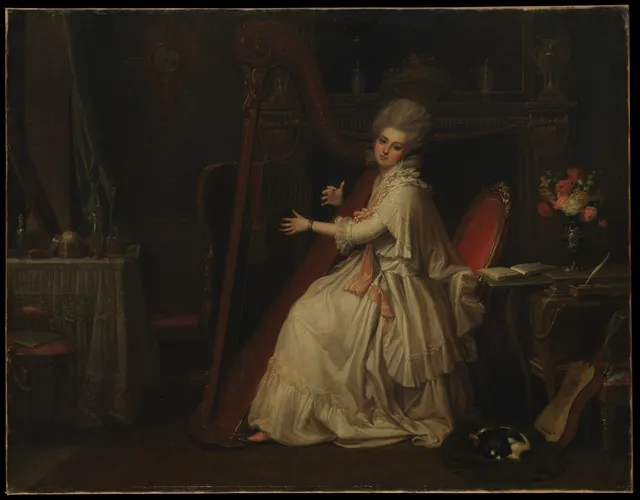
Now look at the handling, because that is where the miniaturist gives himself away. The face is the only part of the picture brought to full resolution. The transitions across the cheek and temple are tight, almost enamelled, the way Cosway built flesh on ivory by laying transparent washes over a luminous white ground. Move outward and the paint loosens by the inch. The hair becomes suggestion. The muslin turns into a few confident, dry drags of a loaded brush. By the time you reach the edges of the gown the picture is barely declared at all. This is not carelessness. It is a hierarchy of attention. He is spending his finish where a held miniature would be scrutinised, on the eyes and mouth, and treating everything else as setting.
The eyes are the gamble. They are large, dark, and faintly liquid, set under high brows, and they catch a single specular highlight that Cosway places with a jeweller's precision. In a lesser hand this is the recipe that tips a portrait into doll-likeness, and Cosway sometimes did tip. Here he stays the right side of the line because the mouth refuses to match. It is not smiling. It is composed, a little guarded, the lips closed with a slight asymmetry that reads as a real person choosing not to perform. That tension, melting eyes against a withheld mouth, is the whole drama of the picture. Marianne Dorothy Harland died young, in 1785, at twenty-six. The portrait does not know that, and it does not need to. What it gives you is the thing Cosway was selling his entire life: the sensation that you have caught someone in the half-second before they decide what to say.
Revisit the canvas with the engravers in mind and a second logic appears. A face resolved this cleanly, against a background this quiet, is a face built to be reproduced. Strip the colour and you still have a complete image, because Cosway has already done the editing a printmaker would otherwise have to do. He composed, consciously or not, for the second life of the picture, the stipple engraving that would carry it into a thousand drawing rooms. The Harland portrait is a single object that behaves like a master pattern.
Why the miniature is the key, not the footnote
Tate's glossary gives the plain definition: a miniature is a small painting, usually a portrait, and the form had an earlier British peak in the sixteenth and seventeenth centuries before Cosway's generation revived it (Tate art terms). The technical fact behind the definition matters more than the size. These works were painted in watercolour on thin slips of ivory, a support that is translucent, unforgiving, and faintly warm. The Metropolitan Museum's Cosway Self-Portrait of about 1770 to 1775 is recorded on just such an oval of ivory, roughly fifty by forty-two millimetres (Met object record). At that scale every decision is final. There is no scraping back. The white of the ivory does the work that white paint does in oil, glowing up through the thin colour and lending flesh its life.
Once you have held that constraint in your head, the full-scale portraits read differently. The thinness Cosway prized in oil, the way he lets the ground breathe through the paint, is the oil-painter's translation of working over luminous ivory. The reluctance to over-finish a sleeve is the habit of a man who has spent his career deciding what a two-inch picture can afford to leave out. The same discipline governs the miniature of Ensign Lionel Robert Tollemache, a named and datable young officer from his fashionable clientele, also painted on ivory (Met object record). Tollemache was born in 1774 and dead by 1793, not yet twenty. Cosway gives him a clear brow, a high colour, and the faint stiffness of a boy in a new uniform. The likeness is specific enough that it could only be him, which is the quiet test the form has to pass. A miniature that flatters generically is a failed miniature. It has to be of someone.
The same painter could also turn the format toward myth. His Hero and Leander shows the other Cosway, the designer of small "fancy" subjects in the neoclassical taste, where the figures are idealised and the drawing leans on contour rather than likeness. It is a useful corrective. Put it beside the Harland portrait and you can see how much of his portraiture is restraint, how easily the same sensibility could slide into pretty abstraction, and how deliberately he held it back when a real face was in front of him.
Works discussed in this article
The self-portrait as manifesto
The Met self-portrait deserves its own paragraph because it tells you what Cosway thought of himself. He was a famously vain dresser, a small man who cultivated an outsized public character, and the ivory shows a face composed for the audience he knew would hold it close. The brow is high, the gaze direct, the mouth set with the same controlled confidence he later gave his sitters. He is using on his own face the exact instrument he used on theirs: full finish at the eyes, a swift surround, the ivory glowing through. The picture is a statement of method. The maker of these objects is himself one of these objects, painted to the same standard, asking the same scrutiny.
Then there is the portrait of his wife. Maria Cosway with Her Daughter Louisa is the rare Cosway with a private stake. Maria was a painter and exhibitor in her own right, named alongside him in Williamson's exhibition lists, and Louisa, their only child, died at six. Knowing that, the picture's tenderness reads less as formula and more as something the painter actually felt. The handling is the same as everywhere else, the loose surround, the resolved faces. The difference is in the looking. Cosway flatters strangers. He studies his family.
What the archive shows that the catalogues do not
Set the canonical record against our own holdings and a useful texture appears. Across Artifact World Gallery, twenty-one works carry Cosway's name, spread over six venues and clustered roughly between 1750 and 1812, all under a single attributed hand. That span is the tell. It tracks almost exactly with the exhibiting career Williamson documents, and it confirms in miniature what the monographs argue at length: Cosway was a phenomenon of a specific half-century, the decades when a court culture, a print economy, and a fashion for the small private likeness happened to align. He did not outlive that moment by much. The cluster is the career.
A spread across six venues also says something about how this kind of art survives. Miniatures are portable by design, which is why they scatter. A grand-manner full-length tends to stay where it was hung. A two-inch oval travels in a pocket, a locket, an estate sale, a dealer's tray, and ends up wherever the last transaction left it. The dispersal is not an accident of collecting. It is the form behaving as it was built to behave.
The unnamed sitters complicate the picture in a productive way. Our Portrait of a Woman is exactly the kind of object the centuries strip of identity. The face is fully Cosway's, the eyes and mouth resolved with care, but the name has fallen off somewhere in the long passage from a private commission to a public collection. This is the ordinary fate of the form. For every Marianne Harland whose biography we can reconstruct, there are a dozen women reduced to "a lady," and the loss is real. A miniature was meant to be the most personal of all painted things. Time turns a great many of them anonymous, which is a quiet argument for the work of attribution and cataloguing that puts the names back.
The second life: prints, and the spread of a face
Cosway's reach is impossible to measure from the originals alone, because the originals were never the whole business. His designs were engraved and re-engraved, and a Cosway likeness could travel far from the person who first commissioned it. A drawing made for one private patron could be cut into a plate, printed, and pulled into drawing rooms on the far side of Europe. The single costly object and the cheap reproductive one were two ends of the same trade, and Cosway worked both. That is the part of his career the surviving paintings undercount, and it is the part that made his face the common currency of fashionable London.
This is where the Harland portrait's compositional logic pays off retroactively. The clean face against the quiet ground is the ideal source for stipple, the soft dotted technique that suited Cosway's melting transitions better than hard line engraving ever could. He painted, and his printmakers translated, in a register that prized softness and glow. F. B. Daniell's 1890 catalogue of the engraved works exists precisely because there was so much of this secondary output to record (Daniell, 1890). The man's fame in his own time rested as much on the cheap copy as on the costly original.
There is a judgment to make here, and I will make it. The standard charge against Cosway is that he is a minor master, a maker of charming trifles who lacked the ambition of the men who painted history and life-size state portraits. The charge mistakes the format for the achievement. To compress a convincing human presence into a few square centimetres of watercolour on ivory, with no margin for error and no chance of revision, is a harder problem than covering a large canvas, not an easier one. Cosway solved it more often than anyone of his generation. The Harland portrait, his rare excursion into full scale, is best understood as a miniaturist proving he could carry the same precision into a bigger room without losing it. That is not a minor talent failing upward. It is a specialist demonstrating the reach of his specialty.
Return one last time to Marianne Dorothy Harland, because the argument lives or dies there. The picture has every reason to be forgettable. It is a pretty young woman in a pale dress against a soft sky, the most exhausted subject in eighteenth-century painting. What keeps it alive is the discipline underneath the charm: the face resolved like a jewel, the rest let go, the mouth that refuses to flatter even when the eyes do. Cosway built that face to be looked at up close, the way you would look at something held in the hand, and then he had the nerve to make it the size of a person. Stand close enough and the painting still wants the intimacy of the locket. That stubborn closeness, scaled up and never abandoned, is the whole of Richard Cosway in one canvas.
Sources & further reading
- Richard Cosway — Wikipedia
- Self-Portrait (object record, ca. 1770-75, ivory) — The Metropolitan Museum of Art
- Ensign Lionel Robert Tollemache (1774-1793), object record — The Metropolitan Museum of Art
- Miniature (art term) — Tate
- Richard Cosway, R.A. (1905) — George C. Williamson / Internet Archive
- A catalogue raisonné of the engraved works of Richard Cosway, R.A. (1890) — F. B. Daniell / Internet Archive
- Richard Cosway (ULAN ID 500115280) — Getty Union List of Artist Names