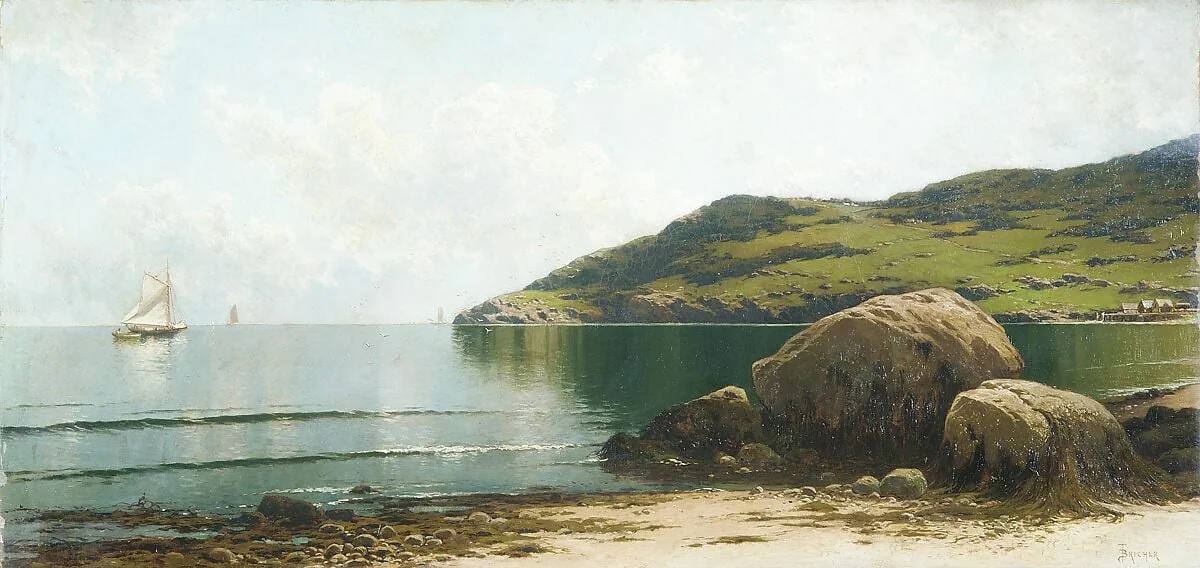
The marine paintings of Alfred Thompson Bricher are easy to file under one heading and lose. He is the painter of the quiet American shore, the man who set a low horizon beneath a wide pale sky and let the sea go still. File him there and you miss the more interesting fact about him, which is that almost nothing in his art stayed where it began. His subjects moved. His medium moved. The style he is grouped under moved, carried from the inland Catskills out to the Atlantic edge, and Bricher moved with it. Read his career as a record of transit and the still surfaces start to look like the end point of a long passage rather than the symptom of a calm temperament.
My claim is plain. Bricher is best understood as a transmitter rather than an originator, and his canvases are the clearest surviving evidence of what happens to a landscape language when it is hauled from one place, one market, and one material into another. The New England coast he grew up beside traveled south into the New York rooms where pictures were sold. The high drama of the first Hudson River School cooled, in his hands, into a repeatable quiet that a parlor wall could absorb. Watch those changes and you learn more about the American art trade of the 1870s than any single masterpiece would teach you. The stillness is not the subject. The journey to the stillness is.
From Portsmouth to the market
Bricher was born in Portsmouth, New Hampshire, in the spring of 1837, and he died on Staten Island in 1908, at New Dorp, a long way from the granite shoreline that made his name. Between those two points he made one decisive move. In 1868 he left New England for New York City, and in that same year he hung a picture titled Mill-Stream at Newburyport at the National Academy of Design. The title is worth pausing on. A mill stream at Newburyport is a Massachusetts subject, a New England subject, carried into the most important exhibition room in the country and offered to a metropolitan audience. The painting traveled before the painter's reputation did, and that order of events tells you most of what you need to know about how Bricher worked.
This is the pattern that repeats across four decades. Bricher spent his summers sketching the shoreline of Cape Ann, Cohasset, Grand Manan, the islands off Maine, then carried the studies back to a New York studio and worked them up into salable oils and watercolors through the winter. The coast was the source. The city was the market. Each finished picture is the residue of that round trip, and you can feel the distance inside it. These are not paintings made in front of the sea in a single charged hour. They are reconstructions, assembled at a desk from memory and study, smoothed into something a buyer in a brownstone could live with for years without tiring of it. The labor is real. It is the labor of an editor as much as a witness, and editors leave a particular kind of fingerprint, visible in what has been removed.
The titles carry the strategy on their face. A coastal picture sold in Manhattan did two things at once. It delivered a calm, well-lit surface a collector could hang above a mantel, and it named a fashionable summering ground the collector might recognize, or want to be seen recognizing. Newburyport, Manchester, Cohasset, the Maine shore: these were not neutral geographic labels but addresses with social weight, the places a certain kind of New York family went in August. Bricher's pictures let a buyer keep a piece of that coast on the wall through the winter, edited down to its most agreeable weather. The view and the destination were sold in the same frame.
Even his name traveled badly. The period reference Artists of the Nineteenth Century and Their Works, compiled by Clement and Hutton in 1879, indexes him as Albert T. Bricher, not Alfred. A working painter, well enough known to be catalogued, and the catalogue still got his first name wrong. It is a small thing, and it tells you what sort of figure he was. Not a celebrity of the Church or Bierstadt order, but a reliable supplier of a popular product, the kind of artist whose pictures were better known than his face. The error is almost a portrait in itself, the supplier outpaced by his own supply.
Marine Landscape, and the look of arrival
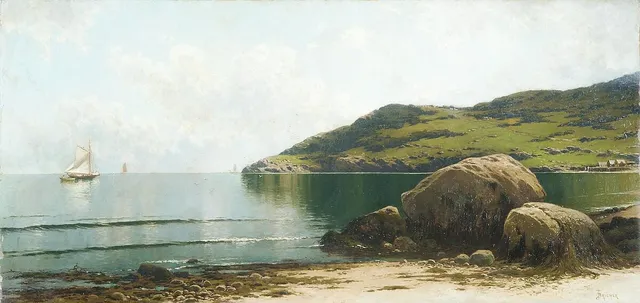
The Metropolitan Museum of Art owns a late oil by Bricher simply called Marine Landscape, dated around 1895. Our own plate of it sits at the center of this argument, so look at the painting closely. The horizon is set low, well beneath the midpoint, which hands most of the canvas to the sky. The sea occupies a narrow band, and across it the light refuses any drama. There is no storm, no burning sunset of the kind Bierstadt staged for his audiences. Instead the water carries an even, silvered brightness, broken only where it meets rock at the lower edge. The brushwork is hidden. You are not meant to see the hand that laid it down. The paint lies flat and quiet, so the eye reads water and air rather than oil and canvas. That concealment is deliberate, and it is the whole purpose of the manner Bricher worked in.
Notice how the rocks are built. They sit in the foreground as dark, weighted anchors, and the painter lets their wet faces catch a hard glint while the sea behind them stays soft. The composition does one job above all others, which is to make the viewer feel the stillness of a held moment. Nothing moves. The picture is a long way, in mood and in miles, from the working shoreline where the studies started. By the time the subject has traveled from a summer rock at Grand Manan to a New York easel in the 1890s, the weather has been edited out of it, and what remains is a coast with its pulse slowed almost to a stop. The drama has not been heightened. It has been withdrawn, on purpose, until the surface becomes the entire event.
The style that traveled: luminism off the mountain
The label most often pinned to Bricher is luminism. Tate defines the term as the painting of light, applied to the American landscape painters of the Hudson River School roughly between 1830 and 1870. It is a useful word as long as you remember it was coined by later historians, not by the painters themselves. What it names is exactly the thing you can see in Marine Landscape, the even glow, the aerial perspective that softens distance into haze, the suppressed stroke. Bricher is listed among the luminists alongside Worthington Whittredge, James Suydam, David Johnson, and others whose attachment to the style is looser than the textbook suggests. The category was assembled after the fact, which is part of why it fits a transmitter like Bricher better than it fits the originals.
Luminism did not arrive from nowhere. It grew out of the Hudson River School, the mid-century movement of American landscape painting whose first generation, Thomas Cole above all, treated the inland wilderness as a moral theater of storms and ruins. Bricher belonged to the second generation, the cohort that inherited the school's reverence for light and quietly drained it of melodrama. Here is the transit that matters most. The sublime moved downhill and out to sea. The Catskill gorge became the Atlantic shoaling water. The thunderhead became a bank of pale vapor on the horizon. The devotion to light survived the move intact, but its temperature dropped several degrees. What Cole aimed at the conscience, Bricher aimed at the eye.
You can read this as a softening or as a thinning, depending on your sympathies. I think it is honestly both. The luminist coast of the 1870s is calmer and more marketable than Cole's wilderness, and something is surrendered in the trade, namely the sense that a landscape might mean something or judge the person standing before it. What is gained is a register of attention so fine that a flat sea becomes worth a long stare. Bricher is not the supreme practitioner of that register. Fitz Henry Lane and Martin Johnson Heade reached places he never did. He is, though, one of its most consistent hands, and consistency turns out to be its own kind of evidence about how a style behaves once it becomes a livelihood. The exception tells you what a painter could do. The repetition tells you what the market would buy.
Close looking: where the rock meets the wash
Set the late Met oil beside two earlier coastal pieces in our archive and the editing process shows its seams. In Along the Cohasset Shore, the foreground ledge runs in from the lower corner on a long diagonal, wet and dark, and the painter places a single pale break of surf where the stone drops into the water. The horizon again sits low. The sky again takes the larger share. The handling here is a degree more nervous than in Marine Landscape, the surf carrying a little more agitation, the clouds a little more weight, as though the studio had not yet smoothed the last of the weather out of the memory. Read the picture left to right and you can almost watch the formula being assembled, the rock anchoring the eye, the water carrying it back, the sky releasing it upward.
Then look at Rocks and Sea, which drops the place name and with it any pretense of topography. There is no Cohasset, no Manchester, no Grand Manan to advertise. What is left is the bare grammar of the type, a mass of dark rock, a sheet of quiet water, a thin band of sky. Strip the title and you strip the souvenir function, and the picture has to survive on its surface alone. It does, mostly, because Bricher knew how to weight a foreground so the calm behind it reads as chosen rather than empty. The wet faces of the stone catch the only hard light in the frame. Everything past them is held in the low, even glow the luminists prized, and the eye, given nothing to chase, settles onto the water and stays.
Works discussed in this article
What changed in transit: oil, water, and the trade
The clearest record of Bricher reshaping his art to fit its destination is his turn to watercolor. He was elected to the American Watercolor Society in 1873, at the precise moment the medium was becoming fashionable with American collectors. Watercolor was cheaper to buy, easier to frame, and suited to the domestic wall. For a painter whose business was supplying the city with views of a coast it could not visit, the medium fit the trade like a glove. The luminist project of holding light still translates almost too readily into transparent washes, where the white of the paper performs the work a glaze does in oil. The style and the market wanted the same thing, and Bricher gave it to both. The shift was not a change of heart. It was a change of channel.
Our own holdings show the shape of that supply at small scale. Artifact World Gallery holds twelve Bricher paintings drawn from five venues, the output of a single hand spanning roughly 1864 to 1895. That is a modest cross section, and it is a revealing one, because it stretches across nearly his whole working life and lands in five separate institutions. The same artist, the same shoreline preoccupations, dispersed. A body of work built to travel did precisely that, and it is still in motion, moving from museum storeroom to gallery wall to the print that hangs in a house he never set foot in. Thirty-one years of output and not a single home for it. That is not an accident of collecting history. It is the logical conclusion of pictures made to be portable from the start.
Look across the works themselves and the range of that transit turns concrete. A Quiet Day near Manchester names a specific stretch of the Massachusetts North Shore. Along the Maine Coast and Along the Cohasset Shore do the same advertising work that Mill-Stream at Newburyport did back in 1868, telling a buyer exactly which fashionable summering coast the picture delivers. Rocks and Sea drops the place name entirely and sells the mood on its own. And then there is The Farm, a reminder that Bricher started as an inland landscapist before the ocean took over his output, a relic of the moment before his subject matter itself migrated to the shore. Five pictures, and between them they map the whole arc, from the field to the named beach to the nameless rock.
The temptation with a painter like Bricher is to grade him against the giants and shelve him as minor. That misreads what he was for. He was a conductor of a style, a man who took the Hudson River School's light off the mountain, carried it to the coast, cooled it, and sent it out into thousands of American rooms in oil and in watercolor. The stillness in his pictures reads less like the calm of a settled temperament than like a thing that has finally stopped moving after a long way traveled. Stand in front of Marine Landscape and you are looking at the last frame of that passage, the moment the sea was at last made to hold.
Sources & further reading
- Alfred Thompson Bricher — Wikipedia
- Marine Landscape (object record) — The Metropolitan Museum of Art
- Luminism (art term) — Tate
- The Hudson River School — Smarthistory
- Luminism (American art style) — Wikipedia
- Morning at Grand Manan — Wikipedia
- Alfred Thompson Bricher (1837-1908) — National Gallery of Art
- Artists of the Nineteenth Century and Their Works (Clement & Hutton, 1879) — Internet Archive