The collection at the Museum of Modern Art gets told, almost always, as a procession of painters. Cézanne hardens a bowl of fruit into geometry, van Gogh sets a night sky spinning, Hopper empties an American street until it aches. That is the glamorous half of the story, and it is the half the wall labels want you to believe is the whole. The other half, the half that actually built the place, is a short list of people who wrote the checks. The question of who painted these pictures has thousands of answers. The question of who paid for them has roughly a dozen, and that dozen, most of them women of Gilded-Age money, did more to fix the canon of modern art than any single artist hanging on the walls.
This essay takes the second question seriously, and the argument is a little uncomfortable: MoMA is less a neutral mirror of the modern movement than a portrait of the taste, nerve, and bank balances of its founders and their successors. The works that became famous became famous partly because a few private collectors decided they should be bought, lent, hung, and reproduced until the public could no longer imagine the century without them. Trace any celebrated canvas back through its credit line and you reach a donor's name, a dealer's invoice, a bequest signed in a lawyer's office. Our own archive lists 12,386 works connected to the museum, made by 4,257 different hands and spanning roughly 1840 to the present. That sprawl did not assemble itself. It was paid for, one acquisition at a time, and the order in which the money moved is the real subject here.
Three women and a crash
The museum opened to the public on November 7, 1929, nine days after the Wall Street Crash. The timing reads like a dare. Its three founders, Abby Aldrich Rockefeller, Lillie P. Bliss, and Mary Quinn Sullivan, were collectors first and institution-builders second, and a press that did not quite know what to do with them tended to file them under society notes rather than art history. That filing was a mistake. These were the people deciding which strain of the new painting would get an American home, and they were doing it with their own purchasing power at a moment when the country's finances were imploding around them.
Bliss had been buying Paul Cézanne and Odilon Redon when most American museums still treated living French painting as a kind of contagion to be quarantined behind academic taste. Her holdings were not a hedge or an investment. They were convictions hung on a wall. When she died, soon after the museum opened, she left it the core of its early collection, and that gift did something a purchase order cannot: it converted a private enthusiasm into an institutional spine. The museum could now claim that a serious Cézanne was not a provocation but a possession, already inventoried, already insured, already ours.
Abby Aldrich Rockefeller brought a different asset to the table, which was the deep tolerance of the Rockefeller fortune for an experiment her own husband found distasteful. The money that underwrote the museum's first decade was, in a real sense, oil money laundered through a daughter-in-law's eye for pictures. Mary Quinn Sullivan, a former art teacher, brought the trained connoisseur's instinct the other two trusted. The point worth holding onto is that the founding was an act of patronage before it was an act of curation. Three women looked at a market that had just collapsed, decided modern art was undervalued and underhoused, and built the institution that would set its price.
The new museum announced itself with a loan exhibition that told you exactly where its loyalties lay. The opening show gathered Cézanne, Gauguin, Seurat, and van Gogh, the four pillars of what the founders considered the usable past of modern painting. The art press registered the debut at once. The November 9, 1929 issue of Art News reported that the museum had opened its galleries the previous day, a small contemporaneous fact that matters because it dates, almost to the hour, the moment private taste became public authority.
The director who drew the map
If the founders paid for the museum, Alfred H. Barr Jr. drew its mind. As MoMA's first director, Barr did not simply hang the pictures the money bought. He diagrammed them. In 1936 he produced the now-famous chart of the development of abstract art, a flow of arrows running from Post-Impressionism down through Cubism and into geometric and non-geometric abstraction, and he put it on the dust jacket of the catalog for the exhibition Cubism and Abstract Art. It is one of the most consequential graphics in the history of taste. A genealogy of pictures, printed on a book cover, hardened into the official story of how modern art happened.
Barr's genius, and the reason the patrons' money compounded rather than scattered, was that he understood exhibitions as arguments. By the time Abstract Expressionism emerged in 1940s New York, the museum had already staged the shows that built the runway for it, including Cubism and Abstract Art in 1936 and Fantastic Art, Dada, Surrealism in 1936 and 1937. Each exhibition did two things at once. It taught the public a category, and it taught the donors what to buy next. The map preceded the territory. Collectors acquired toward the diagram, and their acquisitions, given or sold to the museum, then proved the diagram correct.
This is the engine of the whole institution. Money buys a picture. The director places that picture in a story. The story makes the picture canonical. The canonical picture raises the value and the prestige of the next gift. A donor who hands MoMA a painting is not just being generous. They are buying a place inside Barr's argument, which is the most durable real estate in twentieth-century art.
What the money bought: looking at the pictures
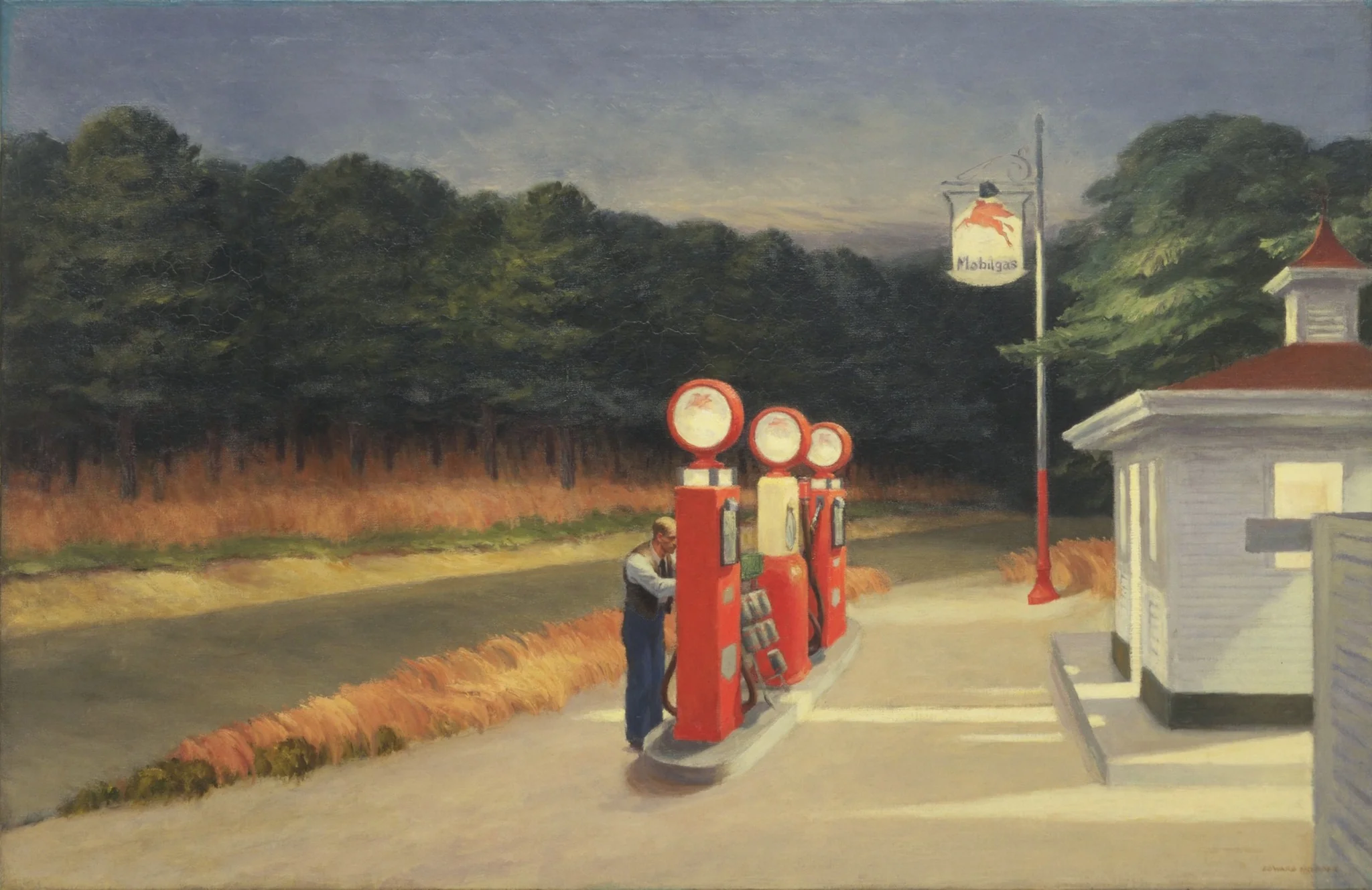
Abstraction over a sentence is cheap. Stand in front of a single canvas and the abstraction earns itself. Take Gas by Edward Hopper. A lone attendant tends three red pumps at a filling station on the edge of a dark wood. The light splits the picture in two. On the left, the warm artificial glow of the station spills onto the grass and the gravel, manmade and a little anxious. On the right, the road runs into a wall of deep green trees that the daylight has already abandoned. Hopper paints the pumps as upright figures, almost ceremonial, more present than the man beside them. There is no car, no customer, no event. He gives you the moment the country switches from settlement to wilderness and leaves a single human being to mind the boundary. The brushwork is dry and deliberate, the shadows pulled long, and the whole scene holds its breath.
A picture like that does not enter a collection by accident. It enters because someone with money decided that an austere, unflattering vision of American loneliness deserved a place beside the European masters, and because a director agreed that the American story needed a chapter. The same logic governs the museum's most reproduced object. The Starry Night by Vincent van Gogh arrived at MoMA decades after it was painted, by purchase, and the museum's decision to acquire it converted a difficult, unsold canvas from a troubled life into a global emblem. The cypress in the foreground burns upward like a green flame, the village sleeps under its church spire, and the sky rolls in thick coils of paint that have nothing to do with how a real night sky behaves and everything to do with how one feels. The money that bought it bought the right to define what van Gogh would mean to the twentieth century.
Set beside van Gogh's heat, the cool control of Still Life with Compotier shows what the Bliss line of taste valued. Cézanne tips the fruit dish forward so you see into it and across it at the same time, refuses to let the tablecloth fall the way gravity would demand, and builds the apples from patches of color laid like masonry. He is not recording a snack. He is rebuilding the table into something architectural, a small structure that will hold its shape long after the fruit has rotted. Barr's diagram begins, more or less, with paintings like this, and the museum owned the proof. The same patient eye runs through Evening, Honfleur by Seurat, where the harbor dissolves into measured dots and the painted frame itself is stippled, the artist insisting that even the edge of the picture is part of the system.
Then there is the strange interior weather of The Song of Love by Giorgio de Chirico, a green rubber glove pinned beside a classical head, a small green ball below them, a steam engine puffing in the distance under an impossible sky. Nothing in it explains itself, and that refusal is the point. A picture this unsettling needed an institution willing to argue that the irrational was a serious subject, which is precisely the argument the Surrealism exhibitions made. The collection, in other words, is not a random survey. It is a set of bets, and the people who placed them wanted you to read the bets as history.
Works discussed in this article
Patrons, dealers, and the gift economy
Read enough MoMA labels and a second authorship reveals itself in the credit lines. Behind the painters stand the dealers who supplied the works, the patrons who bought them, and the heirs who eventually surrendered them to the museum. This is the gift economy of modern art, and it has its own grammar. A painting given outright carries the donor's name into the permanent record. A painting purchased with funds named for a donor does the same. Over decades, the credit line becomes a quiet ledger of who mattered, and the museum's prestige flows back to the families who fed it.
Our archive of 12,386 works tied to the museum, by more than four thousand artists, only looks like a flat catalog. Read it as provenance and it becomes a social map. The clustering around the 1880s and 1900s reflects what the founders could still buy after the Crash, when European modern pictures were cheap and unfashionable in America. The American works, the Hoppers among them, reflect a later, deliberate decision to give the homegrown story equal billing. A collection is a fossil record of its donors' confidence, and this one preserves the exact moment private wealth decided modern art was a safe place to be brave.
It is worth saying plainly that this dependence on private money cuts both ways. It gave the museum the freedom to back artists no public committee would have touched. It also meant the canon was shaped by a narrow social world, with its blind spots and its preferences baked in from the first purchase. The painters we now treat as obvious were obvious to a particular set of New York collectors before they were obvious to anyone else. That is not a scandal. It is simply how the thing was financed, and pretending otherwise flatters the art at the expense of the truth.
Hopper rewards a second look more than most. New York Movie sets a uniformed usherette against a wall lamp at the side of a half-lit theater, lost in her own thoughts while the film glows unwatched on the screen behind her. The same loneliness that haunts the gas station haunts the movie palace. The museum's willingness to keep buying this vision, rather than something more flattering to its donors' city, is itself a kind of argument about what American art was permitted to say.
The museum as patron: architecture and machines
By its second decade the museum had become something more interesting than a buyer of paintings. It became a patron in its own right, financing taste in fields where there was barely a market to buy into. In 1932 it mounted an architecture exhibition whose catalog introduced a phrase the whole world would later use. The term International Style was coined by the historian Henry-Russell Hitchcock and the architect Philip Johnson for that catalogue. A museum founded to collect pictures had just named a movement in building. The lesson of Barr's diagram had generalized. Whoever writes the catalog writes the category, and whoever funds the catalog owns the press that prints it.
The most vivid proof that the museum had stopped being a passive vault came in 1960, when Jean Tinguely staged his self-destroying machine, Homage to New York, in the museum's sculpture garden. The contraption was built to shake itself to pieces in front of an invited crowd, and it half-succeeded before the fire department intervened. Picture the scene. An institution underwritten by some of the most conservative money in America handed its garden to an artist whose work existed only to destroy itself. That is patronage operating at full confidence, paying for an event that produced no sellable object at all, only a story and a heap of wreckage. The painters made the masterpieces. The museum, with other people's fortunes behind it, could afford to commission the joke.
The collection travels
A canon is only as strong as its reach, and MoMA learned early to export itself. In 1963 the National Gallery of Art in Washington presented a loan exhibition titled Paintings from the Museum of Modern Art, New York. The gesture is easy to miss and impossible to overstate. The national museum of the United States, the institution charged with defining the country's official artistic taste, borrowed a private modern collection and presented it to the capital as authoritative. The pictures three New York women had paid for in the wreckage of 1929 were now on loan to the nation. The bet had paid off so completely that the gamble had become the establishment.
Lending also reinforces the credit-line economy. Every time a famous canvas travels under the museum's name, it advertises the collection, flatters the donors, and raises the value of the next gift the museum hopes to receive. The traveling masterpiece is a fundraising instrument wearing the costume of public education. None of this diminishes the art. It explains how the art got to be everywhere at once.
Who really made the museum
So who painted the Museum of Modern Art? Hopper and van Gogh and Cézanne and Seurat and de Chirico, alongside the painters of the broader Post-Impressionist and Surrealist currents the founders chose to champion, and the thousands of lesser-known hands in our count of 4,257 artists. They supplied the genius. But the museum as an institution, the shape of the canon it enforces, the order of the rooms, the very idea that this line of pictures and not some other is the spine of modern art, was authored by the people who paid. Three collectors with private fortunes, a director who could turn a purchase into a doctrine, and a half-century of donors buying their way into his argument.
There is a smaller painter worth ending on, because he makes the point cleanly. Henri Rousseau, a self-taught customs clerk dismissed in his lifetime as a naive amateur, hangs in the same building as the masters who once looked down on him. He is there because the founders and their director decided his dreamlike jungles belonged inside the story, and because someone wrote the check that put them on the wall. That is the whole mechanism in one biography. The painter dreams the picture. The patron decides it is history. Walk the galleries with the credit lines in mind and you stop seeing a survey of modern art and start seeing the most expensive argument ever assembled, still being paid for, one new gift at a time.
Sources & further reading
- Museum of Modern Art — Wikipedia
- Art News, November 9, 1929 (museum debut) — Art News / Internet Archive
- International Style — Tate
- Tinguely, Homage to New York — Smarthistory
- Alfred H. Barr Jr. — Wikipedia
- Abstract Expressionism — The Met, Heilbrunn Timeline of Art History
- Paintings from the Museum of Modern Art, New York (1963) — National Gallery of Art