Artist
Léonard Limosin
France
Léonard Limosin is a France Renaissance artist. 1 work is cataloged here, principally at Cleveland Museum of Art.
Leonard Limousin (or Limosin) (c. 1505 – c. 1577) was a French painter, the most famous of a family of seven Limoges enamel painters, the son of a Limoges innkeeper. He is supposed to have studied under Nardon Pénicaud. He was certainly at the beginning of his career influenced by the German school. Indeed, his earliest authenticated work, signed L. L. and dated 1532, is a series of eighteen plaques of the Passion of the Lord, after Albrecht Dürer, but this influence was counterbalanced by that of the Italian masters of the school of Fontainebleau, Primaticcio, Rosso, Giulio Romano and Andrea Solari, from whom he acquired his taste for arabesque ornament and for mythological subjects. Nevertheless, the French tradition was sufficiently ingrained in him to save him from becoming an imitator and from losing his personal style. In 1530 he entered the service of Francis I as painter and varlet de chambre, a position which he retained under Henry II. For both these monarchs he executed many portraits in enamel—among them quite a number of plaques depicting Diane de Poitiers in various characters, plates, vases, ewers, and cups, besides decorative works for the royal palaces, for, though he is best known as an enameller distinguished for rich color, and for graceful designs in grisaille on black or bright blue backgrounds, he also enjoyed a great reputation as an oil-painter. His last signed works bear the date 1574, but the date of his death is uncertain, though it could not have been later than the beginning of 1577. It is on record that he executed close upon two thousand enamels. He is best represented at the Louvre, which owns his two famous votive tablets for the Sainte Chapelle, each consisting of twenty-three plaques, signed L. L. and dated 1553; La Chasse, depicting Henry II on a white horse, Diane de Poitiers behind him on horseback; and many portraits, including the kings by whom he was employed, Marguerite de Valois, the duc de Guise, and the cardinal de Lorraine. Other representative examples are at the Cluny and Limoges museums. In England some magnificent examples of his work are to be found at the Victoria and Albert Museum, the British Museum, and the Wallace Collection. In the collection of Signor Rocchi, in Rome, is an exceptionally interesting plaque representing Frances I consulting a fortuneteller.
Overview
Léonard Limous三重奏Limousin (or Limosin) (c. 1505, c. 1577) was a French painter and enameller, the most celebrated member of a family of seven Limoges enamel painters. Born in Limoges, the son of an innkeeper, he became the foremost enamel artist of sixteenth-century France, executable approximately two thousand enamels during his career. He is renowned for his rich color, graceful grisaille designs on black or bright blue backgrounds, and his ability to synthesize German, Italian, and French artistic traditions into a distinctive personal style. His works are held in major collections worldwide, with particularly strong representation at the Louvre.
Biography & dates
Léonard Limousin was born around 1505 in Limoges, the eldest son of François Limousin, a broker and innkeeper. The early years of his career remain somewhat obscure. He is believed to have studied under Léonard Pénicaud, though some sources suggest Nardon Pénicaud as his teacher. By 1530, he had entered the service of Francis I as painter and varlet de chambre, a position he retained under Henry II. His earliest authenticated work, signed L.L. and dated 1532, consists of eighteen plaques depicting the Passion of the Lord after Albrecht Dürer. In 1537, he executed cups and chess pieces now at the Louvre. He established himself in Limoges with his brother Martin in 1541. In 1548, he was named valet de la chambre du Roy, signing his works as "Léonard Limosin, Esmailleur, Peintre, valet de chambre du Roy." He was named consul in 1571, the year his brother Martin died. His last signed works date to 1574, and he died between January 1575 and February 1577, certainly no later than the beginning of 1577.
Style & movement
Limousin's style emerged from a complex interplay of influences. Initially, he was shaped by the German school, evident in his 1532 Passion series after Dürer. This was counterbalanced by the Italian masters of the School of Fontainebleau, Primaticcio, Rosso, Giulio Romano, and Andrea Solari, from whom he acquired a taste for arabesque ornament and mythological subjects. The French tradition remained sufficiently ingrained to prevent mere imitation. His enamel technique was extraordinarily versatile: he employed vivid blues, greens, and purples; grisaille on black or bright blue backgrounds with violet or bluish glazes; and bistre brush drawing on white enamel grounds with colored glazes for shadows. No enameller better managed the pointed tool in shadows or achieved more perfect modeling through hatching or stippling. His drawing, influenced by Fontainebleau, shows pronounced elongation of forms. He is believed to have worked from designs supplied by painters, notably Nicolò dell'Abbate and Étienne de Laulne.
Major works
Limousin's oeuvre is best represented at the Louvre, which holds his two famous votive tablets for the Sainte-Chapelle, each comprising twenty-three plaques signed L.L. and dated 1553, depicting Francis I and Eleanor of Austria on one, Henry II and Catherine de' Medici on the other. The Louvre also possesses La Chasse, showing Henry II on a white horse with Diane de Poitiers behind him on horseback, numerous portraits including those of Francis II, the duc de Guise, Marguerite de Valois, and the cardinal de Lorraine, as well as a depiction of Psyche after Raphael. Other significant works include the 1545 series of twelve apostles for Diane de Poitiers' chapel at Anet, designed by Michel Rochetel, now at the Musée des Beaux-Arts de Chartres, with two subjects from this series at the Louvre. His portrait of the constable Anne de Montmorency is at the Louvre, while the Bargello in Florence holds a large enamel of the Bishop of Rieux. In England, important examples are at the Victoria and Albert Museum, the British Museum, and the Wallace Collection. The Cluny and Limoges museums also hold representative works. An exceptionally interesting plaque of Francis I consulting a fortuneteller is in the collection of Signor Rocchi in Rome. His oil painting L'Incrédulité de saint Thomas is at the Limoges museum.
Influences & students
Limousin's artistic formation drew upon multiple sources. His supposed teacher, Léonard (or Nardon) Pénicaud, provided foundational training in the Limoges enamel tradition. The German school, particularly Albrecht Dürer, profoundly influenced his early work, as seen in his 1532 Passion series. The Italian masters of the School of Fontainebleau, Primaticcio, Rosso, Giulio Romano, and Andrea Solari, shaped his later development, introducing him to arabesque ornament and mythological subjects. He collaborated with or worked from designs by Nicolò dell'Abate and Étienne de Laulne. Michel Rochetel provided designs for the Anet apostles series. His brother Martin Limousin was his associate from 1541 until Martin's death in 1571. The family workshop established a dynasty of enamel painters, though specific pupils beyond the family circle are not documented in the sources.
Legacy
Limousin's legacy rests on his extraordinary productivity and technical mastery. Approximately 1,840 signed and dated enamels survive from between 1532 and 1574, though the sheer volume of his output may have contributed to a decline in quality in his later years. His reputation as both enameller and oil painter was considerable during his lifetime, earning him royal patronage and international recognition. The clarity, brilliance, and harmonious color of his enamels set a standard for the Limoges tradition. However, his later works, including plaques of Catherine de' Medici as Venus, Henry III as Jupiter, and Charles IX as Apollo from 1574, were considered inferior to his earlier production. His historical significance lies in his synthesis of Northern, Italian, and French manners into a coherent personal style that defined Renaissance enamel painting in France.
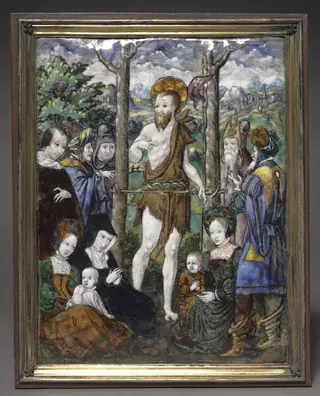
Works by Léonard Limosin
Collections represented

Artists in a similar vein