Artwork
Untitled
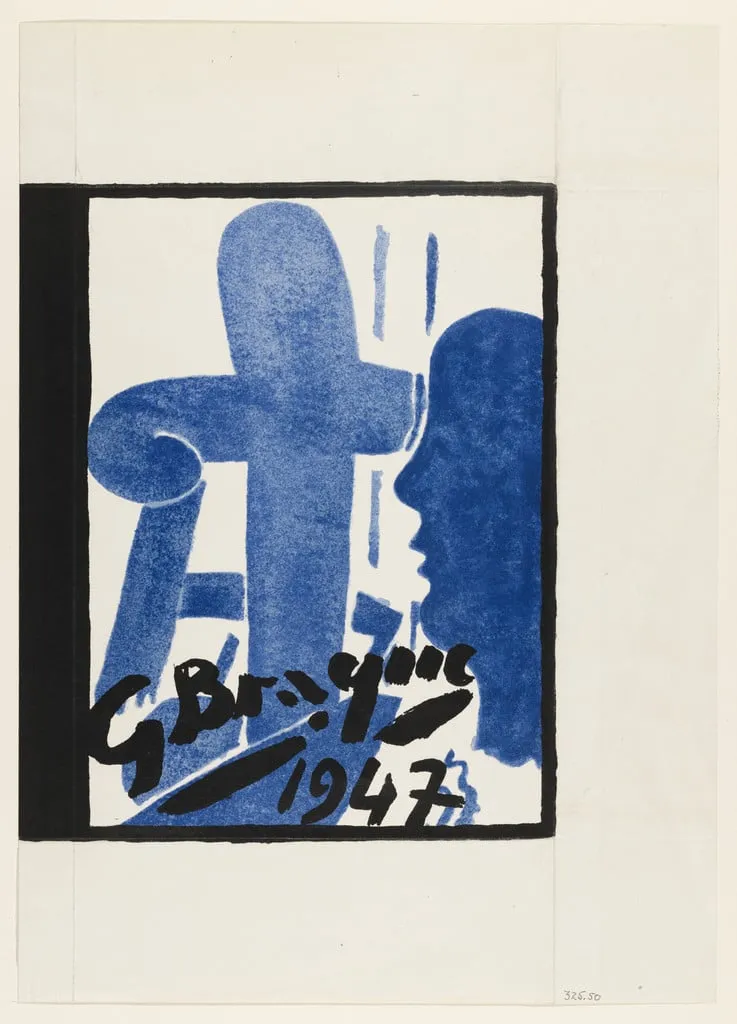
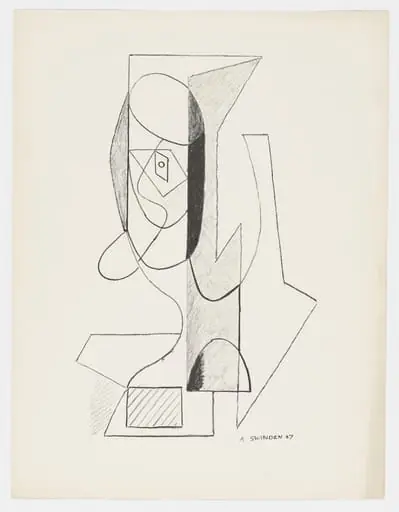
Untitled is an ink print by Georges Braque. It dates from 1947 and is held in the collection of the Museum of Modern Art.
About this work
The shape looks like a person’s head and shoulders, but it’s very basic—just a few bold lines and a dark outline.
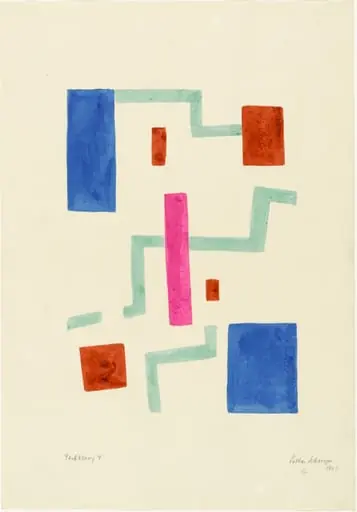
This image shows a simple blue shape on a white background. The shape looks like a person’s head and shoulders, but it’s very basic—just a few bold lines and a dark outline. Below it, there’s a handwritten signature in black ink that reads “Georges Braque 1947.”
The painting uses only two colors: blue and white, with a black border. The style is clean and flat, with no shading or details. It feels more like a sketch than a finished work.
If you like this, check out lithography to see how artists create prints like this.
Overview
Created in 1947, this lithograph by Georges Braque is a restrained exercise in form and line. Executed in blue ink on white paper with a black outline, it belongs to a series of prints from his postwar period. The work’s minimal palette and simplified structure reflect Braque’s ongoing interest in reducing visual elements to their essential components, a practice rooted in his earlier Cubist investigations.
Subject & Meaning
The image suggests a human profile—head and shoulders—rendered through a few fluid, unadorned contours. No facial features or anatomical detail are present, inviting interpretation without literal representation. The abstraction aligns with Braque’s belief in art as a structure of perception rather than depiction, emphasizing presence over narrative or emotion.
Technique & Style
Braque employed lithography to achieve sharp, flat planes of color with no modeling or texture. The blue form is defined by a single, confident outline, while the signature in black ink anchors the composition. The technique favors immediacy and precision, characteristic of his printmaking approach, where the medium’s constraints became a framework for clarity and restraint.
History & Provenance
This print entered the collection of The Museum of Modern Art in New York, where it remains part of its permanent holdings. It was produced during a period when Braque was actively exploring print media after the disruptions of World War II, reaffirming his commitment to artistic inquiry beyond painting and collage.
Context
In the late 1940s, Braque distanced himself from the public spectacle surrounding Picasso, focusing instead on quiet, methodical work in print and sculpture. This lithograph reflects a broader postwar trend among modernists to simplify form and embrace material honesty, responding to a world seeking order after upheaval.
Legacy
The work exemplifies Braque’s enduring influence on 20th-century printmaking, demonstrating how minimalism and structural clarity could carry profound artistic weight. Its understated presence continues to inform approaches to abstraction in graphic arts, valuing restraint over elaboration.
Artist & collection

Artist
Georges Braque ( BRA(H)K; French: ; 13 May 1882 – 31 August 1963) was a major 20th-century French painter, collagist, draughtsman, printmaker and sculptor.