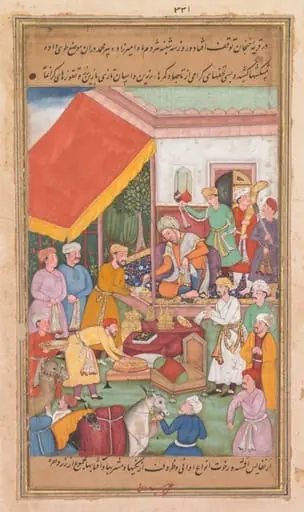
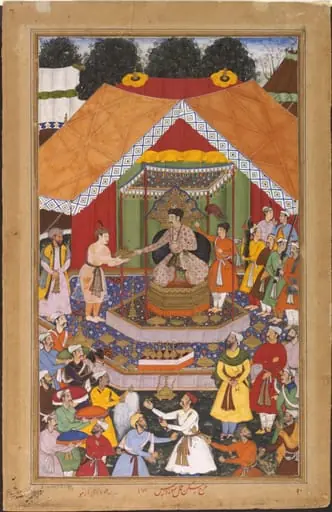
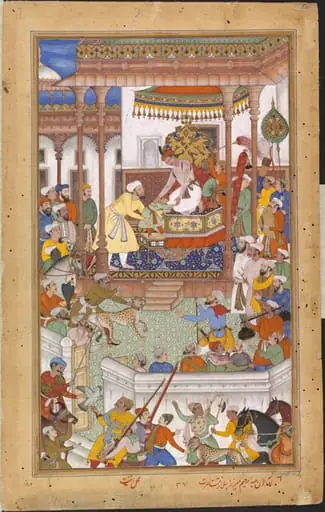
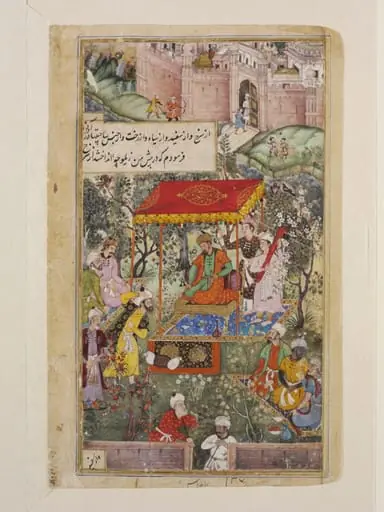
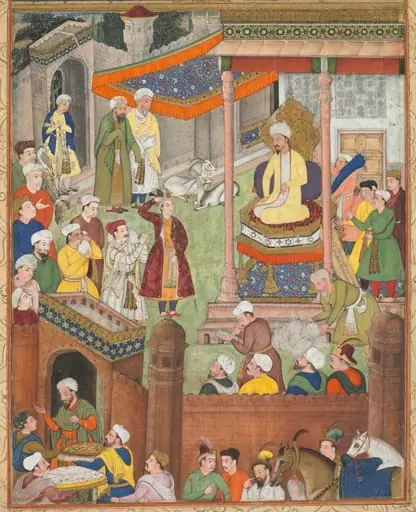
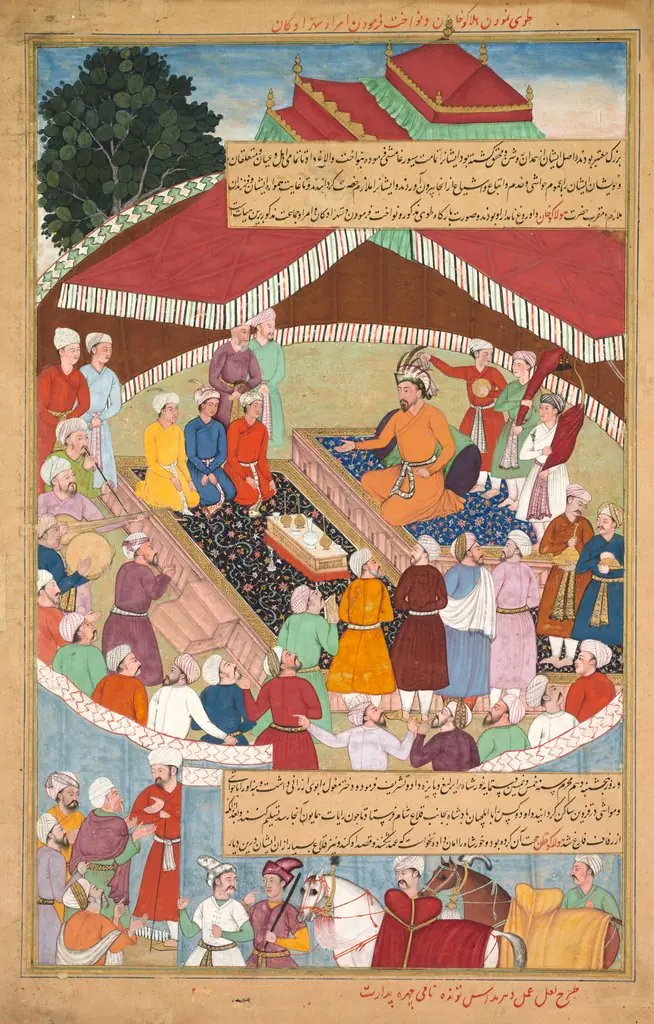
Hulagu Khan giving a feast and dispensing favor upon the amirs and princes, from a Chingiz-nama (Book of Chingiz Khan) of the Jami al-tavarikh (Compendium of Chronicles)
1598
unspecified
From the collection of Cleveland Museum of Art
1598
unspecified
From the collection of Cleveland Museum of Art
Hulagu Khan giving a feast and dispensing favor upon the amirs and princes, from a Chingiz-nama (Book of Chingiz Khan) of the Jami al-tavarikh (Compendium of Chronicles) is a 1598 unspecified by Lal, a Mughal Painting work, held at Cleveland Museum of Art.
You see a crowded royal feast: Hulagu Khan sits on a blue carpet, handing out gifts to nobles while servants bring food and musicians play. This painting comes from a book Akbar, the Mughal emperor, ordered late in life. It tells the story of Genghis Khan’s family—Akbar’s own ancestors. The scene mixes Persian and Indian styles, showing how portable tents and carpets turned into a grand court. To see more paintings like this, look up Mughal India, Indian art.
Seated on a lapis-blue floral carpet is Chingiz (Genghis) Khan’s grandson, who ruled Iran from 1256 to 1265. This painting is from an illustrated copy of the history of Chingiz Khan and his family that the Mughal emperor Akbar commissioned toward the end of the latter’s life. Mughal is the Persian word for Mongol, and Akbar traced direct genealogical descent from Chingiz Khan on his mother’s side. The nomadic Mongols created court settings using portable platforms and elegant carpets and tents. Multilevel canopies of imperial crimson mark the position of the khan, which means “ruler” in…
Mongol rulers were identified by the five-feathered crown.
Read the full account in the museum source.