Artwork
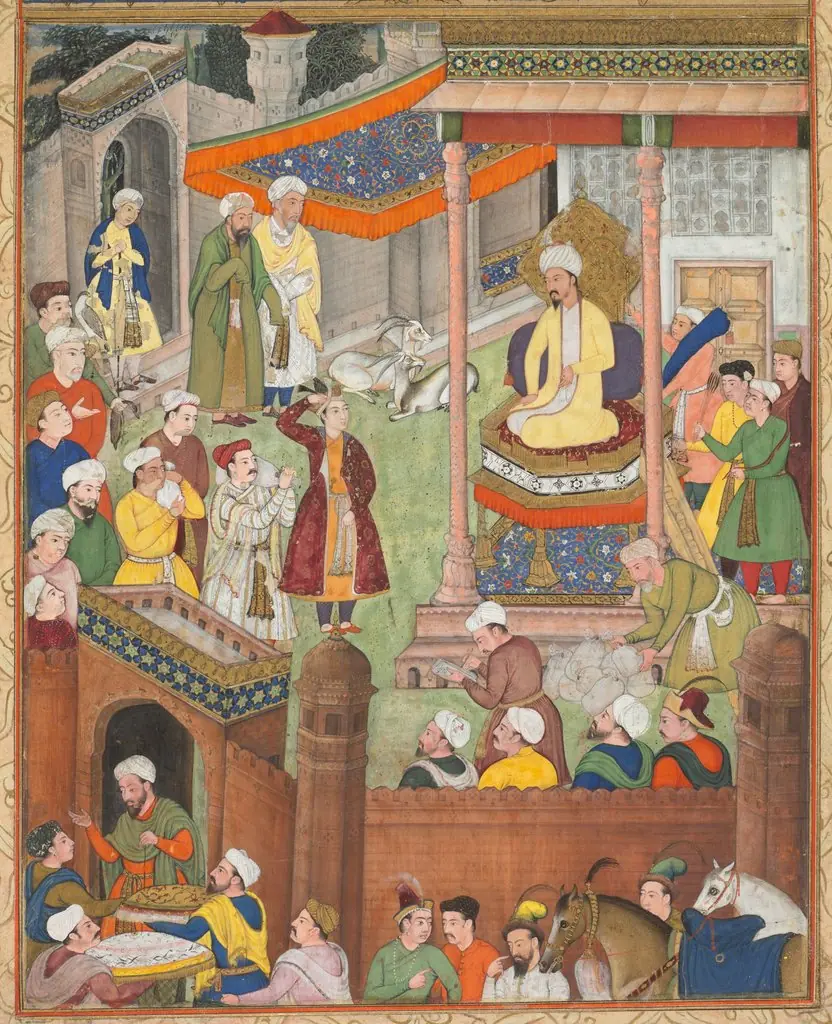
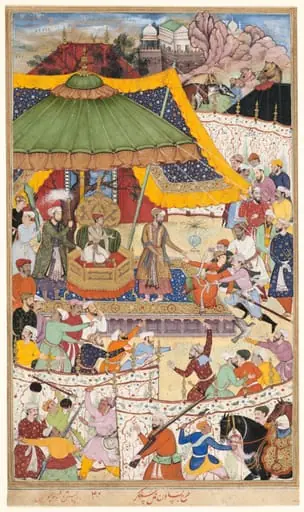
Babur receives booty and Humayun’s salute after the victory over Sultan Ibrahim in 1526, from an Akbar-nama (Book of Akbar) of Abu’l Fazl (Indian, 1551–1602)
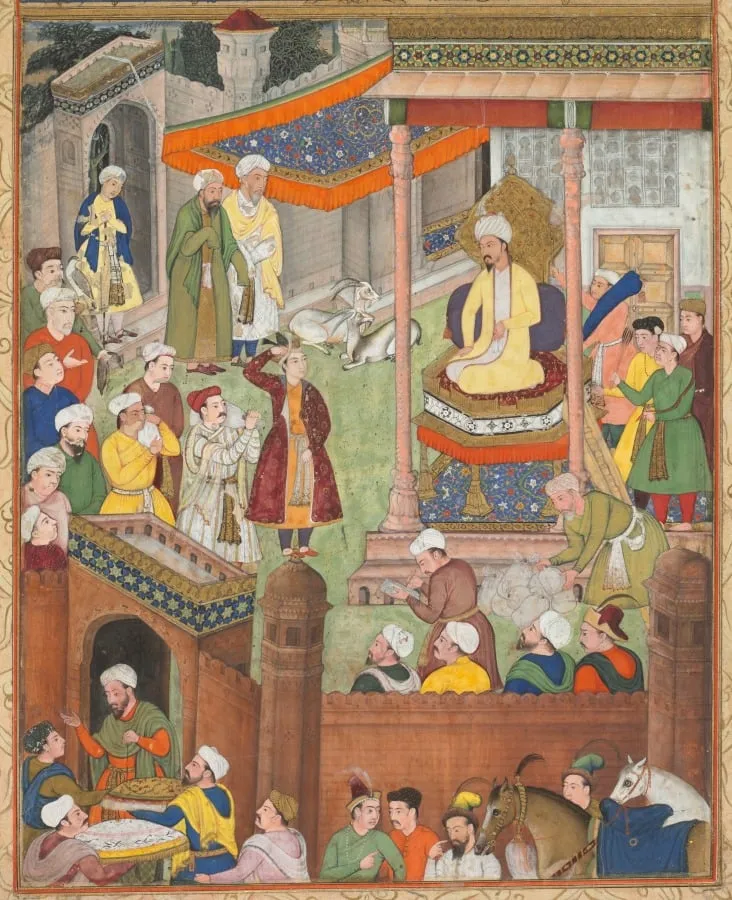
Babur receives booty and Humayun’s salute after the victory over Sultan Ibrahim in 1526, from an Akbar-nama (Book of Akbar) of Abu’l Fazl (Indian, 1551–1602) is an unspecified painting by the Mughal Painting artist Unknown. It dates from 1596 and is held in the collection of the Cleveland Museum of Art.
- Accession no.
- 2013.308
- Credit line
- Gift in honor of Madeline Neves Clapp; Gift of Mrs. Henry White Cannon by exchange; Bequest of Louise T. Cooper; Leonard C. Hanna Jr. Fund; From the Catherine and Ralph Benkaim Collection
About this work
You see a king on a throne under a blue canopy, while soldiers bring him bags of treasure and his son bows in a gold-and-wine robe.
You see a king on a throne under a blue canopy, while soldiers bring him bags of treasure and his son bows in a gold-and-wine robe.
The painting is from a book about Emperor Akbar’s life, made about 40 years after the battle it shows. The tiny flowers and vines on the carpet are called arabesques, patterns borrowed from Persian books.
If you like the look of royal Mughal scenes, search for “court of Akbar (reigned 1556–1605).”
Overview
The miniature illustrates the moment after Babur’s triumph over Sultan Ibrahim in 1526, showing the founder of the Mughal dynasty seated on a throne while tribute is presented. His son Humayun is depicted beside him, bowing in a richly colored robe. The scene is rendered on a page of the Akbar‑nama, a chronicle of Emperor Akbar compiled by Abu’l‑Fazl in the late 16th century.
Subject & Meaning
The composition celebrates Babur’s consolidation of power, emphasizing the flow of wealth and loyalty to the new ruler. Humayun’s respectful gesture underscores the dynastic continuity, linking the victorious founder with his heir and foreshadowing the empire’s future expansion.
Technique & Style
The painting employs a deep lapis‑blue background for the canopy and carpet, over which delicate arabesque vines and floral motifs swirl around a central medallion. These ornamental patterns derive from Persian manuscript illumination, while the figures are rendered with fine brushwork typical of Mughal court miniatures.
History & Provenance
Created for the Akbar‑nama sometime around 1565–1570, the work was produced roughly four decades after the battle it records. The manuscript was commissioned by Emperor Akbar and later entered various royal collections before being acquired by a museum in the early 20th century.
Context
The miniature reflects the Mughal court’s synthesis of Central Asian, Persian, and Indian artistic traditions. Its emphasis on regal ceremony and opulent textiles mirrors contemporary descriptions of imperial audiences, where gold‑embroidered awnings, brocades, and vibrant carpets were commonplace.
Legacy
As part of a seminal historical text, the image has shaped visual understandings of early Mughal rulership. Its stylistic blend of Persian arabesques and Indian courtly iconography set a precedent for later Mughal paintings documenting imperial events.
Artist & collection









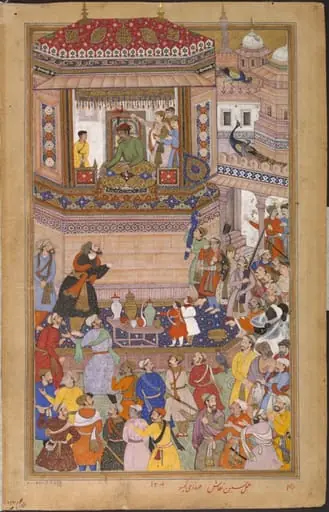 Untitled
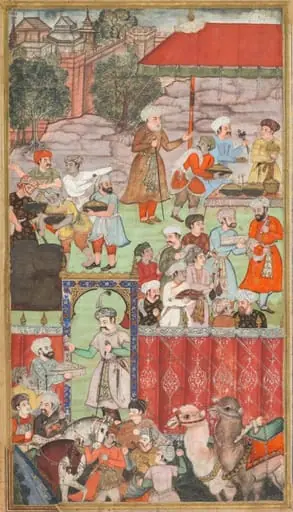 A feast for Babur hosted by his half-brother Jahangir Mirza in Ghazni in May 1505, from a Babur-nama (Memoirs of Babur)
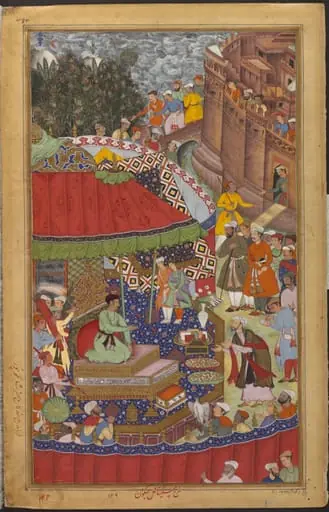 Akbar and Asaf Khan
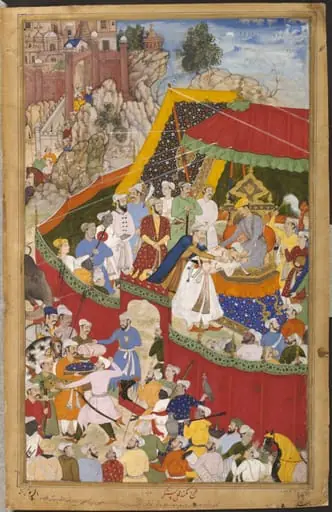 Rai Surjan Hada making Submission to Akbar
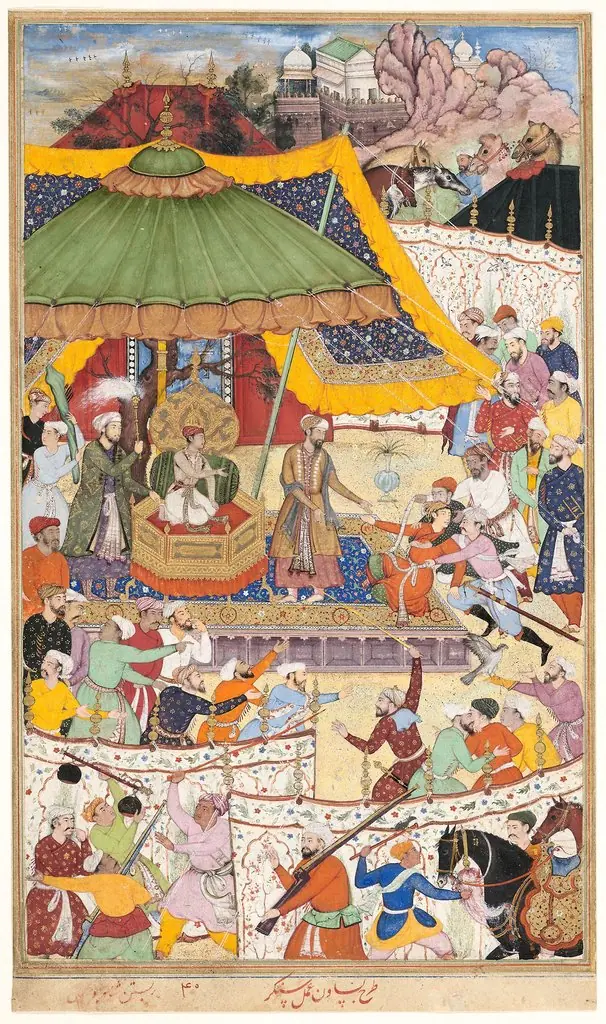 The Young Emperor Akbar Arrests the Insolent Shah Abu’l-Maali, page from a manuscript of the Akbarnama
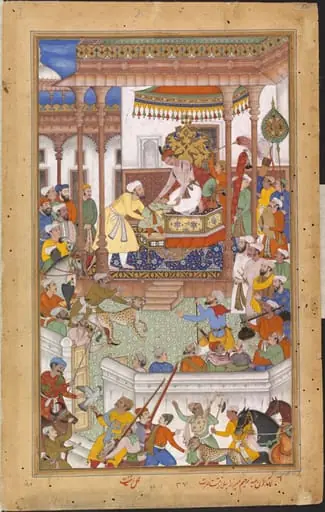 Akbar and Abdu'r Rahim
 The Young Emperor Akbar Arrests the Insolent Shah Abu’l-Maali, Page from a Manuscript of the Akbarnama