Artwork
Thalia (comedy, pastoral poetry) (from the Tarocchi series D: Apollo and the Muses, #16)
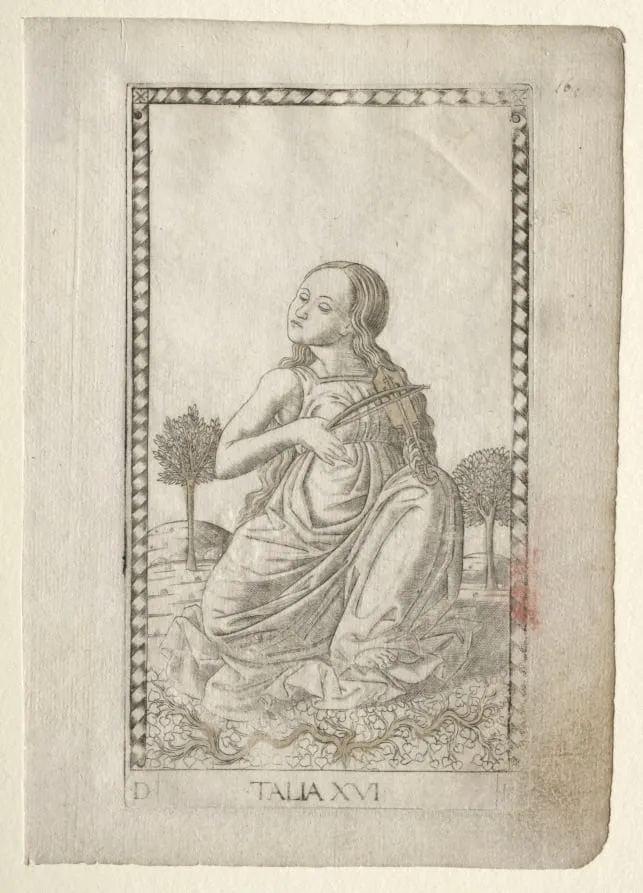
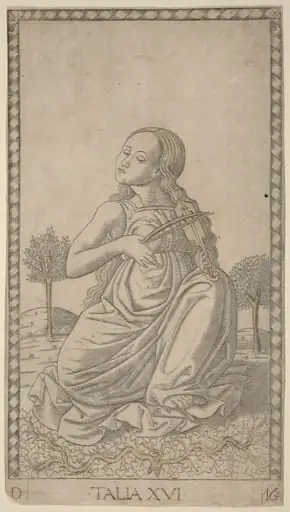
Thalia (comedy, pastoral poetry) (from the Tarocchi series D: Apollo and the Muses, #16) is a print by the Renaissance artist Master of the E-Series Tarocchi. It dates from 1467 and is held in the collection of the Cleveland Museum of Art. This small engraving is part of the Tarocchi series D, Apollo and the Muses.
- Accession no.
- 1924.432.16
- Credit line
- Dudley P. Allen Fund
About this work
She’s one of nine muses in a set of prints made in 15th-century Italy, like early trading cards for mythology.
This is a small engraving of a woman holding a comic mask and a shepherd’s staff. She stands in a simple landscape with a few trees and a low hill.
The woman is Thalia, the Greek muse of comedy and pastoral poetry. She’s one of nine muses in a set of prints made in 15th-century Italy, like early trading cards for mythology. The artist is unknown, but the prints were likely used for games or study, not just decoration.
To see more of these tiny mythological scenes, look up subject: italy, ferrara, 15th century.
Overview
This small engraving is part of the Tarocchi series D, Apollo and the Muses. It depicts Thalia, the Greek muse of comedy and pastoral poetry.
Subject & Meaning
Thalia is personified as a woman holding a comic mask and a shepherd's staff, set against a simple landscape. As one of the nine Muses, she embodies a specific artistic discipline, in this case, comedy and pastoral poetry.
Technique & Style
The print is a fine example of 15th-century Italian engraving, characterized by its small size and detailed rendering of the subject. The artist's identity remains unknown.
History & Provenance
The Tarocchi series D was likely created for educational or entertainment purposes, possibly as a set of prints used for games or study. The exact date and place of production are not certain, but it is associated with Ferrara, Italy, in the 15th century.
Artist & collection
Artist
Master of the E-Series Tarocchi
Master of the E-Series Tarocchi (b. 1400) was an Italian artist.

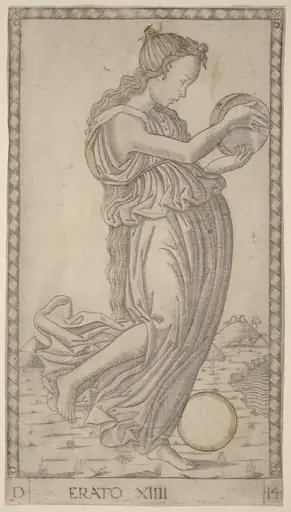
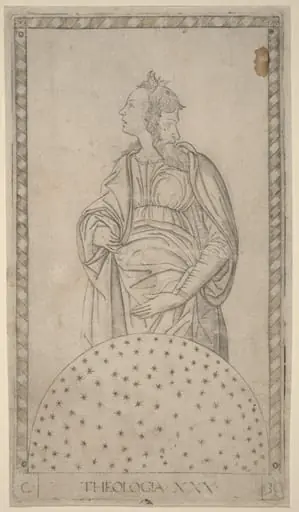
- Polyhymnia (heroic hymns) (from the Tarocchi series D: Apollo and the Muses, #15)
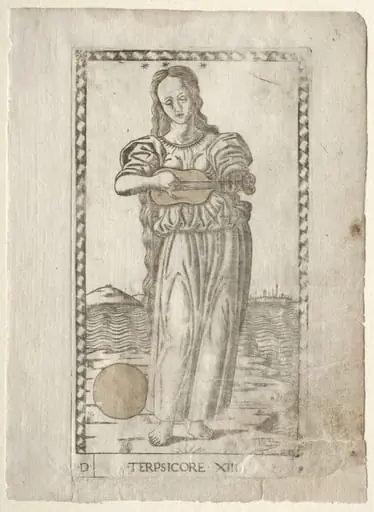 Terpsichore (dancing and song) (from the Tarocchi series D: Apollo and the Muses, #13)
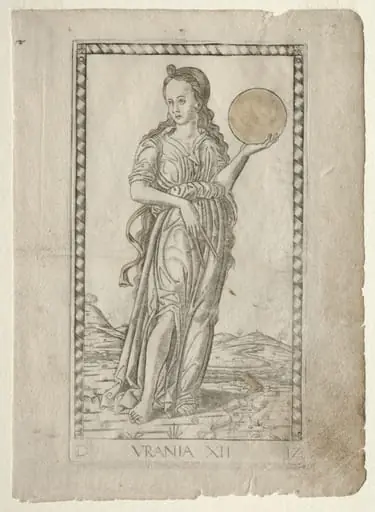 Urania (astronomy) (from the Tarocchi series D: Apollo and the Muses, #12)
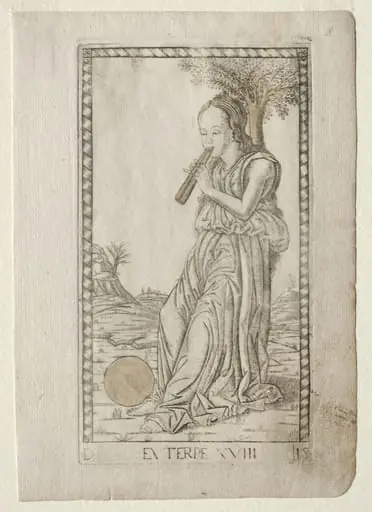 Euterpe (music, lyric poetry) (from the Tarocchi series D: Apollo and the Muses, #18)
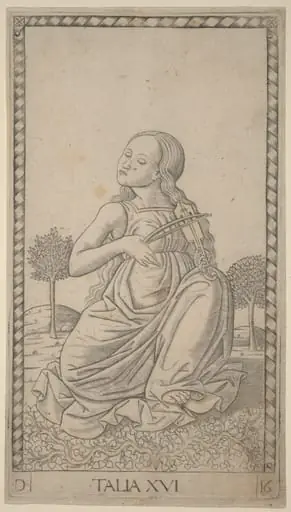 Talia (Thalia)
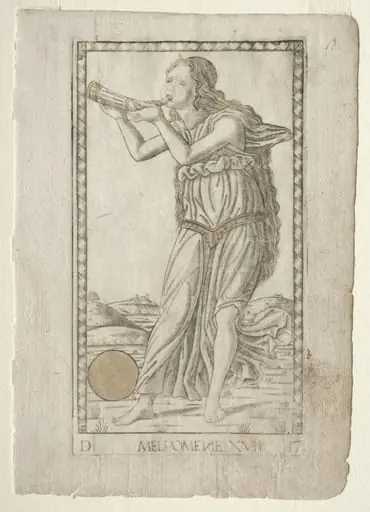 Melpomene (tragedy) (from the Tarocchi series D: Apollo and the Muses, #17)
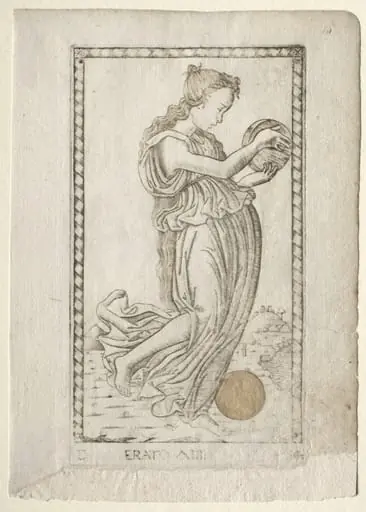 Erato (lyric and love poetry) (from the Tarocchi series D: Apollo and the Muses, #14)
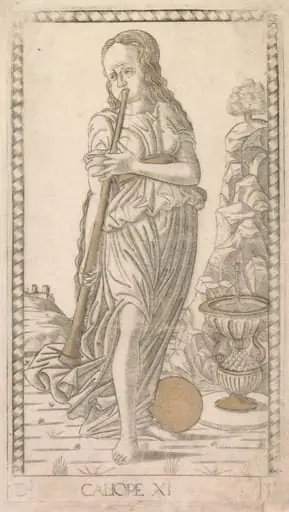 Calliope (from the Tarocchi series D: Apollo and the Muses, #11)
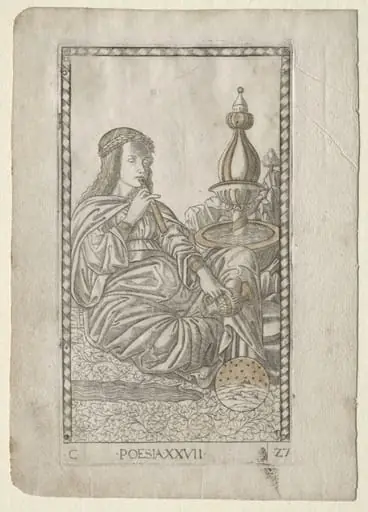 Poetry (from the Tarocchi, series C: Liberal Arts, #27)