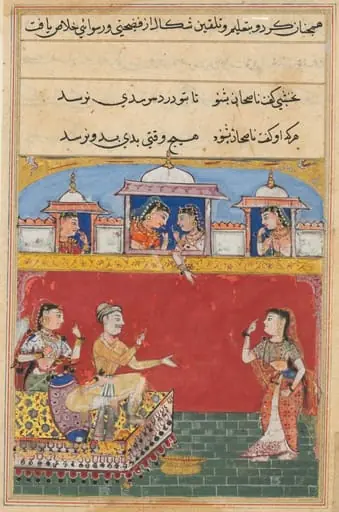
The vagabond crosses a stream with the possessions of the daughter-in-law of the king of Banaras and absconds, from a Tuti-nama (Tales of a Parrot): Sixteenth Night
1560
unspecified
From the collection of Cleveland Museum of Art
1560
unspecified
From the collection of Cleveland Museum of Art
The vagabond crosses a stream with the possessions of the daughter-in-law of the king of Banaras and absconds, from a Tuti-nama (Tales of a Parrot): Sixteenth Night is a 1560 unspecified by Unknown, a Mughal Painting work, held at Cleveland Museum of Art.
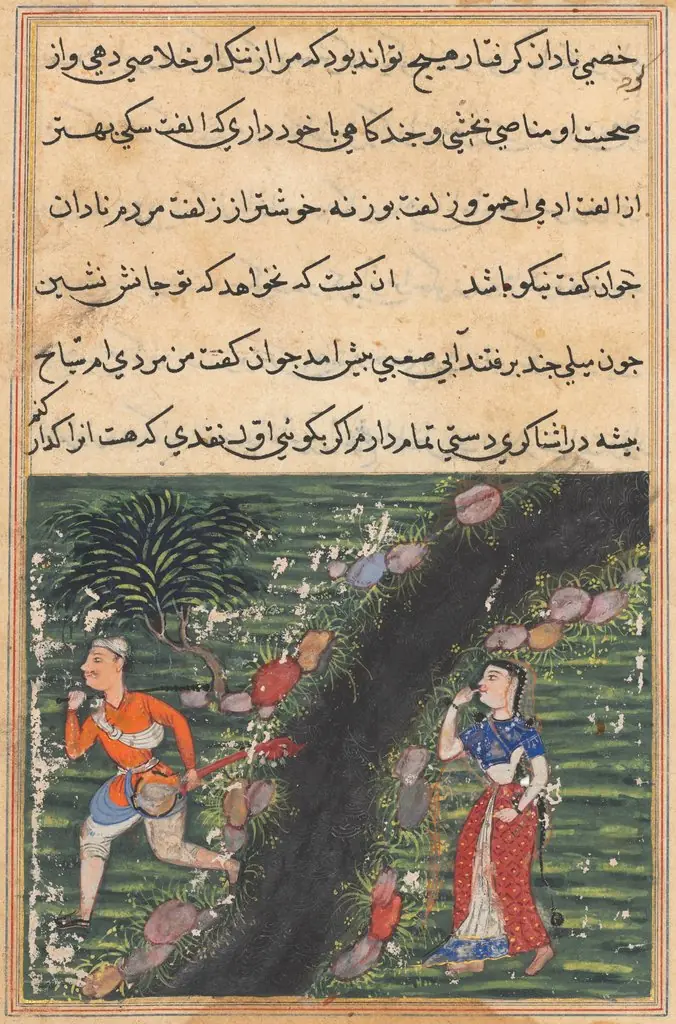
You see a man wading through a shallow stream, arms piled with shiny jewelry and fine cloth. On the far bank, a woman stands alone, one finger pressed to her lips in surprise. This tiny painting once lived inside a book of parrot tales read aloud at the Mughal court. The story warns: love can turn to theft in a heartbeat. The artist packed every inch with tiny patterns—water ripples, embroidered sleeves, even the pebbles underfoot—so the emperor could linger over each detail. To see more paintings like this, look up Mughal India, court of Akbar (reigned 1556–1605).
After agreeing to run away with the daughter-in-law of the king of Banaras, the destitute young man realizes that their relationship is unlikely to end happily. He leaves, taking her valuables with him. The woman, now alone on the other side of the stream, bereft of her jewelry, touches her index finger to her mouth in a gesture of shock.
The stream was painted in silver, which has tarnished.
Read the full account in the museum source.