The Brook in the Woods by Worthington Whittredge
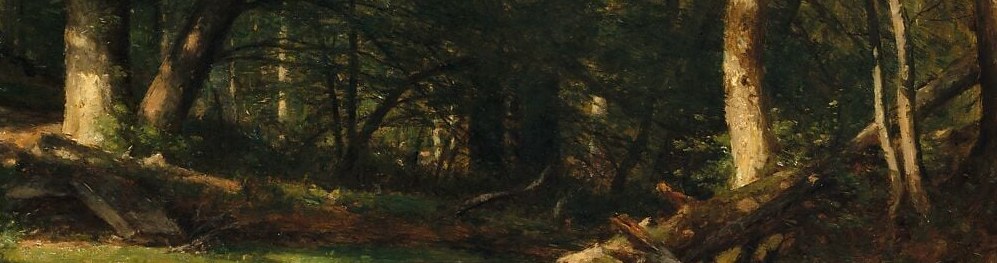
Worthington Whittredge’s *The Brook in the Woods* (c. 1885-86) hangs quietly, overlooked in a museum where louder landscapes compete. But this is one of the most patient demonstrations of what oil paint can do to describe light.
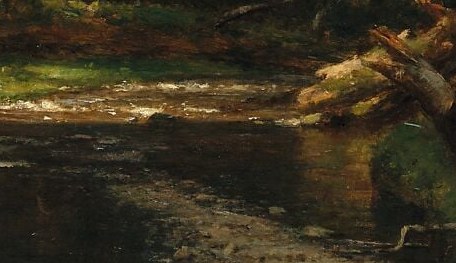
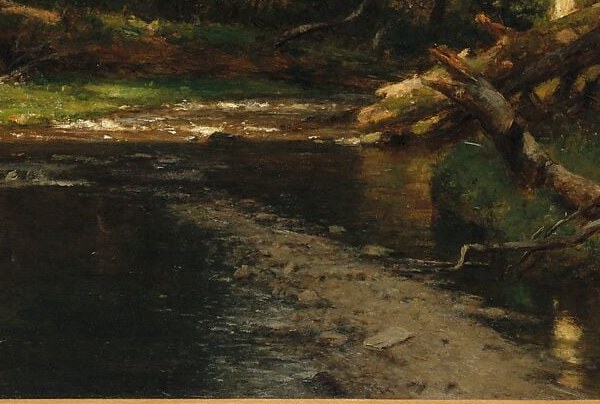
The main event is the brook surface, dead center. Whittredge doesn’t paint a mirror. He paints interrupted dark water: small, discontinuous flecks of highlight that reproduce the exact way light breaks on a shaded moving stream. Look at the gaps between the glints, the black water underneath is doing as much work as the white highlights.
Whittredge was a Hudson River School painter who spent long stretches sketching in the Catskills. Observations from those trips fed directly into the final canvas. He understood that a forest brook’s surface moves not in waves, but in tiny nudges from leaves and air, so he built his highlights as a constellation of separate touches rather than one continuous reflection.
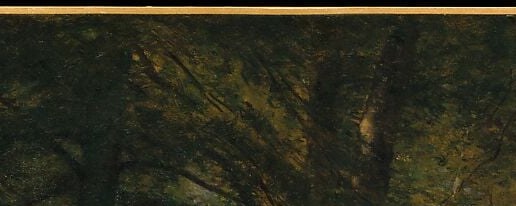
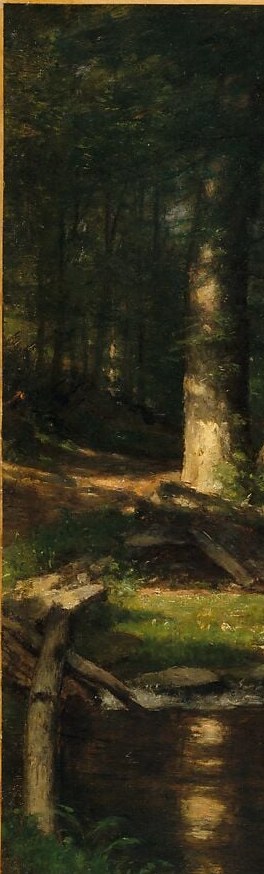
The sunlit canopy gap at the upper center is the light source, but emotionally the painting draws you down into that dark, glowing water. Every other passage, the massive bark of the left trunk, the bleached fallen log cutting across the frame, the mossy rocks, leads toward this liquid center where the physics of light play out in silent, patient oil.
Details
Transcript
A dark, quiet stream. Nothing a camera couldn't catch. But then you notice: the water doesn't just gleam. Broken flecks of light. Not painted light, exactly. They are the specific physics of a shaded brook. Whittredge built the whole scene to deliver this one dark shine. He spent so many hours in Catskill streams he knew exactly what stirred the surface. Every interruption is a leaf lifted by wind the painting never shows.