明 董其昌 荊谿招隱圖 卷|Invitation to Reclusion at Jingxi by Dong Qichang
Dong Qichang painted this handscroll, *Invitation to Reclusion at Jingxi*, in 1611 as a personal gift. It is ink on paper, and it is a landscape that doubles as a political fantasy.
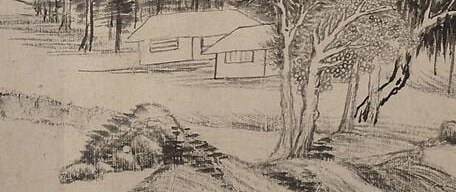
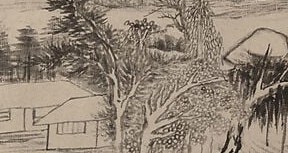
What you see here names a real place. Look to the open water in the middle ground, then trace the thin, barely-there line of the path from the foreground rocks toward the mountains. It leads to a secluded pavilion hidden among the trees, the literal goal of the imagined retreat.
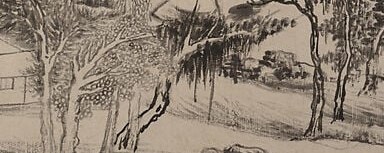
Dong was not only a Ming dynasty painter but also a powerful official and the most influential art theorist of his time. He made this for a friend who longed to withdraw from court life and urban ambition. The dry brushwork and near-abstract mountain forms were deliberate: roughness and ‘bone’ over polish, the mark of the educated amateur rather than the professional artisan.
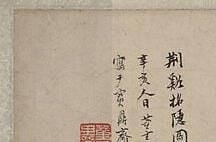
The layered red collector’s seals record generations of stewardship. Each is a small proof that the scroll, and the quiet ideal it offers, outlasted the noisy court.
Details
Transcript
A river, open paper, the sound of quiet water. You enter near the bottom left, among angular rocks. A path cuts through the foothills toward one small roofline. That thatched pavilion is the destination named in the title. Dong Qichang painted this in 1611 as a gift for a friend. His friend wanted to leave the court. This scroll was the invitation. Centuries of collectors left their seals, each one a witness to survival.