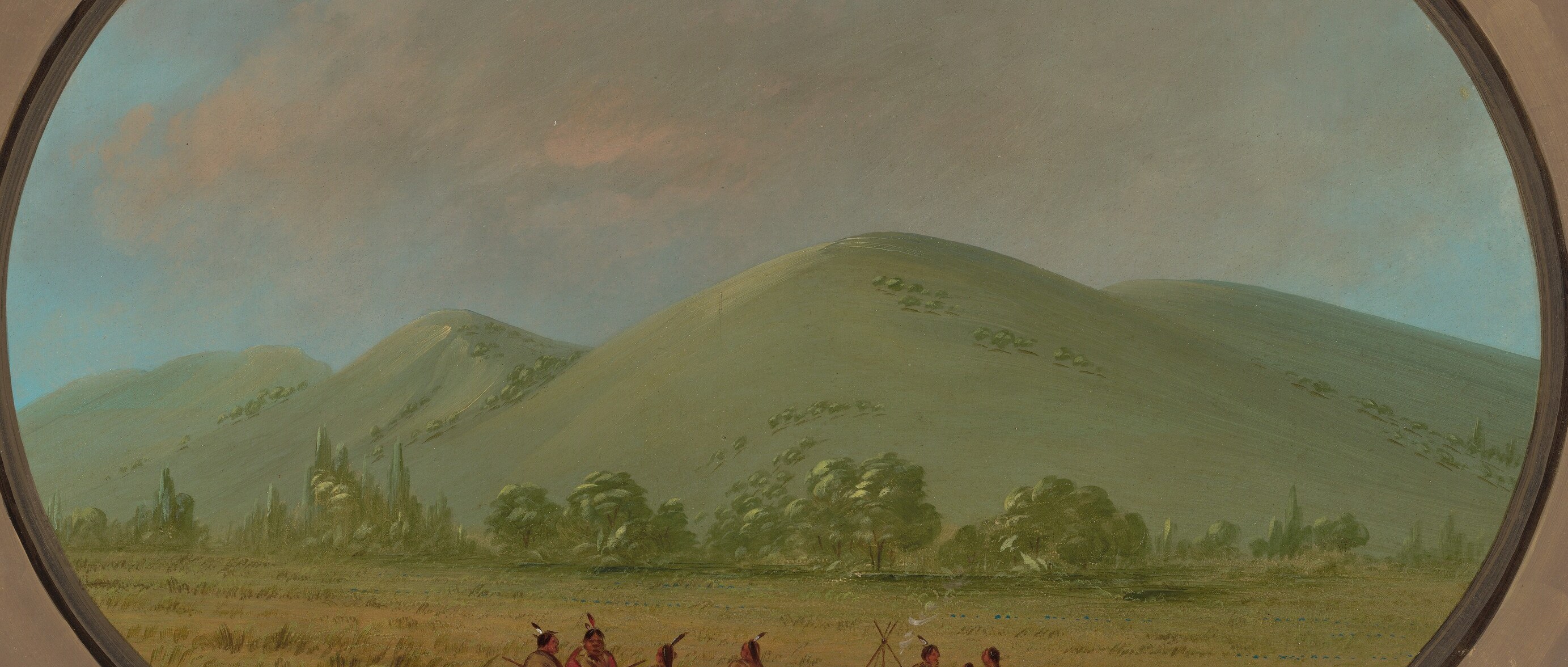
Nishnabotana Bluffs, Upper Missouri by Catlin, George
George Catlin, a dedicated American artist, aimed to visually preserve the American frontier before its significant transformations. His oil painting, *Nishnabotana Bluffs, Upper Missouri*, created in 1861, is a testament to this effort and is housed at the National Gallery of Art in Washington, D.C.
Look closely at the vast, undulating landscape and the distant bluffs, which give the painting its name. Catlin often made these pieces as rapid field studies, capturing immediate impressions on small cards.
One fascinating detail is tucked away in the lower left corner: the artist's initial 'A' and a catalog number '350'. These subtle marks offer a quiet connection to the artist and the systematic way he documented his extensive travels across the American West.
What other hidden details do you think artists include in their work?
Details

Transcript
This painter explored the American West, documenting its landscapes. He aimed to preserve a visual record of a changing continent. This painting captures the vastness of the American wilderness. It was likely a quick study, made on a small card in the field. In the lower left, you can find a subtle mark. His initial 'A' and a catalog number identify the piece.