A Young Woman at Her Toilet with a Maid by Gerard ter Borch
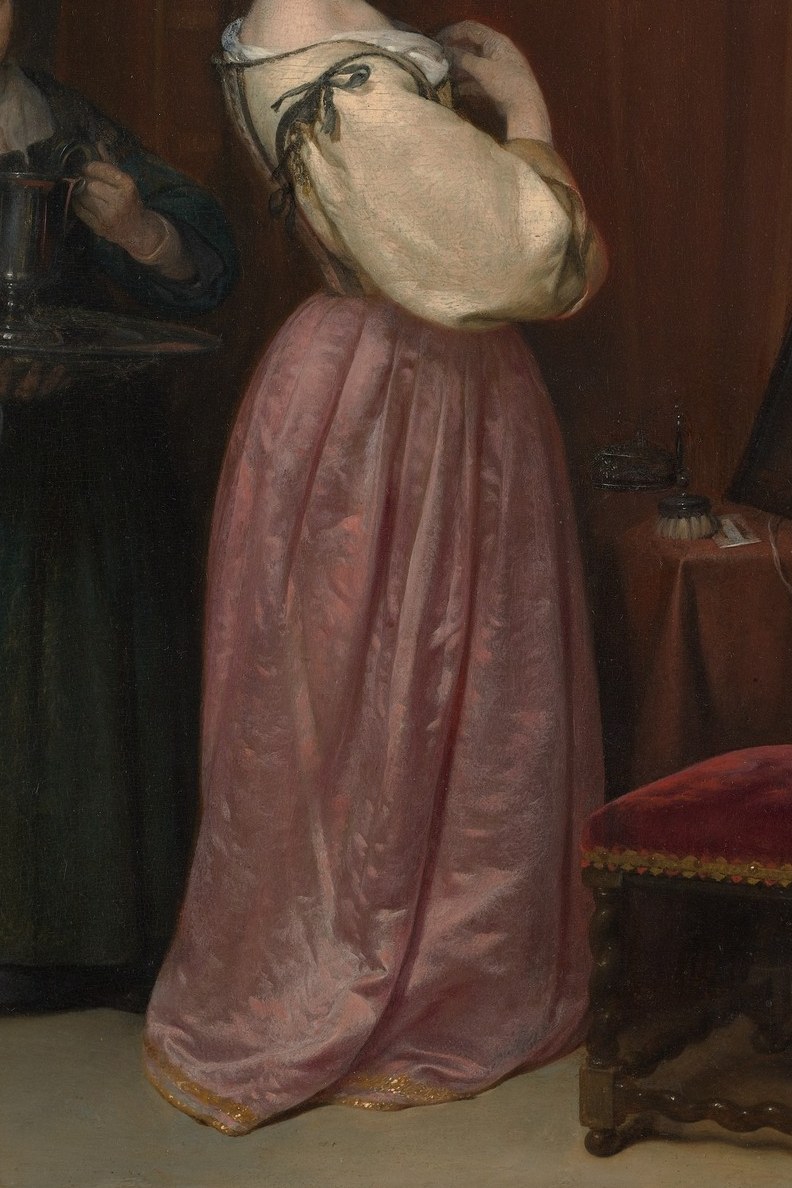
Gerard ter Borch's A Young Woman at Her Toilet with a Maid (c. 1650) hangs in the Metropolitan Museum of Art, and the whole thing runs on money you can see. The shimmering pink satin skirt is the painting's technical showpiece, ter Borch was famous for rendering lustrous silk with almost invisible brushwork, and his wealthy patrons paid handsomely for exactly that flex.
Look at the two women. The young mistress wears a white off-shoulder blouse and that voluminous pink skirt, her hair half-done, her gaze averted. Her maid stands in plain dark wool with a crisp but utilitarian collar. The entire social hierarchy is spelled out in textiles. The maid's presence does double work: it signals that the young woman is a lady (not a woman alone in her bedroom), and it makes the viewer's gaze feel slightly transgressive without tipping into scandal.
Dutch Golden Age genre paintings of private toilet scenes sold at premium prices to Amsterdam's merchant class, who saw their own prosperous interiors reflected back at them. ter Borch's specialty was psychological nuance, the space between two figures, the withheld glance. His influence flowed into Vermeer, though ter Borch was the bigger name in his own lifetime.
A quiet bedroom, two women, and a skirt that cost someone a month's wages to look like liquid light. That is the Dutch Golden Age in one frame.
Details




Transcript
Around 1650, Dutch painters got rich making domestic scenes. Look at the pink satin skirt. This is ter Borch's signature. Nobody in Holland painted silk like this. Now look at the maid. Plain wool. A working collar. Her whole status is in the fabric. She makes the scene respectable, and also charged. The young woman turns away. Her privacy is staged for us. ter Borch sold canvases like this to Amsterdam's richest merchants for small fortunes.