Sand Bank with Willows, Magnolia by William Morris Hunt
William Morris Hunt's "Sand Bank with Willows, Magnolia," painted in 1877, is a poignant landscape held in a private collection. It captures a serene, almost reflective moment between two figures in nature, hinting at guidance and quiet companionship.
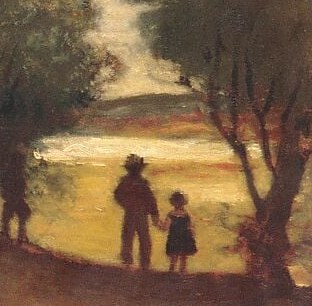
Look closely at the figures, particularly the small child being led. Their simple, almost silhouetted forms suggest a universal narrative of connection against a backdrop of natural beauty.
Hunt was a prominent American painter, influenced by his studies in Paris and the Barbizon school. Despite his success, his life was marked by loss, including the destruction of many works in the Great Boston Fire of 1872 and the deterioration of his murals in the State Capitol at Albany, New York. This painting, created shortly before his presumed suicide, resonates with a quiet contemplation.
The painting invites us to reflect on moments of connection and the solace found in nature, even amidst life's challenges. What stories do you see unfolding in this tranquil scene?
Details
Transcript
A quiet moment between two figures. The larger figure gently guides the small child. The painter, William Morris Hunt, often found solace in nature. He trained in Paris, bringing Barbizon influences back to America. But tragedy followed him, with many works lost to fire and decay. This tranquil scene captures a tender, guiding connection. It was painted shortly before his own life ended tragically.