Untitled by Sahibdin

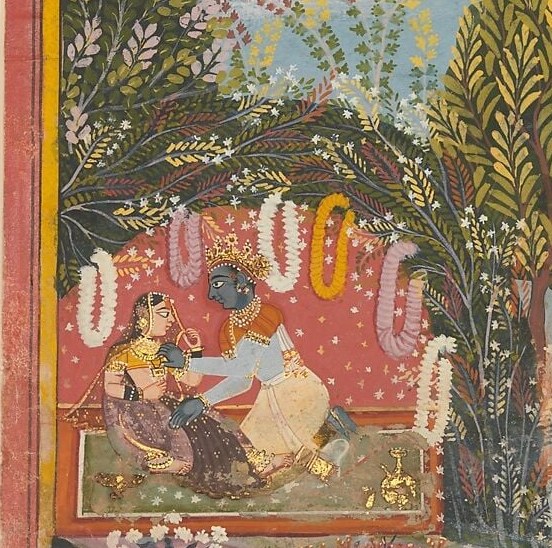
This is a painting of Radha and Krishna, made around 1665 by the Mewar artist Sahibdin. It comes from a manuscript tradition, painted in opaque watercolor on paper, and was likely made for a royal court in Rajasthan. The entire work is an argument about devotion, and it makes that argument not through spectacle but through one restrained, extraordinary detail.

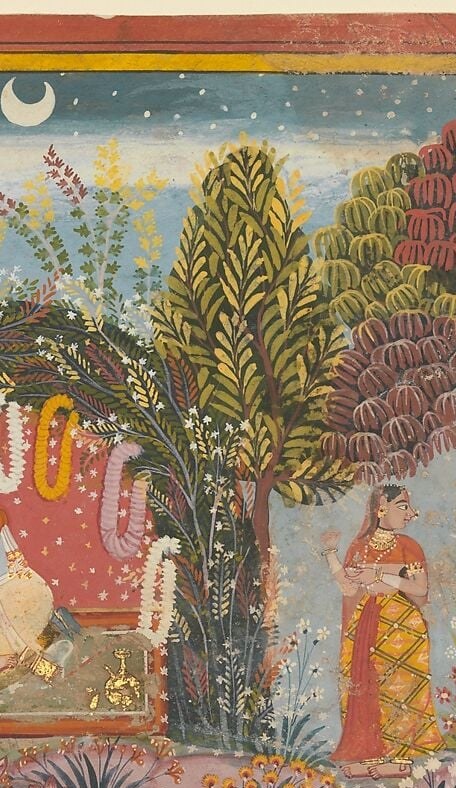
Look at Radha's hand resting on Krishna's arm. The rest of the painting builds a world around them, a sacred bower of dark and flowering trees, a crescent moon half-hidden in the sky, an attendant standing witness, but the whole visual and theological weight of the image lands on that touch. Krishna's golden halo tells you he is divine. Her hand tells you that divinity can be reached.

Sahibdin was active in the mid-17th-century Mewar school, where artists illustrated episodes from Hindu sacred literature for courtly patrons. He is known for blending traditional iconography with a quiet emotional intensity. This scene avoids grand narrative action in favor of a suspended, personal exchange between two figures. The deep greens, blues, and luminous golds create a stained-glass warmth that holds the couple inside their own pocket of the night.

A crescent moon marks this as a secret meeting, the nightly rāsa, when Radha and Krishna meet away from the world. The painting keeps their privacy. We are allowed to see, but only just.

#arthistory #indianminiaturepainting #mewarpainting

Details
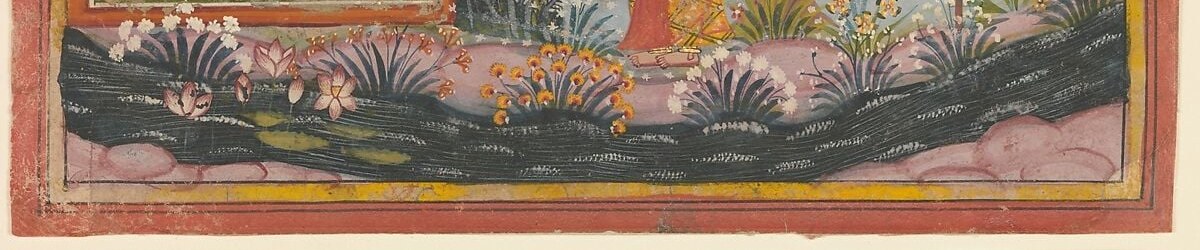
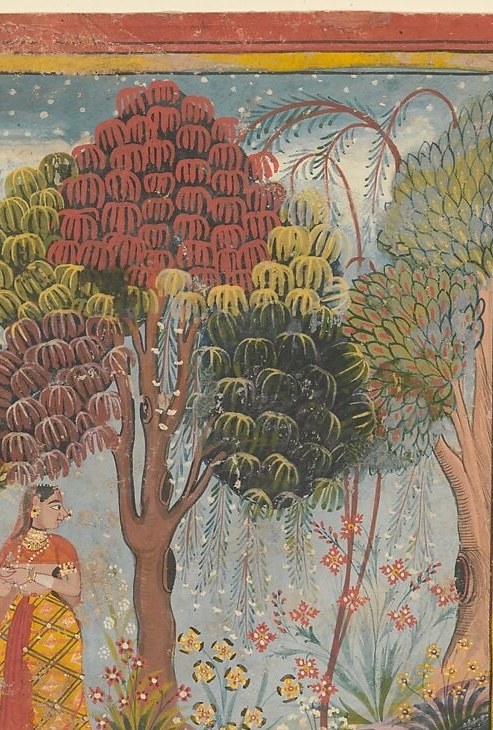
Sahibdin's characteristic foreground register of stylized blooms in blue, pink, and yellow , a visual threshold separating the divine scene above from the earthly viewer below
Sahibdin's signature jewel-like foliation built from stacked lobes of opaque pigment , the tree functions as a kuñja (sacred bower) enclosing the divine couple from the profane world
The devotional core of the composition , their side-by-side proximity enacts the theology of divine love; blue flesh against jeweled garments signals cosmic status within intimate human scale
The saturated red canopy creates a chromatic counterpoint to the dark greens; likely an ashoka or kadamba tree, both sacred in Krishna's mythology and a recurring motif in Mewar manuscripts
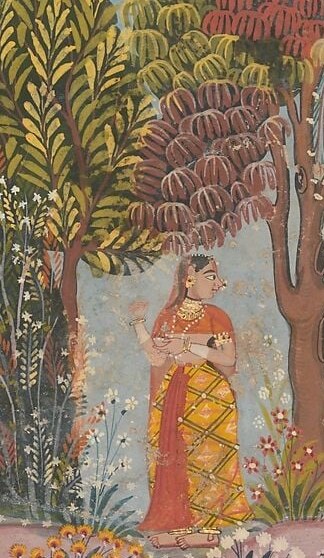
The sakhī is witness, intermediary, and narrative function in one figure , her upright posture and slight turn toward the couple direct the viewer's eye to the sacred union
Transcript

A god and a woman sit together at night. His name is Krishna. The gold circle means he is divine. Sahibdin painted this in a Rajasthan workshop, around 1665. He spent his life illustrating sacred stories for royal patrons. Now look at her hand. In this tradition, that gentle touch collapses the distance between human and god.