Artwork
Untitled
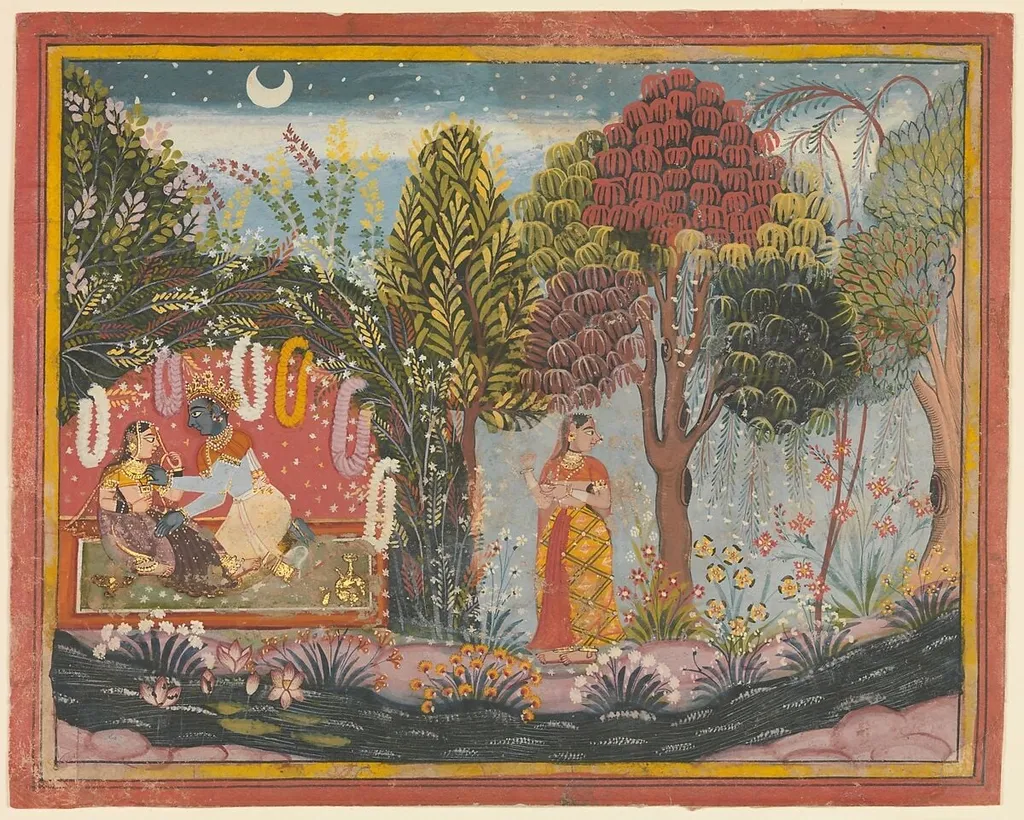
Untitled is a watercolor painting by the Baroque artist Sahibdin. It dates from 1665 and is held in the collection of the Metropolitan Museum of Art.
- Accession no.
- 1988.103
- Credit line
- Gift of Ernest Erickson Foundation, 1988
About this work
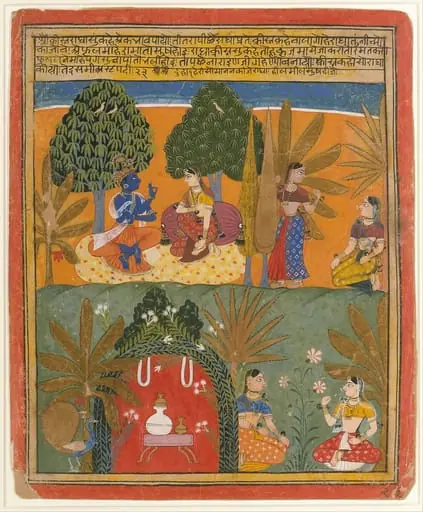
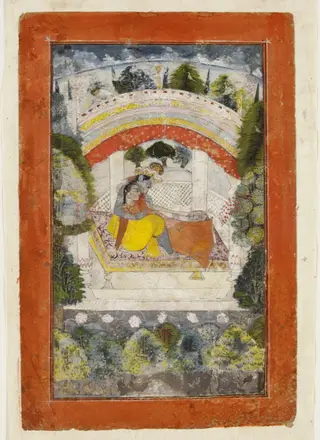
Radha and Krishna sit beneath a tree, her hand on his arm as he plays a flute. The colors glow like stained glass: soft greens, blues, and golds. Sahibdin painted the scene in Rajasthan around 1665. The gold halo around Krishna marks his holiness, a traditional touch.
Subject & Meaning
The presence of the attendant underscores the courtly context of the scene, reinforcing the theme of divine love (śṛṅgāra) central to Bhakti imagery.
The painting shows Krishna and Rādhā seated beneath a tree accompanied by a female figure, likely a gopi attendant. Krishna is identifiable by his blue skin and peacock feather crown, while Rādhā appears in traditional attire beside him. The tree provides a shaded setting that frames the pair, a common compositional device in Indian miniature painting to suggest intimacy and the natural world as a witness to their love.
The presence of the attendant underscores the courtly context of the scene, reinforcing the theme of divine love (śṛṅgāra) central to Bhakti imagery.
Technique & Style
Created in 1665 by the artist Sahibdin, this work is executed in ink and opaque watercolor applied to a paper support. As a devotional painting from India, the piece employs traditional Rājpūt media, utilizing the opacity of the watercolor to define figures such as Krishna and Rādhā alongside natural elements like trees. The handling of the medium allows for distinct color separation and delineation of forms typical of the period's devotional art.
The stylistic approach focuses on the representation of divine and human subjects within a natural setting, characteristic of the artist's output during the mid-seventeenth century.
History & Provenance
Painted in 1665 by Rajasthani artist Sahibdin, this ink and opaque watercolor on paper depicts Krishna, Rādhā, a tree, and an attendant figure, subjects drawn from Hindu devotional imagery. The work belongs to the religious genre and was created in India, reflecting the artistic conventions of 17th-century court patronage. It is held in the collection of the Metropolitan Museum of Art. No specific accession number or exhibition history is recorded in the available sources.
Context
The painting exemplifies 17th-century Indian devotional art, situating Sahibdin within the broader tradition of Rajput court workshops that emphasized Hindu mythological narratives. Its depiction of Krishna and Rādhā alongside symbolic elements such as a tree aligns with the religious genre, reflecting the spiritual patronage of Mughal-era courts. The work's dated inscription of 1665 provides a precise anchor for tracing the evolution of Sahibdin's oeuvre within the larger chronology of Indian miniature painting.
Legacy
Sahibdin's 1665 depiction of Krishna and Rādhā beneath a tree exemplifies the technical conventions of Rajput devotional painting through its intricate use of ink and opaque watercolor on paper. Its inclusion in the Metropolitan Museum of Art's collection has positioned it as a benchmark for studies of Indian miniature art and Krishna iconography. The painting contributes to the historical narrative of South Asian art by shaping academic discourse on devotional subjects and the migration of Rajput works to Western institutions.
Overview
Created in 1665 by the Mewar painter Sahibdin, this untitled work depicts the divine couple Radha and Krishna in a moment of intimate communion beneath a flowering tree. Executed in ink and opaque watercolor on paper, the composition centers on the figures, with Radha seated close to Krishna, her hand resting on his arm as he plays the flute. The artist employs a palette of soft yet rich greens, blues, and golds that create a luminous effect against the paper ground.
A tree with thick, arching branches and clusters of tiny red fruit frames the upper portion of the scene, establishing a natural canopy that encloses the lovers. Sahibdin, a prominent figure in 17th-century Rajput painting, is known for his distinct style that blends traditional Indian iconography with a heightened sense of emotional expression and decorative detail. This work exemplifies the devotional aesthetic of the Mewar school during the mid-17th century, where the depiction of the Radha-Krishna narrative served both religious and courtly functions.
The painting reflects the period's emphasis on the emotional intensity of the divine love story, rendered through precise brushwork and a vibrant, yet harmonious, color scheme characteristic of Sahibdin's mature period.
Artist & collection

- Radha Awaiting Reconciliation with Krishna, from a Gita Govinda of Jayadeva
 Lakshmi and Devotees
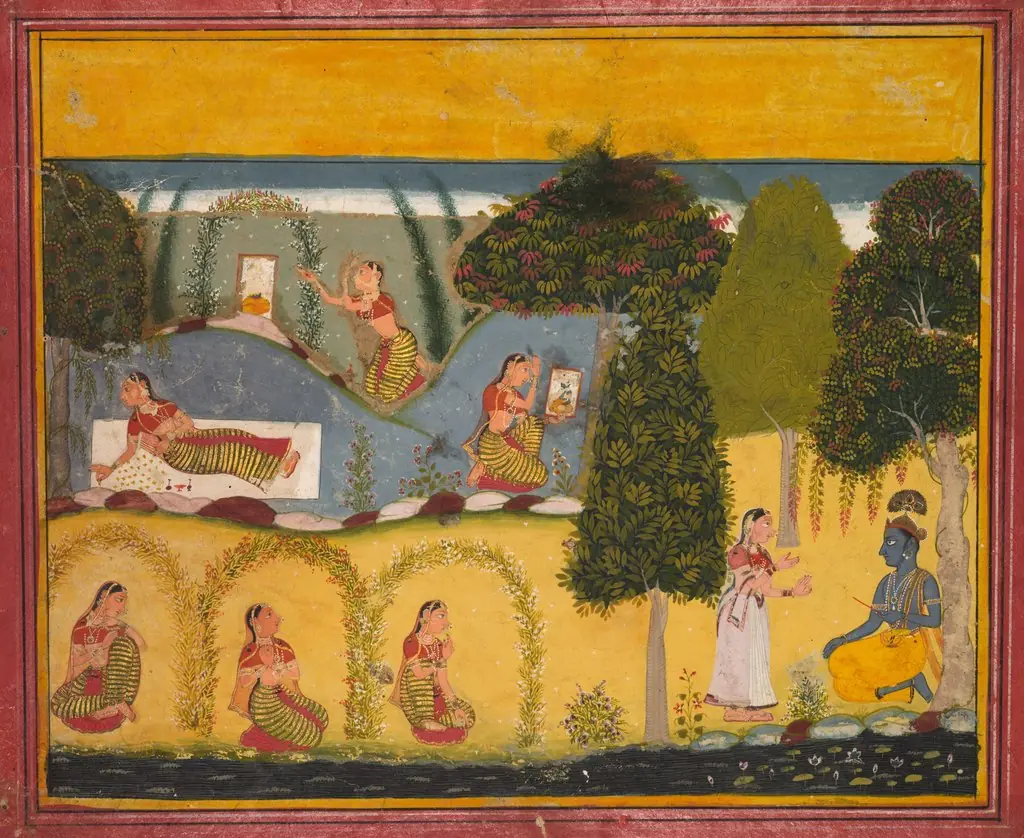 Radha Awaiting Reconciliation with Krishna, from a Gita Govinda of Jayadeva
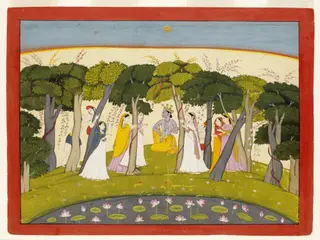 Krishna
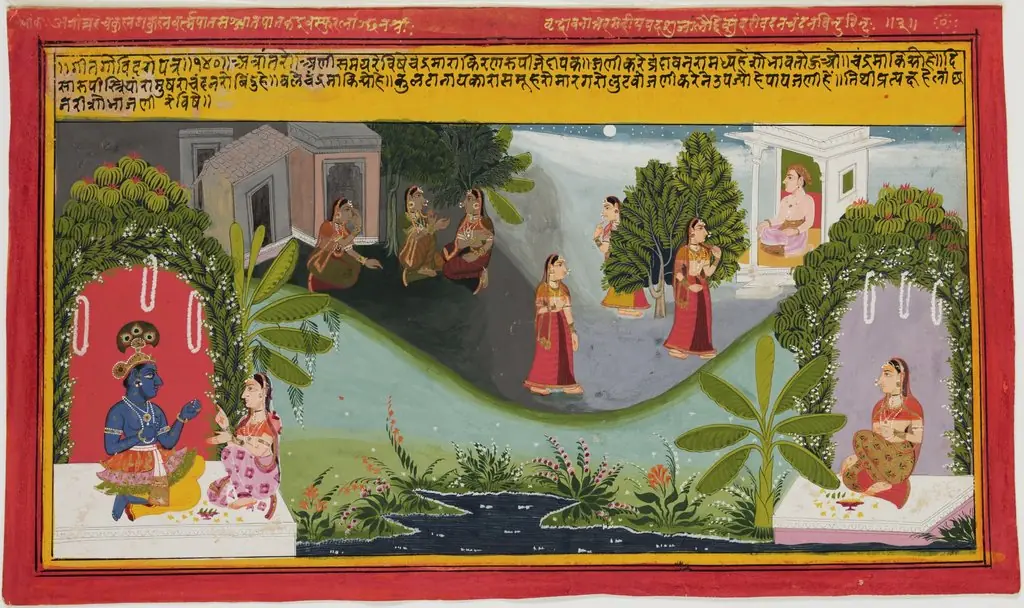 Radha's Attendant Converses with Krishna and Woman Travels By Moonlight to Meet her Lover (page from the Gita Govinda)
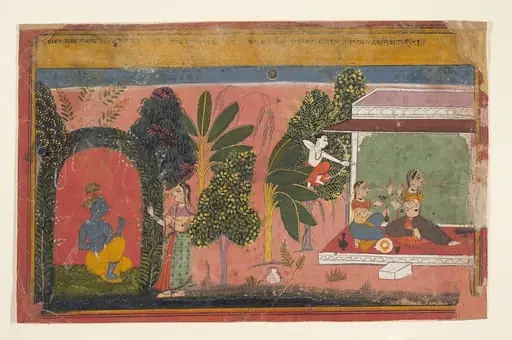 Untitled
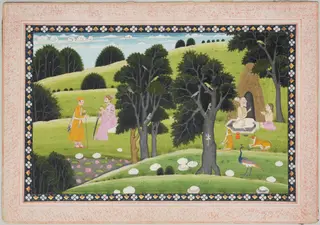 The Guru Discourses While Noblemen Wait
 Untitled
 Krishna Prepares for Radha's Visit (page from the Gita Govinda)
 Krishna and Radha
 Rati, the Goddess of Erotic Love, Takes Aim at Krishna, from a Rasikapriya
 Radha and Krishna