Low Tide, Riverside Yacht Club by Theodore Robinson
In the summer of 1894, Theodore Robinson set up his easel on the Connecticut shore and painted a yacht club at its quietest hour. Low Tide, Riverside Yacht Club is an American Impressionist landscape that crosses the Atlantic in a single frame. Robinson had recently returned from Giverny, where he worked side by side with Claude Monet, and this painting carries that friendship in every brushstroke.
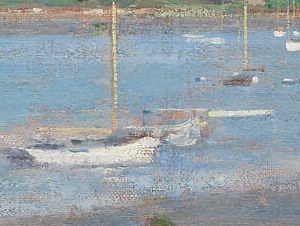
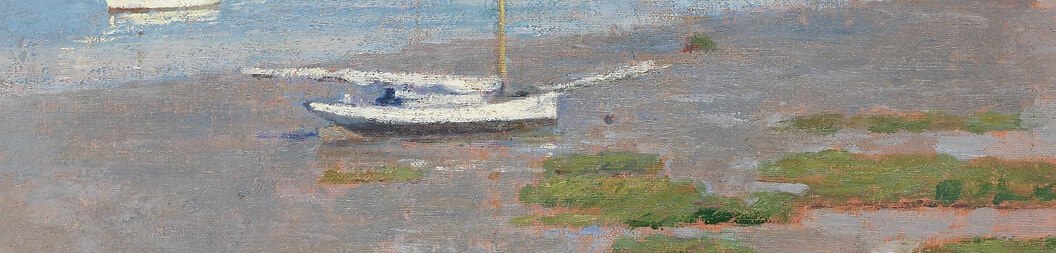
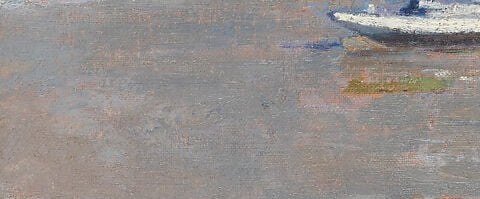
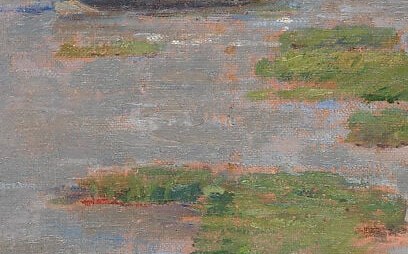
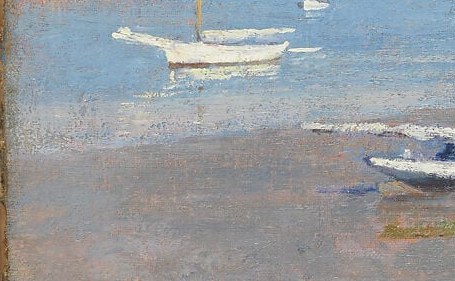
The water has pulled back, exposing a patchwork of mud and marsh grass. The boats sit grounded, their masts still against a pale, luminous sky. Robinson keeps the palette deliberately soft. This is not the high-color Impressionism of a sunny French meadow. It is a New England morning, all damp air and diffused light. Look closely at the narrow channel of remaining water cutting through the tidal flat, and the way the hull of the foreground rowboat catches the most light.
Robinson was a quiet, diligent artist. He absorbed Monet's broken brushwork and devotion to plein-air painting, then tempered them with a distinctly American restraint. This canvas dates from a late, mature period. In 1896, just two years after painting this scene, he died of an asthma attack at age 43. His output was not vast, which makes major works like this one scarce and sought-after.
A Robinson painting was sold by Christie's in New York, and the market has only tightened. His finest pieces now reside in the Met, the Art Institute of Chicago, and the Smithsonian. What do you notice first: the grounded boats or the wide, patient sky?
Details
Transcript
Riverside, Connecticut. The summer of 1894. A yacht club sits empty at low tide. The painter studied with Claude Monet in France. He brought Impressionism home to America. Look at the mudflats. He paints the tide pulling away. This was one of his last summers. He died two years later, at 43. A painting that built the bridge between two continents.