Green Peaks under Clear Sky: After Huang Gongwang by Wang Yuanqi
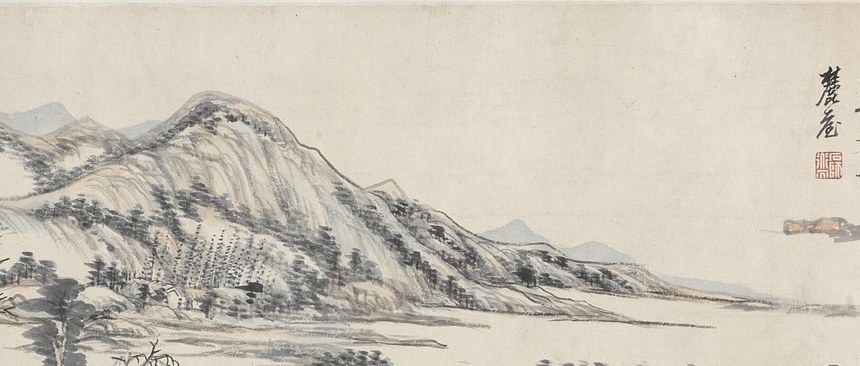
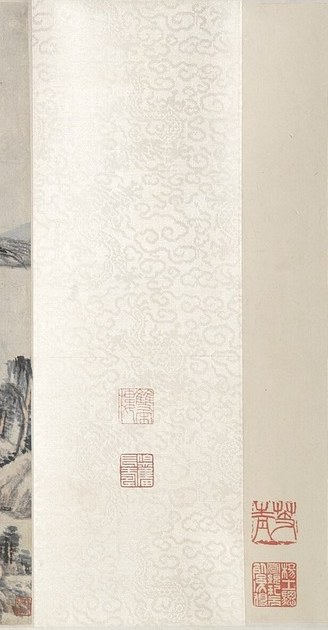
This is "Green Peaks under Clear Sky: After Huang Gongwang," painted in 1706 by Wang Yuanqi and held at The Cleveland Museum of Art. It is a quiet, scholarly landscape that is also a forensic document. The red stamps scattered across the silk are not damage or decoration, they are the signatures of every major collector who has owned this work since the 18th century.
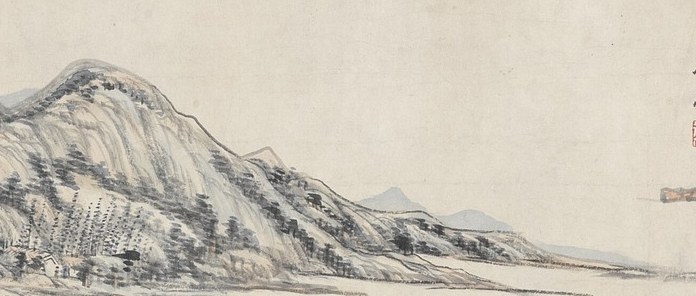
Look first at the mountain face. Wang Yuanqi was the leading orthodox painter of his generation, and here he uses accumulated short, dry hemp-fiber strokes called pima cun to build form without outlines. The technique is a deliberate homage to the Yuan dynasty master Huang Gongwang, reimagined through Qing-era precision. Down the left shore, a small pavilion tucked into the trees signals the scholar-recluse's withdrawal from official life, a core literati theme.
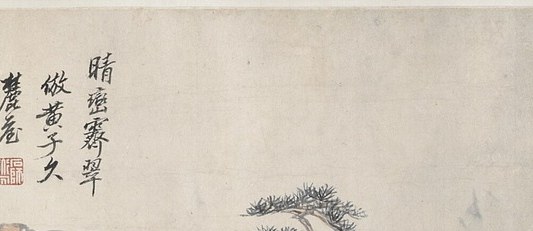
The inscription in the upper right and the colophon strip on the right edge function as the painting's historical spine. Chinese scroll paintings travel with their provenance attached. The red seals beneath the colophon are each a distinct historical fingerprint, linking the painting to specific collectors, connoisseurs, and possibly an imperial catalog. A painting with many respected seals was authenticated and protected by its own social history.
In a sense, this landscape was never alone. It moved through dynasties and wars with its owners' names pressed onto its skin, each seal a witness to its safe passage.
Details
Transcript
A quiet landscape. Mist, mountains, a hidden village. It was painted in 1706 by a Qing dynasty master. He built these peaks with hundreds of short, dry strokes. But the real story is up here. The artist signed it, and so did everyone who owned it. Each red square is a collector's seal, a mark of possession. Together they form the painting's unbroken chain of custody. A biography of survival, stamped onto the work itself.