明 張瑞圖 後赤壁賦圖 卷|Illustration of Su Shi’s “Second Ode on Red Cliff” by Zhang Ruitu
Zhang Ruitu painted this handscroll in 1628, not on paper, but on satin. The full title is Illustration of Su Shi's 'Second Ode on Red Cliff', and it lives at the Metropolitan Museum of Art. It visualizes a famous 1082 poem by Su Shi about a nighttime boat excursion beneath towering red cliffs, but the real story here is the material intelligence of the painting itself.
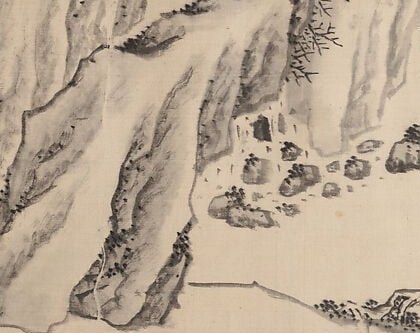
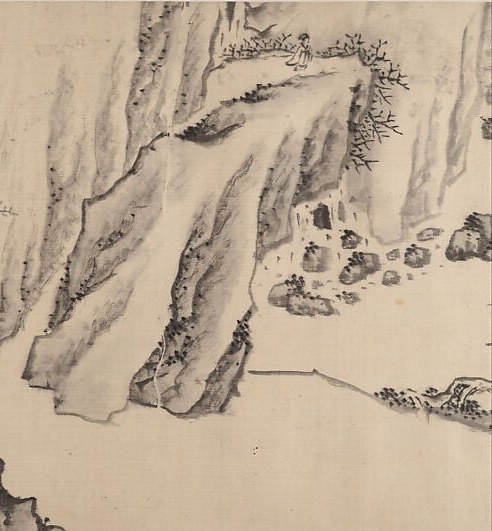
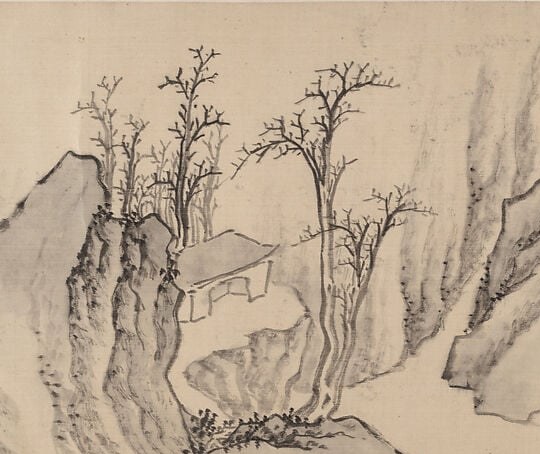
The right cliff dominates the composition, and if you zoom in, its surface is built entirely from dry, angular strokes, Zhang Ruitu's signature cun technique. He came up as a calligrapher, and you can see it: he doesn't model rounded rock, he writes it with the same wrist that inscribed the colophon in the lower left.
And then there's the other half of the trick. All that pale space, the water, the mist, the upper sky, contains no paint at all. On a handscroll unrolled slowly from right to left, the bare satin reads as moonlit river. The material itself performs the emptiness the poem describes. A single tiny boat, barely visible, is the only human sign.
Zhang Ruitu fell from political grace late in life, his career had been tied to a disgraced faction at the Ming court. He spent his last decades painting. This scroll unfolds like a private cinema: the dry cliff, the luminous void, the near-invisible boat. Night, solitude, and a sheet of silk doing the work of moonlight.
Details

Transcript
Look at the right cliff face. The strokes are dry, angular, pure calligraphy. Zhang Ruitu was a calligrapher first. He carved rock with a brush. Now look where the paint stops. Bare satin becomes luminous water, mist, and moonlit sky. Two materials: dry ink and bare silk. That's the whole painting. Scroll paintings were unrolled one arm's length at a time. This was a private film, frame after frame, from cliff to boat to void.