Untitled by Devidasa of Nurpur
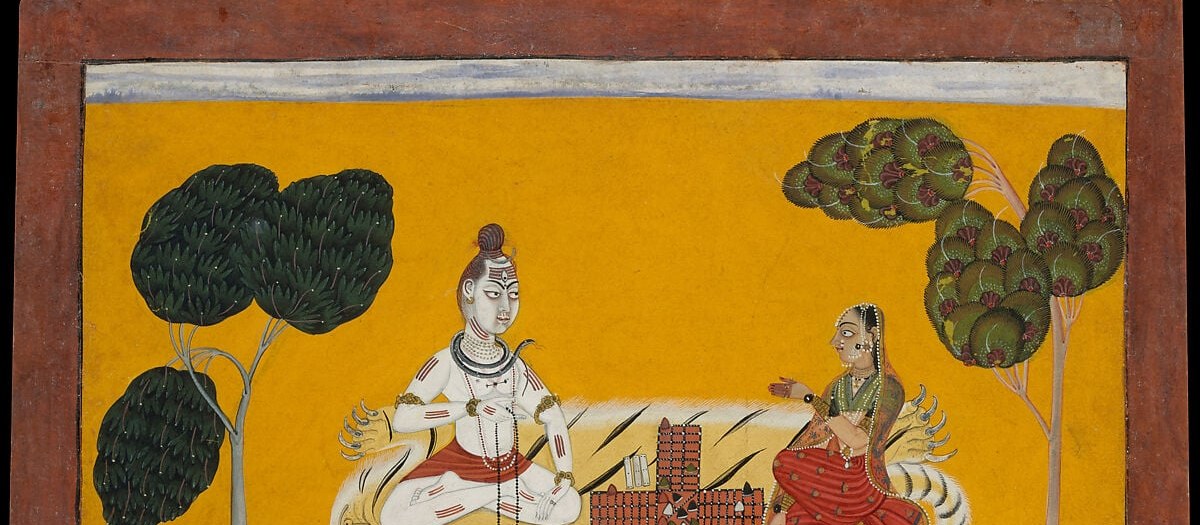
This is Shiva and Parvati Playing Chaupar, painted in 1694 by Devidasa of Nurpur. It belongs to the Basohli school, a tradition that flourished in the hill states around Jammu, and its palette is built from the raw materials of the physical world, quite literally.
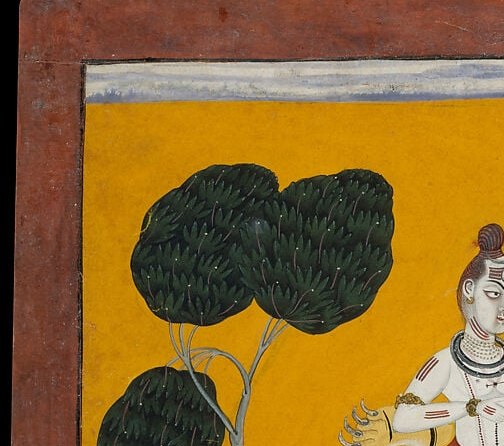
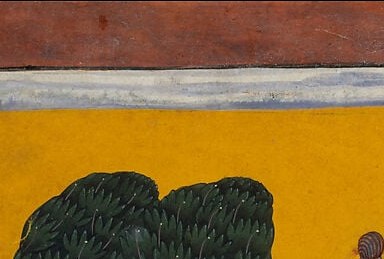
Look first at the luminous yellow that fills the background. It is not a sky or a wall; it is divine radiance made from Indian yellow pigment, traditionally produced from the urine of cows fed on mango leaves. Then look at the flat white of Shiva's body, denoting his ascetic ash-smearing, and the saturated red of Parvati's garment. In Basohli painting, unmodeled color does not represent light hitting a surface; it carries theological meaning by pure, brilliant contrast.
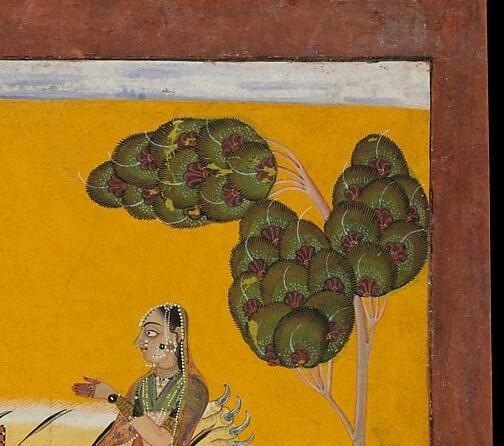
Now look closely at Parvati's crown. The turquoise inlay is not mineral paint. Court ateliers used iridescent beetle-wing casings, cut and laid onto the surface like tiny gems. The gold and silver leaf throughout the painting was applied with the precision of a jeweler, not a brush.
Devidasa was active around 1680 to 1720, working for local rulers who prized this intense, graphic style. The checkered red-and-black border here is a diagnostic signature of the 1690s Nurpur workshop, as reliable as an artist's name. The painting renders a game of cosmic leisure, but its wonder is in the workshop: mango-fed cows, crushed beetles, and a goldsmith's hand, all pressed onto a sheet of paper in the Himalayan foothills.
#arthistory #basohli #indianminiaturepainting
Details
Transcript
They sit in a warm field of yellow. It's not sky. It's Indian yellow pigment, made from the urine of cows fed mango leaves. Shiva's ash-white skin is raw, flat color. No shadow. No blend. Now look at her jewels. The turquoise in the crown is iridescent beetle-wing casing, cut and laid by hand. All the drama here is built on two colors meeting. A painter in the Himalayan foothills made the divine out of mango leaves, gold, and insects. 1694.