Artwork
Untitled
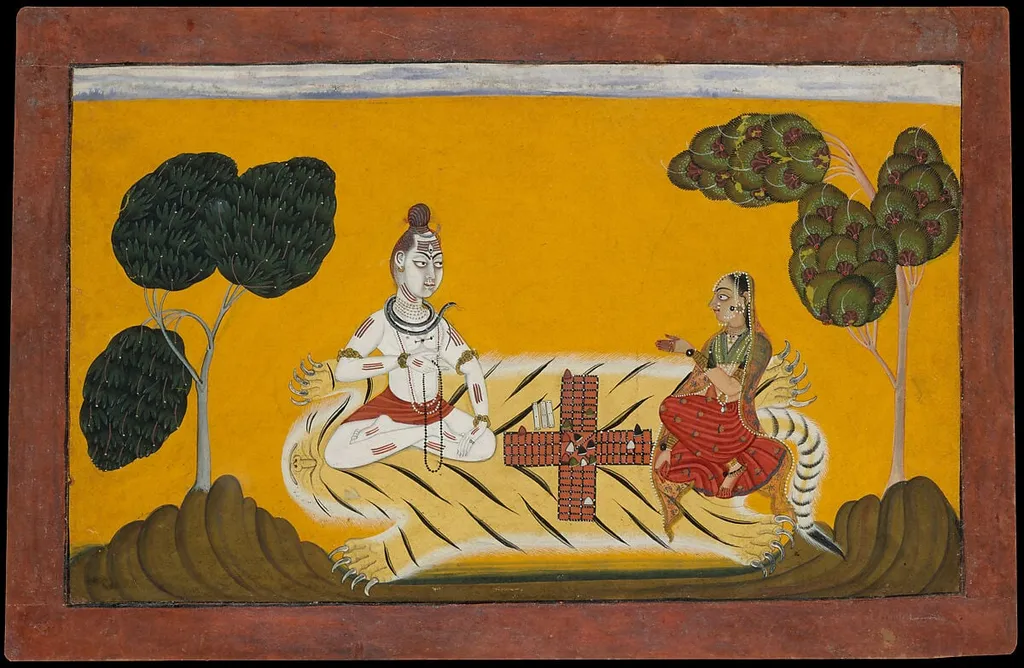
Untitled is a watercolor painting by the Baroque artist Devidasa of Nurpur. It dates from 1694 and is held in the collection of the Metropolitan Museum of Art.
- Accession no.
- 57.185.2
- Credit line
- Gift of Dr. J. C. Burnett, 1957
About this work
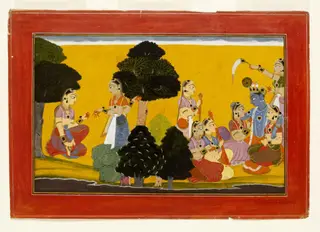
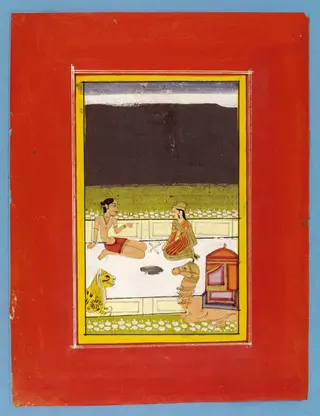
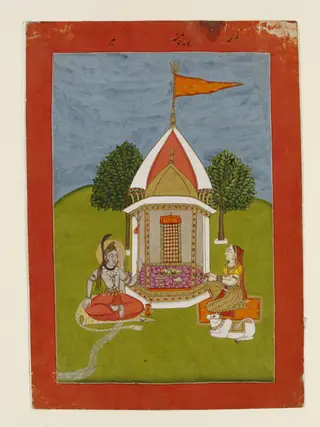
Parvati and Shiva sit close over a checkered game board, crowns and jewelry bright with gold, a small servant holding a tray of snacks nearby. Devidasa painted this in 1694 in the Basohli style of the hills near Jammu, known for bold color and fine detail. Silver and gold give it a royal sheen.
Subject & Meaning
Devidasa of Nurpur's 1694 opaque watercolor depicts the Hindu deities Shiva and Parvati engaged in the game of Chaupar, a traditional dice-and-board pastime often associated with divine play and the passage of fate. The figures are situated within a natural setting marked by a tree, while a tiger skin, closely linked to Shiva as his customary seat or garment, appears among the depicted elements, reinforcing his ascetic identity. Together these motifs situate the work within the genre of mythological painting, presenting the divine couple in a leisurely, contemplative moment rather than a narrative of cosmic action.
The pairing of the two deities with the game board and the tiger skin evokes themes of companionship, chance, and the union of ascetic and domestic aspects of divinity central to Shaiva iconography.
Technique & Style
Handling shows controlled brushwork and meticulous detailing, particularly in the depiction of costume and attributes.
The painting employs opaque watercolor with ink outlines heightened by silver and gold, applied on paper support. The composition is rendered in a precise, linear manner typical of early-modern Pahari style, with carefully modulated color fields and delicate metallic accents defining jewelry and drapery. Figures are set within a shallow, planar space; Parvati and Shiva occupy a terrace-like setting beneath a stylized tree, while the chaupar board and tiger skin lie flat, emphasizing the scene’s ritual rather than spatial illusionism. Handling shows controlled brushwork and meticulous detailing, particularly in the depiction of costume and attributes.
History & Provenance
Created in 1694, the painting known as Untitled was produced by the artist Devidasa of Nurpur in India. Executed in opaque watercolor, ink, silver, and gold on paper, the work depicts mythological figures including Shiva, Parvati, and Chaupar. The artwork measures 16.5 cm in height and 27.6 cm in width.
It is currently held in the collection of the Metropolitan Museum of Art, where it remains part of the institution's holdings. The piece is classified as a painting within the genre of mythology, featuring specific iconographic elements such as a tiger skin and a tree.
The painting Untitled by Devidasa of Nurpur, dated 1694, is held in the collection of the Metropolitan Museum of Art in New York. While the provided records confirm the work's location within this major institution and its creation in India, they do not specify a particular accession or inventory number. Furthermore, the available documentation details the artwork's physical attributes and mythological subject matter but contains no information regarding its exhibition history or specific displays.
Overview
This untitled painting, created by Devidasa in 1694, depicts the Hindu deities Parvati and Shiva engaged in a board game. Rendered with opaque watercolor, ink, silver, and gold on paper, the work showcases the distinctive Basohli style. A small attendant stands nearby, offering refreshments, while the divine figures are adorned with elaborate crowns and jewelry, emphasizing their regal presence within the composition.
Context
The Basohli style, exemplified by this painting, flourished in the hill states surrounding Jammu. This regional artistic tradition was renowned for its distinctive visual language, which often incorporated bold colors and a sense of dramatic intensity. Such works were typically commissioned by local rulers and patrons, reflecting the cultural and artistic vibrancy of the Himalayan foothills during the late 17th century.
Artist & collection