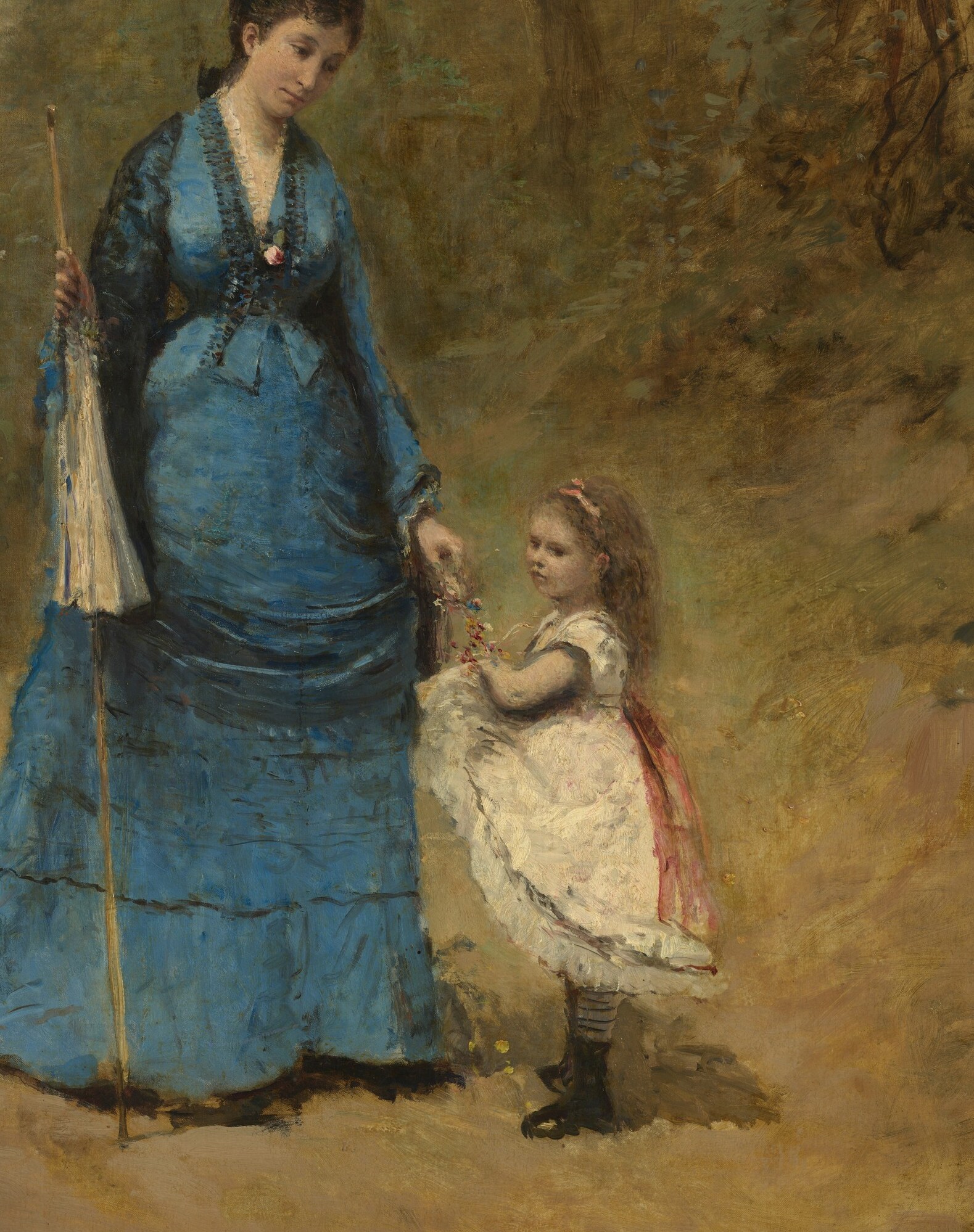
Madame Stumpf and Her Daughter by Corot, Jean-Baptiste-Camille
Jean-Baptiste-Camille Corot's "Madame Stumpf and Her Daughter," painted in 1872, showcases his unique style that blended classical portraiture with the emerging Impressionist movement. This oil on canvas, found in a prominent museum collection, reveals the artist's mastery of subtle details.
Look closely at the delicate rendering of Madame Stumpf's face and the small flower she holds. Corot's gentle brushwork brings a quiet intimacy to these elements, hinting at the tender relationship between mother and child.
Corot was a pivotal figure in 19th-century French art, celebrated for his landscapes and later for his portraits. This work, from the end of his career, demonstrates his ability to infuse traditional subjects with a soft, atmospheric quality. His distinct approach to light and detail sets his work apart.
Even his signature is a subtle part of the composition. What other small surprises do you notice?
Details
Transcript
This painter bridged classical landscapes and Impressionism. Look closely at the mother's face. Her downward gaze is gentle and thoughtful. Now see the small flower in her hand. The artist used delicate brushwork for these tiny details. His signature is almost hidden in the foliage.