Infant Funeral Procession by William P. Chappel
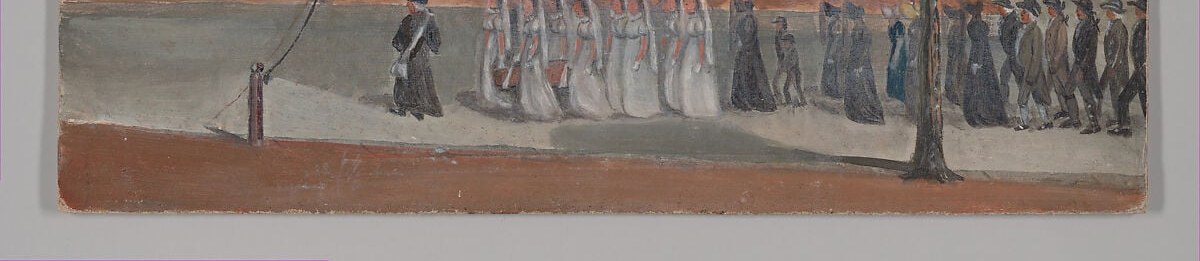
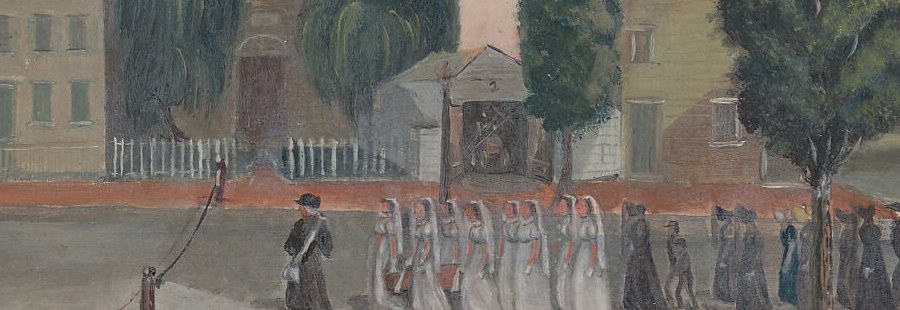
This is William P. Chappel's “Infant Funeral Procession,” painted in the 1870s and held by the Metropolitan Museum of Art. The painting records a moment so common that it barely registers as a historical event: a child's funeral on a working-class New York street.
First, find the coffin. It is the small white rectangle at the center of the procession. Victorian custom dressed infants and young children in white for burial, a color marking them as innocent. Paired with the mourners' black clothing, the white coffin becomes the painting's visual and emotional anchor, easy to miss at a scroll's pace, impossible to forget once you see it.
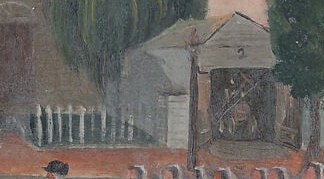
Chappel (1801-1880) was a New York artist who painted everyday urban life without heroism. He worked in oil on slate paper, a support that gave his scenes a soft, almost hazy quality, like a memory. In the 1870s, child mortality remained a routine sorrow; a funeral like this one would have been a familiar sight on the streets of lower Manhattan or Brooklyn. The unpaved road and the plain brick buildings place it squarely in a working neighborhood.
What strikes me is how quiet the painting is. No angels, no drama, just a community walking a child to the grave. Have you ever noticed a small, white coffin in a 19th-century painting and realized what you were looking at?
Details

Transcript
New York, 1870s. A line of mourners fills a dusty street. They are almost all in black. But look at what they carry. A tiny white coffin, barely visible against the dark clothes. Children were buried in white. It marked them as innocent. This is a public street, not a churchyard. Dirt, no cobblestones. The painter recorded ordinary life. A child's funeral was part of it.