Still Life: Flowers and Fruit by Severin Roesen
View the artwork: Still Life: Flowers and Fruit →
Severin Roesen trained as a porcelain painter in Cologne, where he spent years learning to render tiny floral scrolls on curved ceramic surfaces with absolute precision. When he fled debts and political upheaval to New York in 1848, he brought that miniaturist hand with him. This painting, now at the Metropolitan Museum of Art, is forty inches across. Every petal, every grape, every dewdrop was built with a brush small enough to paint china.
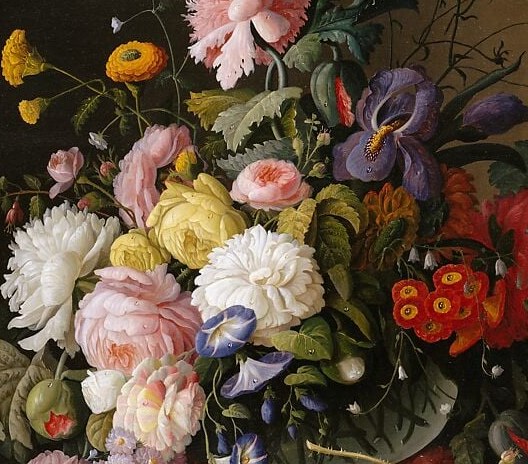
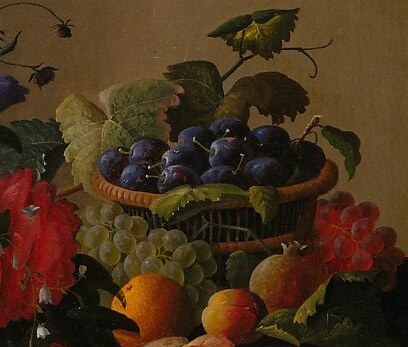
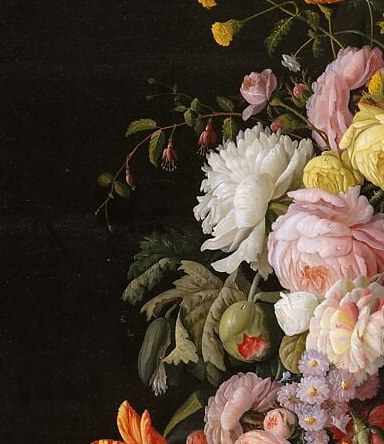
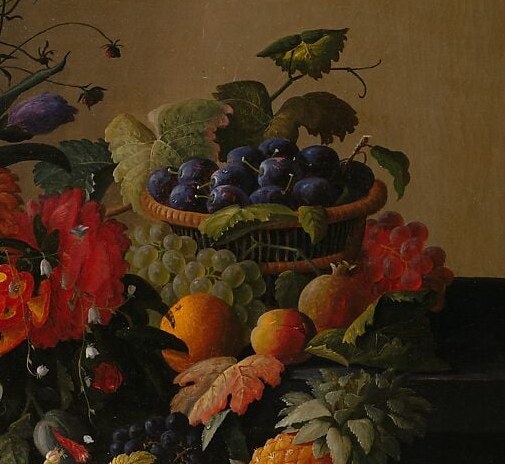
Look at the dewdrops on the central white roses. They are not painted as rounded objects. They are a single dab of white with a tiny dark shadow underneath, placed just so. Your eye assembles the rest. The grape bloom is even quieter: a powdery gray-white haze across each berry, with a pinprick highlight that convinces you the skin is taut and translucent. Both tricks come straight from porcelain decoration, where every mark must read instantly because there is no room for a second pass.
The painting was undated and largely forgotten until the Met acquired it in 1967 through a complex arrangement of gifts and bequests. By then Roesen himself had vanished from history: after a productive decade in New York and Pennsylvania, painting for lumber barons, he simply disappeared from the record after 1872. We still do not know when or where he died. What remains is this improbable canvas, in which a fugitive porcelain painter poured out an American Eden one microscopic highlight at a time.
Which do you fall for first: the dewdrops or the grapes?
#arthistory #severinroesen #stilllife
Details
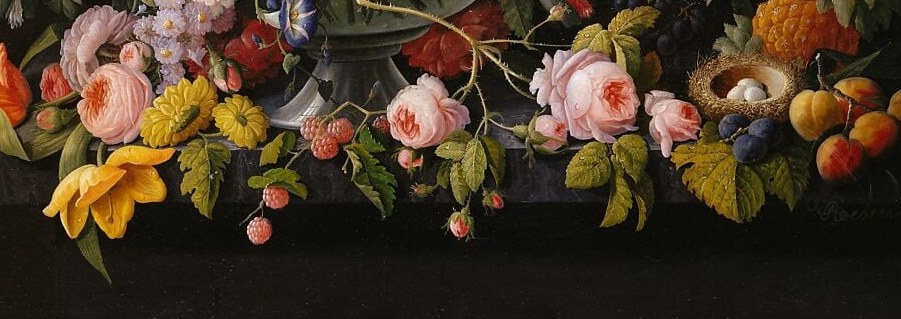
Transcript
The first thing you notice is the sheer abundance. He arrived from Germany with nothing, and painted American plenty. Now look at the grapes. Each one wears a ghost of white. Those tiny reflections are the first of his porcelain-painter tricks. He trained painting floral scrolls on vases in Cologne. And he brought that microscopic precision to oil on canvas. Now find the drops of water, scattered across the central petals. They are nothing but white paint. And they will fool your eye.