Philemon and Baucis by Rembrandt van Rijn
View the artwork: Philemon and Baucis →
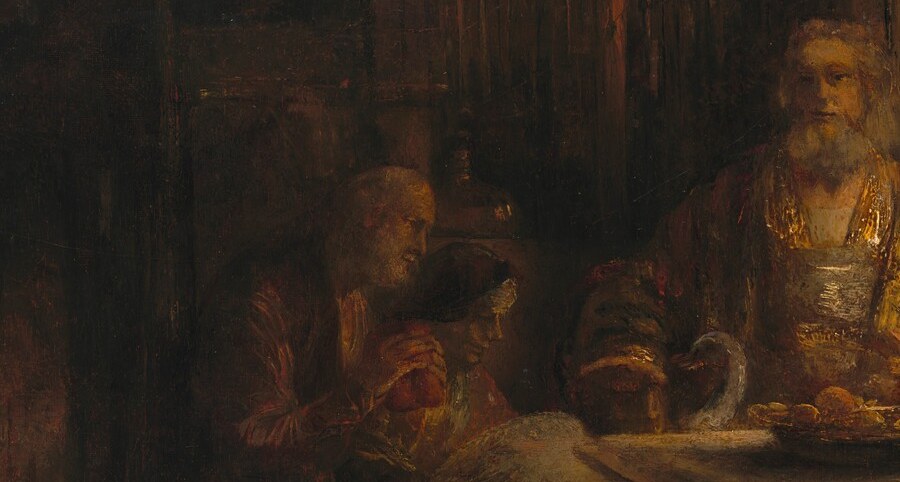
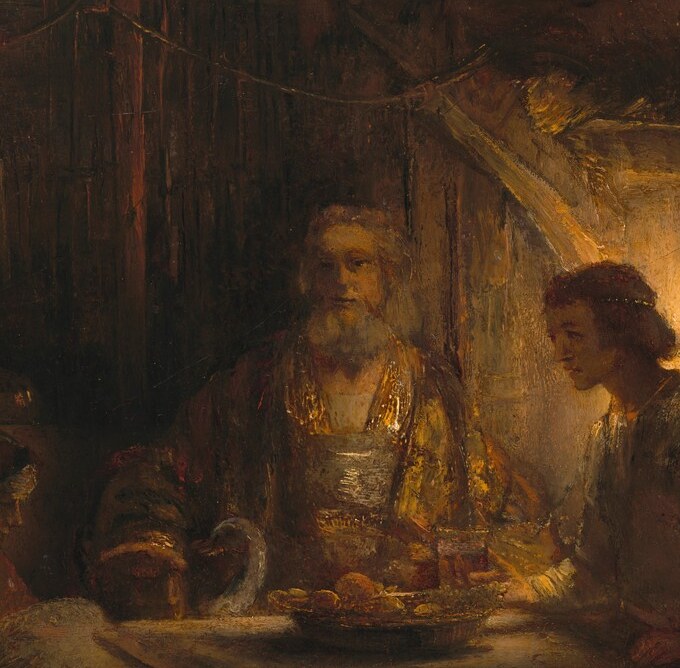
Rembrandt's "Philemon and Baucis" (1658) is the only surviving painting he ever made of this subject, and it captures a single, charged instant from Ovid's Metamorphoses. The gods Jupiter and Mercury, disguised as weary travelers, have been turned away by every wealthy household in town. Only an impoverished old couple takes them in. Now the wine bowl on the table has begun to refill on its own, and Baucis has just realized who her guests are.
Watch the goose. Philemon and Baucis, desperate to honor their divine visitors, attempt to catch their single goose to make a proper meal. The bird scrambles into Jupiter's lap. The god's hand will stop the sacrifice. It is a wry, tender detail Ovid wrote, and Rembrandt preserved it: mercy arrives through an animal's instinct, not a thunderbolt. The entire room is lit by one candle flame, Rembrandt's signature tenebrism making humble domestic light the vehicle of revelation.
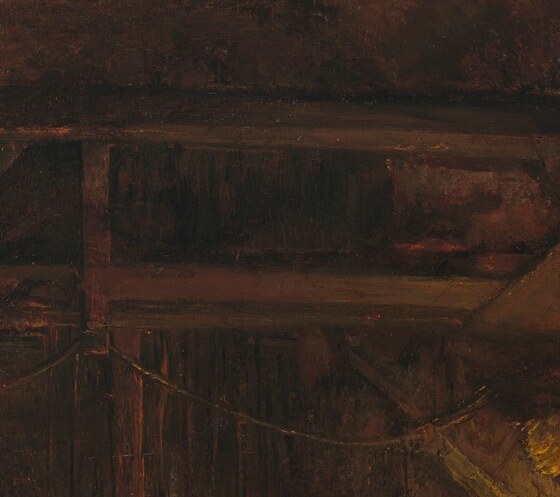
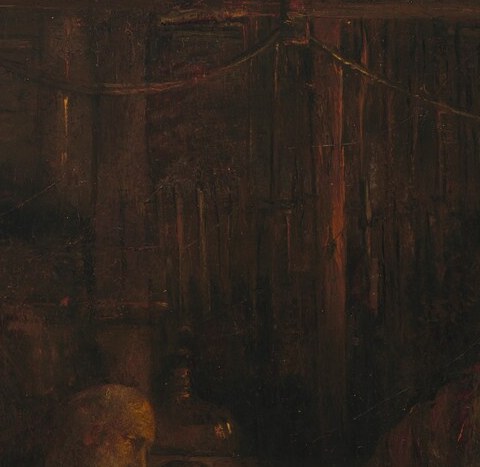
Rembrandt was 52 when he painted this. He was deep in financial trouble, selling possessions to stay afloat, and his own life had taught him something about reversals of fortune. He modeled Jupiter's illuminated, outward-facing pose on Leonardo's Christ in the Last Supper, fusing classical myth with the gravity of a biblical supper. The panel is small, 54.5 by 68.5 cm, and its condition today shows centuries of wear, but the intent survives.
The painting came to the National Gallery of Art in Washington, D.C. in 1942 as part of the Widener Collection. Before that it passed through the hands of two major American collectors of the Gilded Age, Charles T. Yerkes and Joseph E. Widener, who recognized it as a late, searching work by a master who still had everything to say about light and mercy.
Next time you see a single candle in a painting, look for what it illuminates first.
#arthistory #rembrandt #dutchgoldenage
Details
Transcript
It looks like an ordinary supper in a poor cottage. But look at the wine bowl on the table. It keeps refilling itself. That is the moment Baucis knew. Now look at her hands. The astonishment is real. They try to sacrifice their only goose. It flees to the god's lap. Jupiter spares the bird. That is divine mercy made visible. The single candle is the only light source. Revelation itself. Rembrandt signed it in the shadows. A mortal witnessing the divine.