Artwork
Philemon and Baucis
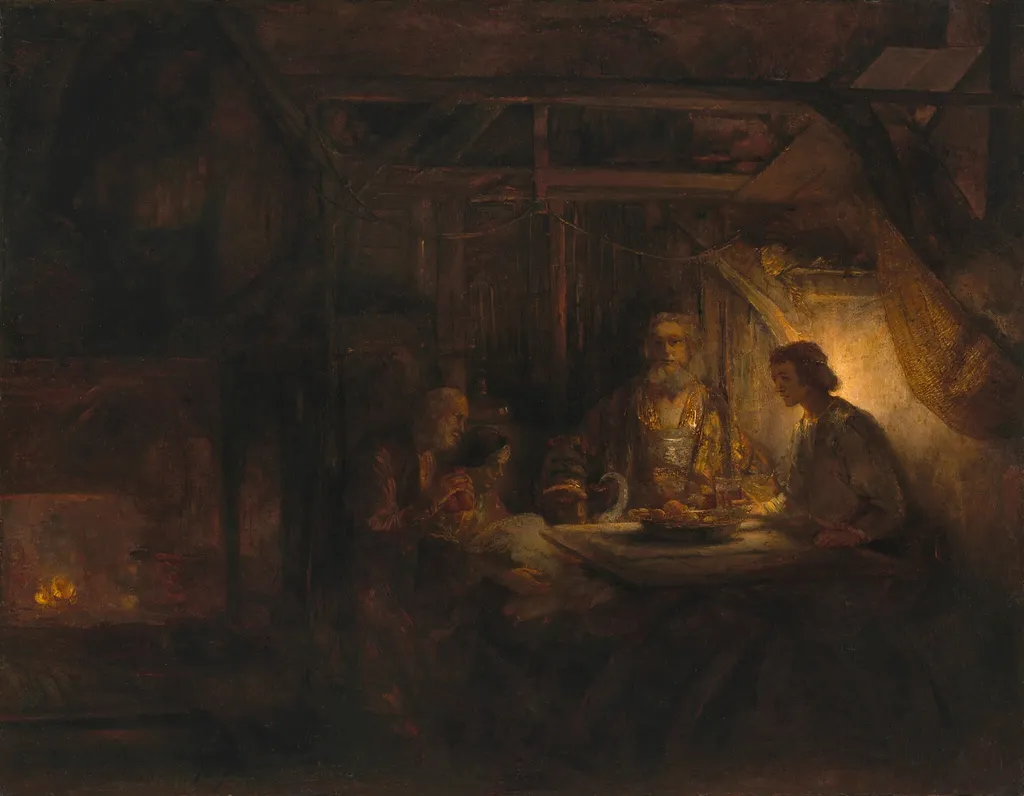
Philemon and Baucis is an oil painting by the Baroque artist Rembrandt van Rijn. It dates from 1658 and is held in the collection of the National Gallery of Art.
- Inscription
- Inscribed:lower left: Rembrandt f. 1658
About this work
The guests are Jupiter and Mercury in disguise, and Rembrandt's 1658 panel catches the instant the gods reveal themselves to Philemon and Baucis.
In a dim Phrygian cottage, an elderly couple lunges after a goose that has darted to the lap of a seated stranger. The guests are Jupiter and Mercury in disguise, and Rembrandt's 1658 panel catches the instant the gods reveal themselves to Philemon and Baucis. A lamp behind Mercury throws a muted glow over Jupiter's golden robe. It entered the National Gallery of Art in 1942 with the Widener Collection.
Subject & Meaning
The painting illustrates the story from Ovid's Metamorphoses in which the gods Jupiter and Mercury, disguised as mortal travelers, seek shelter and are welcomed by the elderly Philemon and Baucis. The scene captures the moment just before the gods reveal their true identities: the couple kneels at the table while Baucis reaches for their only goose to prepare a meal, and Jupiter, wrapped in a purple-gold cloak, raises a hand to stop her. Rembrandt blends mythological narrative with spiritual symbolism; the calm, majestic figure of Jupiter recalls representations of Christ, and the composition emphasizes revelation and divine grace.
By focusing on the instant of recognition rather than the subsequent reward, the work transforms a pagan tale into a meditation on hospitality and the awe of encountering the divine.
Technique & Style
Executed in oil on panel, the painting measures 54.5 × 68.5 cm. Its condition is notably poor, with extensive and largely unsuccessful restoration attempts. Stylistically, Rembrandt depicts the climactic moment just before the gods reveal themselves: Mercury stands in profile, silhouetted against a wall, while Jupiter's head is illuminated from behind, lending him a calm, majestic presence. The four figures are arranged around a table, with Philemon and Baucis kneeling at left.
Rembrandt's composition draws on precedents by Adam Elsheimer and Peter Paul Rubens, yet his handling is more restrained, emphasizing the spiritual revelation over dramatic action. The quiet dignity of Jupiter recalls Christian iconography, infusing the mythological scene with a transcendent quality.
History & Provenance
Painted in 1658, the work's earliest recorded owner was Captain William Baillie (1723–1792) in London. It passed through several sales and private collections, including Major Stanton and Charles Sedelmeyer, before entering the collection of Charles T. Yerkes by 1893. After Yerkes' sale in 1910, it was owned by Otto H. Kahn, then Joseph E. Widener, who gifted it to the National Gallery of Art in 1942. A preparatory drawing dating to around 1655 is also known.
Context
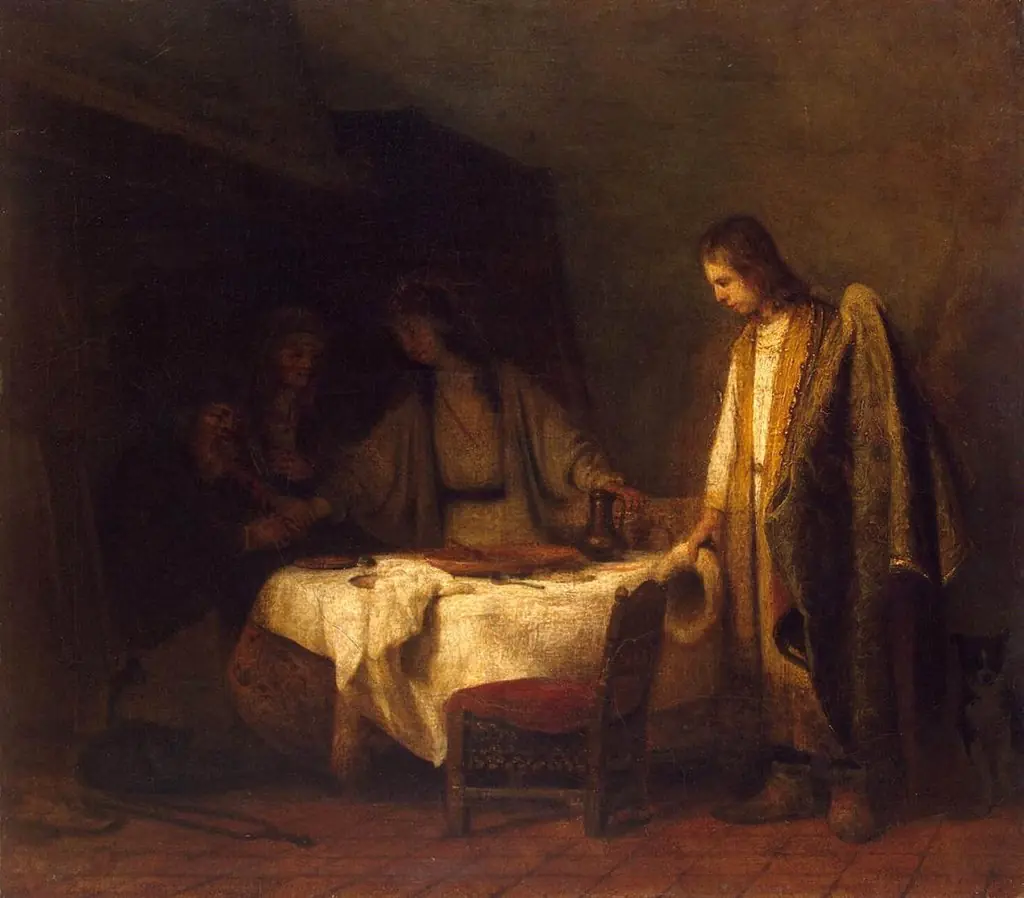
This painting is one of Rembrandt's few mythological subjects and is considered the most famous artistic treatment of the Philemon and Baucis myth. Its attribution has been debated: some scholars propose an assistant such as Arent de Gelder, while others maintain Rembrandt's authorship, and the work's poor condition further complicates authentication. Art historically, Rembrandt drew on precedents by Adam Elsheimer and Peter Paul Rubens, but he infused the scene with a spiritual dimension reminiscent of his religious works, such as the Supper at Emmaus, thereby elevating the mythological narrative. This synthesis of classical and Christian themes marks the painting's significance in Rembrandt's later oeuvre.
Legacy
Rembrandt's Philemon and Baucis is one of very few mythological paintings by the artist and is regarded as probably the most famous artistic representation of the Ovidian myth. Its attribution remains debated, with some scholars assigning it to his circle, such as his pupil Arent de Gelder. The painting's poor condition and numerous unsuccessful restorations have hindered scholarly consensus on its authorship and diminished its physical legacy.
Despite these challenges, the work remains a significant example of Rembrandt's engagement with classical mythology and is held in the collection of the National Gallery of Art, Washington.
Overview
Rembrandt's 1658 painting, Philemon and Baucis, illustrates a scene from Ovid's Metamorphoses. It uniquely captures the moment the disguised gods Jupiter and Mercury reveal their divine nature to the elderly, hospitable couple, Philemon and Baucis. The artwork focuses on the couple's realization and their attempt to offer their last goose, which seeks refuge with Jupiter. This oil on panel work is the sole surviving depiction of this specific myth by the artist.
Own this work as a print
Artist & collection

Artist
Rembrandt Harmenszoon van Rijn, known mononymously as Rembrandt, was a Dutch Golden Age painter, printmaker, and draughtsman.