The Rabbit Hunters by Thomas Hewes Hinckley
In 1850, American painter Thomas Hewes Hinckley made a hunting picture that refuses to show the action. The Rabbit Hunters, now in a private collection, captures the strange suspended stillness just before the shot, a kind of waiting that feels almost more tense than the chase itself.
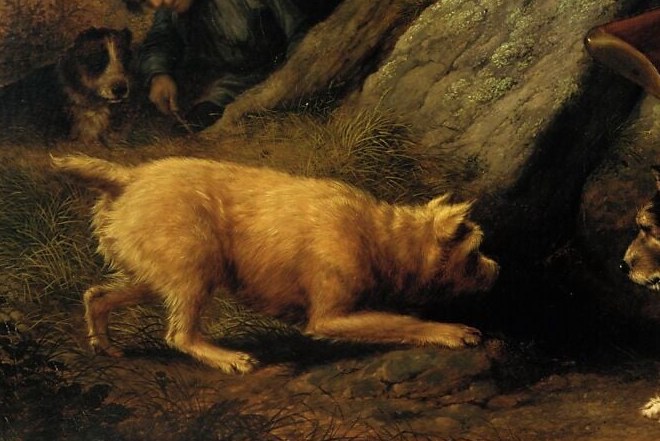
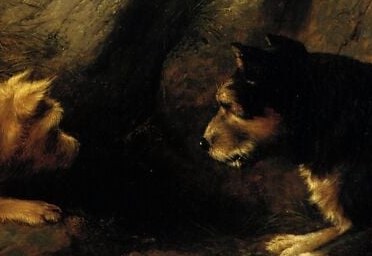
Look first at the large golden retriever in the foreground. He is the painting's real anchor: alert, low to the ground, every muscle coiled. Now look harder, just below his muzzle, and you will find the rabbit. It is hiding in plain sight in the leaf litter. That hidden animal is the pivot the entire composition turns on, easy to miss at first, and exactly where Hinckley wants your eye to land last.
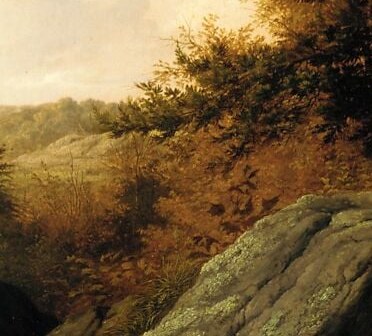
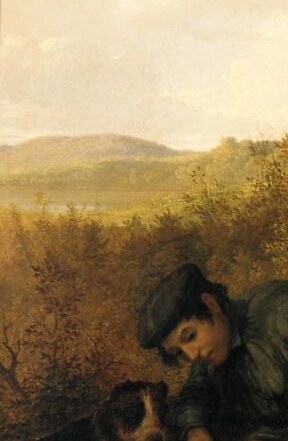
Now look for the men. Two hunters in red coats stand with their rifles, but Hinckley has pushed them deep into the shadowed foliage at the edges of the frame. One nearly vanishes into the dark tree canopy at left. Their faces are barely legible. In a genre that typically celebrated the sportsman, this painting demotes the human hunters to near-invisibility. The dogs and the rabbit own the story.
Hinckley's choice reflects a quiet truth about American sporting culture of the 1850s: good dogs were prized as the real artists of the field. A hunter might boast about his dog's nose far more than his own aim. This painting is an eyewitness to that world, and it watches with a patience that feels almost modern.
Details

Transcript
It looks like an ordinary 1850s hunting scene. Two hunters in red coats, rifles ready. A winter sky. But the painter almost hides the men in the shadows. They are not the main event. The dogs are. This golden dog anchors the whole composition. Hunter and hunted, locked in a circle of pure waiting. Thomas Hewes Hinckley painted not the kill, but the quiet.