The Ark by Lodewijk Tieling (active ca. 1695-1700)
This is The Ark, painted around 1700 by the Dutch artist Lodewijk Tieling, and for a very long time, nobody knew it was his. For centuries it was catalogued simply as 'Dutch School, later seventeenth century' until scholars connected it to a 1778 auction record in Leiden, finally securing the attribution to this little-known Amsterdam painter.
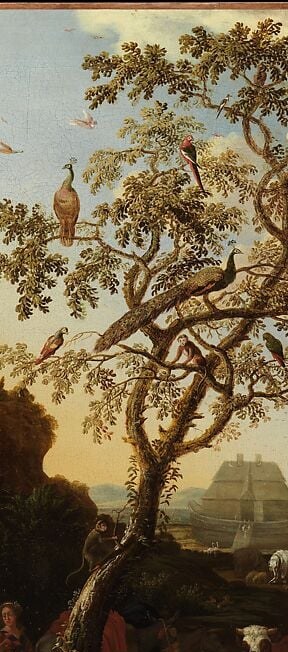
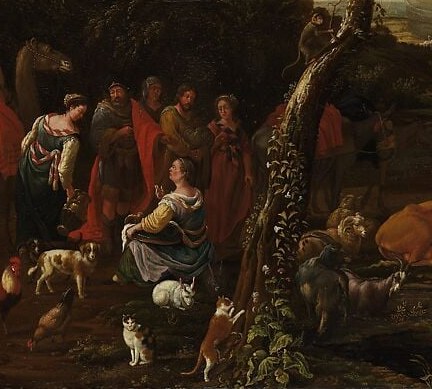
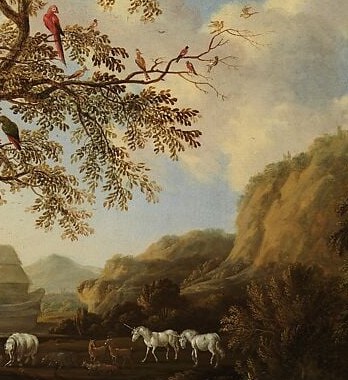
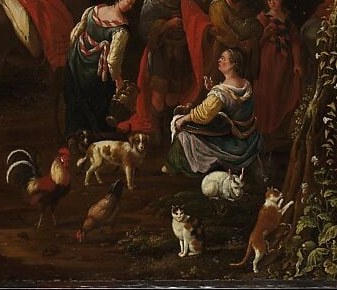
Look at the lower half of the canvas. It teems with animals borrowed from the Paradise pictures of Jan Brueghel the Elder and Roelant Savery. Among them, pay attention to the large dark predator placed peacefully among its prey. That quiet coexistence is the theological heart of the image: a preview of the covenant and a world restored.
The painting's composition was inspired by a much older work by Cornelis Snellinck, a Rotterdam painter, though both may have been copying a now-lost original. Tieling himself registered as a citizen of Amsterdam in 1696, and only about twenty pictures are known by or attributed to him. This one is among his largest and most ambitious.
Its American story is remarkably whole. Samuel Verplanck, a New York merchant, likely bought it in Amsterdam in 1761 during his wedding trip to Judith Crommelin. It remained with their descendants in Fishkill-on-Hudson for over 170 years before James DeLancey Verplanck and John Bayard Rodgers Verplanck donated it to the Metropolitan Museum of Art in 1939. It is currently in The American Wing. Can you imagine living with a four-foot-wide biblical epic over your mantel for seven generations?
#arthistory #dutchgoldenage #metmuseum
Details
Transcript
For centuries, no one knew who painted this. It was just 'Dutch School, late 1600s.' Noah directs the loading of the ark. But a 1778 auction record finally solved the mystery. The painter was Lodewijk Tieling. A merchant bought it in Amsterdam in 1761. It stayed in his family until 1939. Then they gave it to the Met.