The Aegean Sea by Frederic Edwin Church
View the artwork: The Aegean Sea →
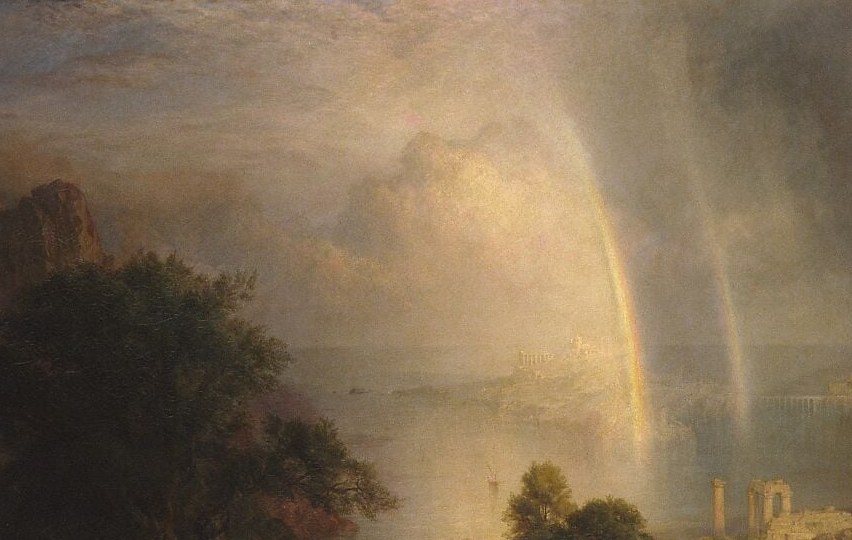
In Frederic Edwin Church's The Aegean Sea, a double rainbow arches across a glassy expanse, connecting three distinct civilizations in one impossible view. Painted around 1877 and now at the Metropolitan Museum of Art, this is the last monumental canvas Church ever completed.
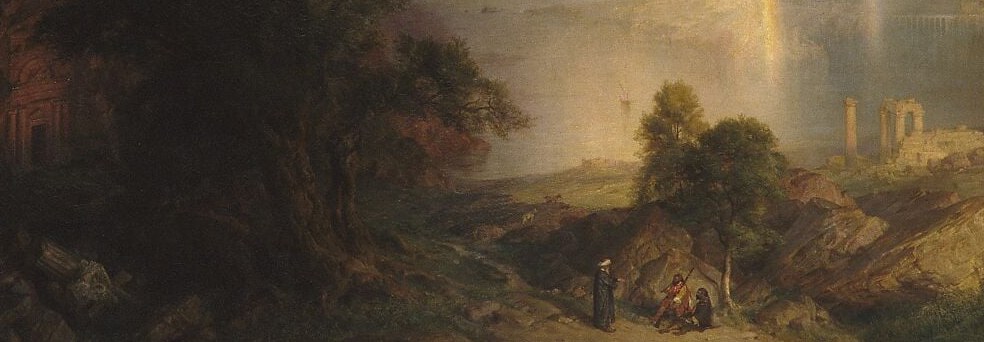
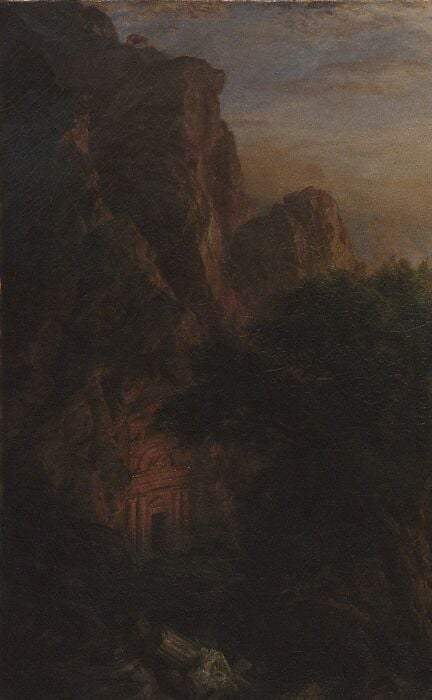
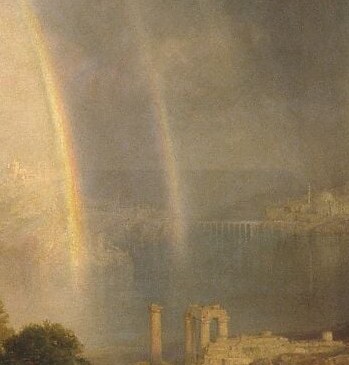
Look for the architecture. On the left, the dark rock-cut tombs of Petra. On the right, free-standing Roman columns from Syria. And on the far horizon, nearly invisible at first, the faint silhouette of minarets, representing Constantinople. The rainbow binds them all, a single covenant of light crossing time and faith.
Church traveled through the Ottoman Levant and Greece from 1867 to 1869, filling sketchbooks. Back in his New York studio, he composed this fantasy from memory, collapsing thousands of miles and centuries into one Luminist panorama. Shortly after finishing, rheumatoid arthritis left him unable to paint on this scale again. The painting entered The Met in 1902.
A career defined by dramatic summits and fiery skies ended here, not with a storm, but with a quiet sea, a breaking sun, and a colossal arc of light stretched across a world he could no longer travel.
#arthistory #fredericchurch #hudsonriverschool
Details

Transcript
A calm sea under a breaking sky. On the left, tombs cut into dark rock, Petra. On the right, Roman columns from Syria. And there on the horizon: minarets. Constantinople. Church painted this from memory, a fantasy of all the Levant. The light that touches each empire is a single, doubled rainbow. His last massive canvas. After this, arthritis took his hands.