Artwork
The Aegean Sea
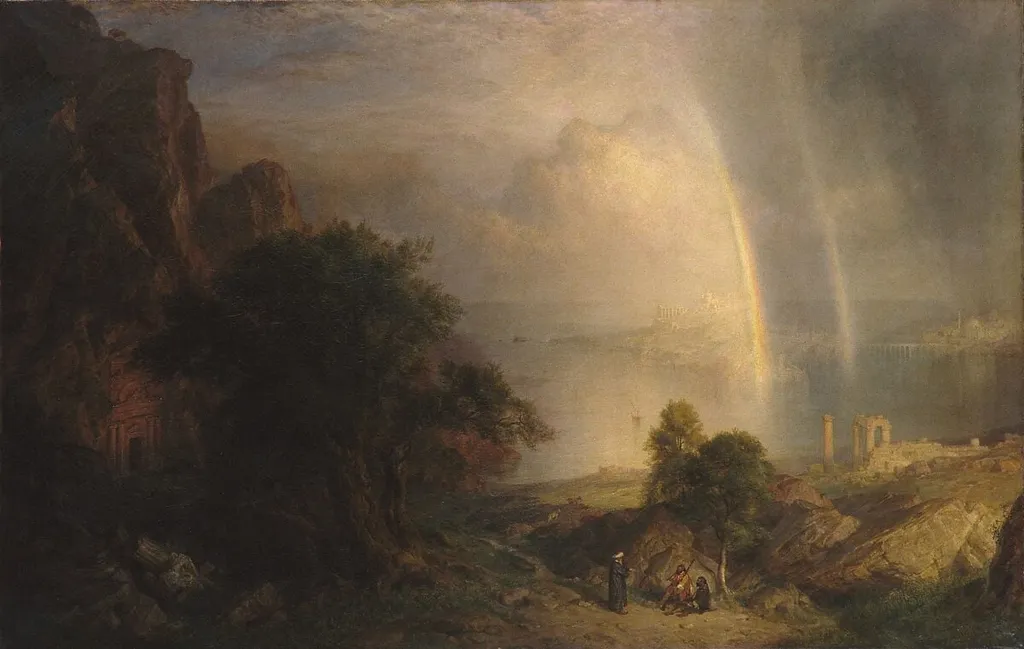
The Aegean Sea is an oil painting by the Hudson River School artist Frederic Edwin Church. It dates from 1877 and is held in the collection of the Metropolitan Museum of Art.
- Accession no.
- 02.23
- Credit line
- Bequest of Mrs. William H. Osborn, 1902
About this work
Carved tombs of Petra rise at left, Roman columns from Syria at right, and distant minarets suggest Constantinople across a calm Aegean. Frederic Edwin Church assembled this composite view around 1877 from his 1867 to 1869 travels through the Ottoman Levant and Greece. It was his last large canvas before arthritis curtailed his career. The Met acquired it in 1902.
Subject & Meaning
The painting presents a capriccio of the Aegean Sea, combining specific architectural and natural motifs from Church's travels.
The painting presents a capriccio of the Aegean Sea, combining specific architectural and natural motifs from Church's travels. The composite view includes a rock-cut entrance from Petra, fallen capitals from the Temple of Bacchus at Baalbek, Roman columns from Syria, distant classical ruins resembling the Acropolis or Temple of Apollo, and the dome and minaret of an Istanbul mosque, all set before a sea and sky animated by a double rainbow. Three small human figures, based on studies of Bedouins, appear in the foreground, their scale emphasizing the vastness of the landscape and the layered history it represents.
Church's shift from naturalism to an idealized, atmospheric style underscores the work's symbolic character: the rainbow, a frequent motif in his oeuvre, may signify harmony or divine promise, while the juxtaposition of Greco-Roman, Biblical (Petra), and Islamic architecture suggests a vision of the Mediterranean as a cradle of successive civilizations. The gilded frame, ornamented with Middle Eastern motifs, reinforces this eclectic iconography.
Technique & Style
Executed in oil on canvas, The Aegean Sea is one of Frederic Edwin Church's last large-scale works, measuring 54 by 84.25 inches (137.2 × 214 cm). Church employed a composite method, synthesizing on-site sketches from his 1867–1869 travels into a capriccio that combines a rock-cut entrance from Petra, fallen capitals from Baalbek, Roman columns, classical ruins, and a mosque dome. The handling departs from his characteristic naturalism toward a more idealized style, with atmospheric effects, notably a double rainbow, reminiscent of J. M. W. Turner's works.
The brushwork renders both minute architectural details and broad, luminous sky passages. Church designed a custom gilded frame adorned with eclectic Middle Eastern motifs, including stars and rosettes, complementing the painting's formal qualities.
History & Provenance
Frederic Edwin Church painted The Aegean Sea around 1877, near the end of his career, making it one of his last large-scale works. The composition grew out of Church's travels through Europe and the Middle East from 1867 to 1869, combining sketches of sites such as a rock-cut entrance from Petra, fallen capitals from Baalbek, Roman columns from Syria, and distant classical ruins possibly inspired by the Acropolis or the Temple of Apollo, along with a mosque dome and minaret from Istanbul. The painting was purchased by railway magnate William H. Osborn, a close friend and patron of Church.
After Osborn's wife Virginia Reed (Sturges) Osborn died in 1902, the work was bequeathed to the Metropolitan Museum of Art, where it is held. Church also designed a gilded frame with eclectic Middle Eastern motifs for the painting.
Legacy
The Aegean Sea is recognized as one of Frederic Edwin Church's last large-scale paintings, marking a late phase in his career. Purchased by railway magnate William H. Osborn, a close friend of the artist, the work entered the collection of the Metropolitan Museum of Art in 1902 upon the bequest of Osborn's wife, Virginia Reed Sturges. Its inclusion in the museum's holdings has ensured its continued study as an example of Church's later, more idealized style, blending architectural capriccio with naturalistic detail.
The painting is classified in the American Wing, contributing to the understanding of Church's legacy within American landscape painting.
Overview
The Aegean Sea, painted by Frederic Edwin Church in 1877, is a composite landscape that synthesizes memories from the artist's travels through the Ottoman Levant between 1867 and 1869. Executed in oil on canvas, the work does not depict a single geographical location but rather assembles distinct architectural and natural elements into a unified, idealized vista. On the left, the carved rock-cut tombs of Petra rise dramatically, while the right side features classical Roman columns evocative of Syrian antiquity.
In the distance, minarets suggest the skyline of Constantinople, all set against a tranquil expanse of the Aegean Sea. This composition reflects Church's late-career shift toward imaginative reconstruction rather than strict topographical realism. Created more than a decade after his Middle Eastern expedition, the painting serves as a meditation on the historical layers of the region, merging biblical, classical, and Islamic motifs.
As a significant work by a leading figure of the Hudson River School, it demonstrates the artist's continued engagement with Eastern themes and his mastery in blending observed details into a cohesive, atmospheric whole.
Artist & collection

Artist
Frederic Edwin Church was an American landscape painter born in Hartford, Connecticut.